AEO vs SEO: What's the Difference?
AEO optimizes for AI citations. SEO optimizes for search clicks. Learn the key differences, when to prioritize each, and why you need both in 2026.

Key Takeaways
- Different goals: SEO earns clicks; AEO earns citations: different goals need different signals.
- You need both: traditional search still drives 85 to 88% of discovery, while AI search (12 to 15% and rising) is the emerging channel.
- AI search is three channels: our primary research found 94.2% of AI-cited pages appear in exactly one engine, and zero appeared in all three.
- Different scoreboards: AEO KPIs are citation rate and AI visibility per engine; SEO KPIs are rankings and organic traffic.
- Which to fund first: sequence by where your gap is, then let your own referral data break the tie.
AEO vs SEO: Quick Comparison
Both disciplines earn visibility, but they optimize for different outcomes on different timelines. The single sharpest split is speed: AEO shows results in weeks, SEO in quarters.
| Factor | AEO | SEO |
|---|---|---|
| Primary Goal | Be cited by AI assistants | Rank higher in search results |
| Leading Ranking Factors | Referring domains + content freshness | Backlinks + content quality |
| Content Format | Q&A structure, direct answers | Comprehensive, long-form |
| Technical Foundation | SSR, schema, llms.txt | Core Web Vitals, crawlability |
| Author Importance | Critical (expert attribution) | Low (except E-E-A-T niches) |
| Update Frequency | Critical (12-month freshness) | Quarterly refreshes |
| Schema Importance | Helpful for structure (Article, Person) | Helpful but not required |
| Traffic Type | AI-referred (high trust) | Search clicks (volume) |
| Measurement | Citation rate, AI visibility | Rankings, organic traffic |
The Technical Foundation row is where teams underestimate the work. AEO leans on server-side rendering so AI crawlers can read the page without executing JavaScript, on schema that labels who wrote the content and what it answers, and on an llms.txt file that tells AI systems what to prioritize. Classic SEO never imposed those requirements. Get these wrong and the strongest content stays invisible to the engines. We walk through each in Technical AEO Foundations, with companion reads on what drives AI citations and how to measure AEO.
The Fundamental Difference
SEO asks: "How do I rank higher so more people click my link?"
AEO asks: "How do I become the source AI cites when answering questions?"
If you want the full beginner's guide to AEO before comparing it to SEO, start there. This matters because the signals are different. Google ranks pages based on backlinks, keywords, and user experience. AI assistants cite pages based on structured data, direct answers, and expert attribution. A page can rank #1 on Google but get zero AI citations, 80% of AI-cited sources don't rank on Google Page 1.
What Does AEO Stand For in SEO?
AEO stands for Answer Engine Optimization: the practice of structuring content so AI answer engines such as ChatGPT, Perplexity and Google AI Overviews cite your brand when they answer a question. SEO earns the click; AEO earns the citation inside the answer itself. It is the discipline we practice at Novastacks.
AEO stands for Answer Engine Optimization. It's the practice of structuring your content so AI answer engines, ChatGPT, Perplexity, and Google AI Overview, cite you when they answer a question, instead of optimizing only to rank a link in Google's results.
SEO, search engine optimization, is the older craft it grew out of. SEO structures a page to rank in the list of links so a searcher clicks through to your site. AEO structures the same expertise to be quoted inside the AI answer, where there may be no click at all. The work draws on the same raw material (clear writing, real authority, current information), but SEO is judged on the click and AEO on the citation.
The vocabulary around it can be confusing, so here's the house position: AEO is the umbrella term. AIO (AI Optimization) is a tactical subset of AEO, and GEO (Generative Engine Optimization) is the same idea under a different label. The labels multiply because agencies want to signal they understand AI search, but the underlying work, earning citations inside AI answers, is one craft. If you're weighing the labels, see AEO vs GEO vs SEO.
One deliberate exclusion: answer engines historically include voice assistants like Siri and Alexa, but this guide focuses on the chat and AI-search surfaces where citation value concentrates in 2026.
The Query Itself Is a Different Shape
Every difference on this page traces back to one root cause: people ask AI a different kind of question than they type into Google. A Google search is a few keywords, like "aeo vs seo", that the searcher then resolves by clicking through results. An AI prompt is a full question, often several sentences, that expects the answer back in one turn: "What's the difference between AEO and SEO, and which should a B2B SaaS company invest in first?"
That longer, fuller query is why the optimization work diverges. A keyword page can rank for "aeo vs seo" by matching the phrase. To be cited in the AI answer, the same page has to carry the specific, self-contained passage that answers the whole question (the definition, the number, the caveat) in a form the model can lift without stitching fragments together. That gap is why a page can top the search results for a phrase and still never appear in the AI answer to the question behind it.
AI Search Isn't One Channel, It's Three
"AI search" is not one channel, it's three that barely overlap. This is the biggest shift in how AEO differs from SEO, and it comes straight from our own study.
The practical read: "get cited by AI" has no single answer. It resolves to a different engine, and a different kind of page, depending on what your buyers are asking, which is exactly why AEO and SEO need different measurement than a single blended score.
Takeaway
There is no single "AI search" to optimize for. Decide which engine matters for your buyers' questions before you spend on AEO, and measure that engine on its own.
AEO and SEO Together: How They Work as One System
AEO and SEO work best together, not as either/or. SEO earns the clicks in traditional search results, still 85 to 88% of web discovery, while AEO earns the citations inside AI answers, an emerging 12 to 15% and rising.
Many of the same signals feed both, and the foundation matters more than most comparisons admit:
- Technical accessibility. Whether a crawler can reach the page at all: robots.txt and CDN rules that let it in, a server that answers reliably, and a clean URL and internal link structure that puts the page within reach. Fail here and both channels fail together.
- Rendering. Whether the content exists in the initial HTML response. Googlebot will queue a page for a second rendering pass and execute your JavaScript; most AI crawlers will not. So a client-rendered page can still rank while being invisible to answer engines, which is one of the few places the two systems genuinely part company at the technical level.
- Topical authority. Not a third-party score, but how much evidence exists that you are an expert in your specific field: depth of coverage on one subject rather than shallow coverage of twenty, consistency in how you describe what you do, and independent sources repeating the same facts about you. Both systems reward the same underlying thing, that a real body of work sits behind the page.
- Freshness and structure. Recently updated content, clean headings, tables and lists that both a reader and a parser can follow.
Where they diverge: AEO adds off-site presence and answer-first structure that classic SEO does not require.
And because the AI engines barely overlap (see the three-channel finding above), the AEO half of "together" is really per-engine. The commercial and transactional queries where all three engines return citations at once are where a combined AEO + SEO effort compounds most.
The Key Differences in Detail: KPIs, Methods and Tools
KPIs: what each discipline measures
The key difference is the scoreboard. SEO KPIs measure ranked clicks: keyword rankings, organic traffic, and click-through rate. AEO KPIs measure being the cited source: citation rate and AI visibility, and, critically, tracked per engine, not as one blended number.
| Discipline | AEO KPIs | SEO KPIs |
|---|---|---|
| Primary metric | Citation rate (per engine) | Rankings, organic traffic |
| Visibility | AI visibility by engine | Impressions, click-through rate |
| How to read it | Per engine, never blended | Aggregate across the SERP |
Our primary research is the reason for the per-engine rule: because ChatGPT, Perplexity, and Google AI Overview share almost no citations, a single blended "AI visibility" number hides the one distinction that decides where budget goes, which engine, for which query type. Track citation rate per engine so you can catch a shift early.
Method: how the day to day work differs
Compared with traditional SEO, AEO changes four things: the goal (be cited by AI vs rank in search results), the leading signals (referring domains + content freshness vs backlinks + content quality), the content format (Q&A and direct answers vs comprehensive long-form), and the time to results (60 to 90 days vs 6 to 12 months).
See the full side-by-side in the Quick Comparison table above.
Tools: what you need in the stack
The tools split along the same line as the KPIs. SEO tools track rankings, traffic, and backlinks, while AEO tools track whether AI engines cite you and how your AI visibility trends per engine. For a side-by-side of the AEO platforms, see our guide to the best AEO tools in 2026.
AEO vs SEO: Which Should You Invest In?
The question is usually asked as though one channel has to win. In practice the answer is decided by what is currently blocking you, and there are four honest positions rather than two. Work through them in order.
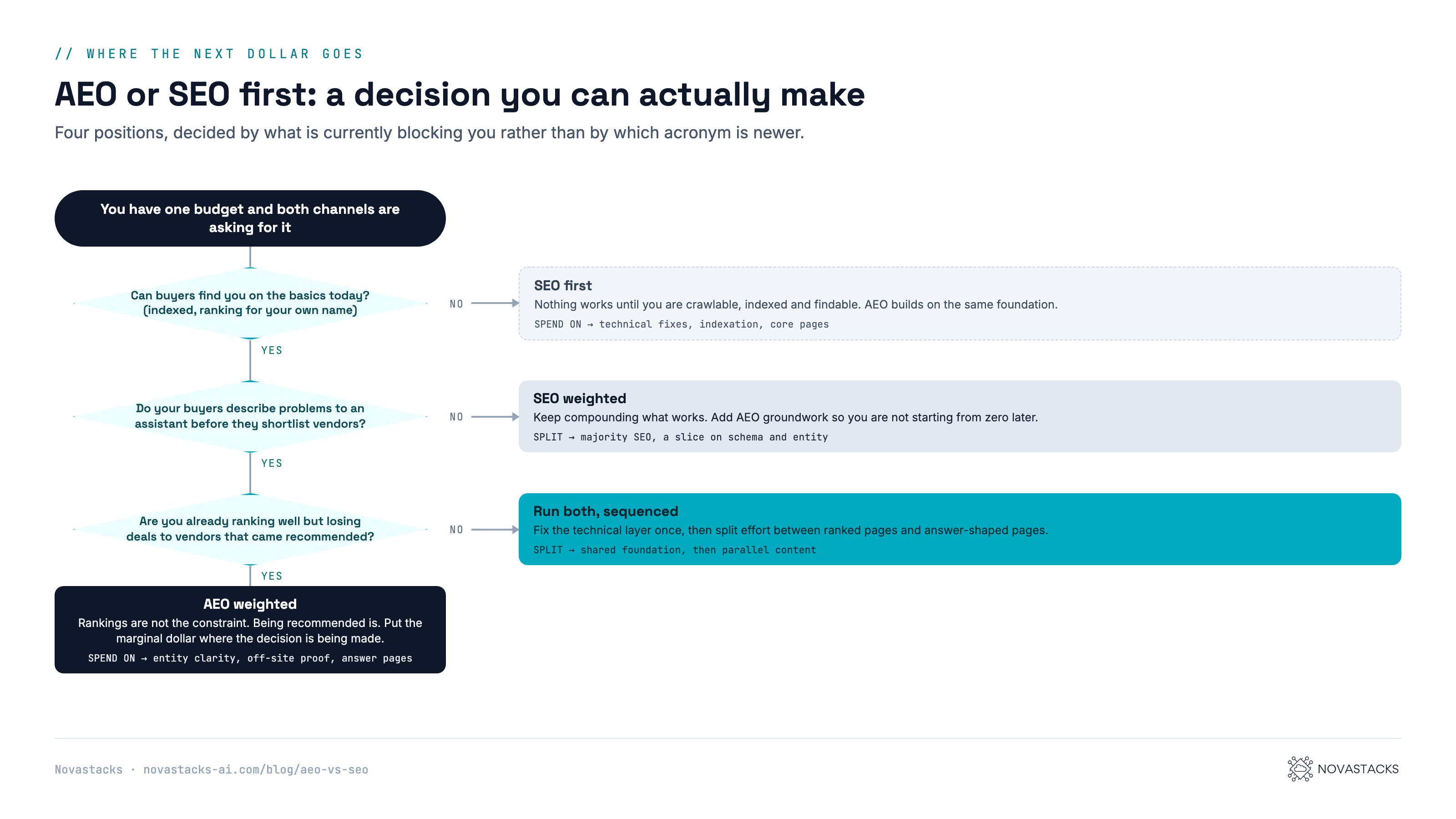
SEO first, if the basics are not in place
If you are not indexed, not ranking for your own brand name, or your pages cannot be crawled, AEO has nothing to build on. The two disciplines share a foundation: a page a crawler cannot read fails in both systems. Spend here first, and the AEO work gets cheaper later because the repair is already done.
SEO weighted, if your buyers have not moved yet
Some categories still run on classic search behaviour. If your customers are not describing their problem to an assistant before they shortlist, keep compounding what works and add only the AEO groundwork that is cheap: schema, entity consistency, crawler access. That way you are not starting from zero when the behaviour does shift.
Both, sequenced, for most companies
The common case. Fix the shared technical foundation once, then split content effort: pages built to rank, and pages built to be quoted. They are not the same page, which is the part most teams get wrong. Our research found only 15% of pages that rank in Google's top 10 also earn an AI citation, so assuming your ranking content will carry you into AI answers is the expensive mistake.
AEO weighted, if you rank but lose the deal
The clearest signal for shifting budget: you are on page one, traffic looks healthy, and sales calls keep revealing that the prospect already spoke to a competitor who "came recommended". Rankings are not your constraint. Being named inside the answer is, and that is bought with entity clarity and off-site proof rather than more ranked pages.
Invest in both, but sequence by where your gap is. Start with SEO when you have little organic visibility, technical crawl issues, or need volume at scale. Start with AEO when you already rank but aren't getting cited, your buyers research with AI, or competitors are being cited and you're not, AEO also shows results faster (60 to 90 days vs 6 to 12 months).
Then let your own data break the tie. Our primary research recommends pulling your last-90-day referral traffic by source (chatgpt.com, perplexity.ai, and Google AI referrals) and checking which of your pages already surface in AI answers, then funding the engine that's already working for you first.
Building SaaS? The same logic applies with AEO weighted more heavily, because SaaS buyers research comparisons and alternatives with AI assistants, see our AEO for SaaS guide.
The Traffic Decline Reality: What the Data Shows
Studies show organic traffic decline ranges from 5-25% depending on industry and query type. When an AI Overview appears, it cuts the click-through rate on the top organic result by about 35%, the figure Ahrefs measured in April 2025 (revised to 58% in its December 2025 update), and AI Overviews now surface on close to half of tracked Google searches.1
This matters for resource allocation. SEO still drives the majority of discovery. AEO captures an emerging channel. Both warrant investment. Neither replaces the other.
Crawls Do Not Equal Citations
GPTBot can crawl your site 1,000 times without ChatGPT ever mentioning you.
Server logs showing AI crawler activity measure upstream visibility, bots accessing your content. This does not predict downstream outcomes, actual citations in user-facing responses. The two metrics have weak correlation.
Confusing crawl activity with citation success leads to misallocated effort. A site can achieve perfect technical accessibility for AI crawlers while producing content that LLMs never surface in answers.
Takeaway
Crawler hits measure access; citations measure use. Report the mention rate in AI answers, not the bot-visit count in your server logs. The two barely correlate.
A caveat on Q&A formatting
Why You Need Both
Traditional search still drives the large majority of web discovery, on the order of 85 to 88%: while AI search accounts for an estimated 12 to 15% and climbing, per aggregated 2026 market-share data, with one forecast putting AI at 28%+ by 2027. Treat both figures as directional estimates rather than audited totals, but the gap is wide enough that neglecting either channel leaves discovery on the table.
The good news: many optimizations benefit both. Seer Interactive found 0.65 correlation between organic rankings and LLM mentions, though this was measured on high-authority domains (1M+ monthly visits). For smaller sites, the correlation may be weaker. Quality content, domain authority, freshness, and clear structure help both AEO and SEO, but AEO has additional requirements around off-site presence and content structure.
AI Traffic Converts Differently, Not Just Less of It
Volume is only half the story. Reading 85 to 88% versus 12 to 15% and stopping there leads a finance team to write off AI search as a rounding error. The counter-argument is about value, not volume: a visitor who arrives from an AI answer has usually finished comparing options inside that answer, so they land further down the funnel than a typical search click.
Semrush's June 2025 study of 500+ high-value topics found AI-referred visitors converting at roughly 4.4× the rate of standard organic traffic. The mechanism is intuitive: the AI already did the shortlisting, so the click that follows sits closer to a decision than a first look does.
Watch-out
The 4.4× figure is not settled. Amsive's paired analysis of 54 sites found no statistically significant conversion difference between AI and organic traffic (p = 0.79). Treat AI traffic as high-intent but unproven at that multiplier. Measure conversion on your own referral data before you re-budget around one number.
What Choosing AEO Actually Costs
AEO is not free upside, and an honest comparison names the costs. Four matter most before you move budget:
- Maintenance is constant. AEO rewards freshness, so content decays faster: around 95% of citations come from pages published in the last ten months. A page you can leave alone for a year in SEO needs revisiting in AEO.
- Measurement is immature. There is no Search Console for AI answers. Citation tracking is per-engine, sampled, and still stabilizing, which makes ROI harder to prove to a finance team than ranked-keyword reporting.
- Much of the work is off your own site. A large share of AI mentions come from third-party pages (forums, review sites, documentation) that you influence but do not control. That is slower and less certain than editing your own page.
- Structure can fight readability. Optimizing hard for extraction pushes a page toward clipped, answer-first blocks. Overdo it and you get the synthetic chunking Google warned against, plus a worse read for humans.
None of this argues against AEO. It argues for sequencing it with eyes open: know the maintenance and measurement bill before you commit, not after.
Optimize Pages by Function
Not all pages serve the same purpose for AEO and SEO. Different page types require different optimization approaches:
Marketing Pages
(homepages, product pages, landing pages)
- SEO focus: Conversion, user experience, brand messaging
- AEO focus: Limited. AI rarely cites marketing pages directly. Focus on schema markup and brand entity signals.
Knowledge Pages
(blog posts, guides, help docs, glossaries)
- SEO focus: Keyword targeting, internal linking, search intent matching
- AEO focus: High priority. These are what AI systems cite. Structure for extraction.
Trying to optimize a marketing page for AI citations is often wasted effort. Concentrate AEO resources on your knowledge content.
Where to Start
Start with AEO when your gap is in AI answers; start with SEO when your gap is in basic visibility. The table maps the common situations to a first move.
| If this is you | Start with | Why |
|---|---|---|
| You rank well but aren't getting AI citations | AEO | The gap is in the answer, not the ranking, and citations land in 60 to 90 days |
| Your audience uses AI for research (B2B, technical) | AEO | Your buyers are already in the channel you're missing |
| Competitors are being cited and you're not | AEO | You're losing the answer even when you still hold the ranking |
| You need faster results (60-90 days) | AEO | AEO shows movement in weeks; SEO takes quarters |
| You have zero organic visibility | SEO | AEO compounds on an existing content and authority base |
| Your audience uses traditional Google search | SEO | Meet the demand where the volume still is |
| You have technical issues hurting crawlability | SEO | Fix the foundation before layering AEO on top |
| You need volume at scale | SEO | Search still drives the large majority of discovery |
Your First Week, Either Way
- Pull last-90-day referral traffic by source (chatgpt.com, perplexity.ai, Google AI) to see which engine already sends you visitors.
- Run your top 10 buyer questions through ChatGPT, Perplexity, and Google AI Overview and record who gets cited.
- Confirm your key pages render server-side and carry Article and Person schema.
- Pick the one engine that matters most for your buyers and track its citation rate on its own.
Takeaway
Roughly 85% of AEO happens off your own site. Build the on-site foundation first, then invest in the forums, reviews, and documentation that AI actually quotes. Traditional SEO never asked for that split.
FAQ: AEO vs SEO
What's the main difference between AEO and SEO?
SEO optimizes for link clicks in search results (ranking higher = more clicks). AEO optimizes for being cited by AI assistants when they answer questions (being the source AI uses = direct recommendation). Different goals require different optimization signals.
Should I choose AEO or SEO?
You need both. SEO drives traditional search traffic (85-88% of web discovery). AEO captures the growing AI-first audience (12-15% and rising to 28%+ by 2027). Neglecting either leaves traffic on the table. Many optimizations (quality content, expertise signals) benefit both.
Which is faster: AEO or SEO results?
AEO is significantly faster. First AI citations typically appear within 60-90 days of implementation. SEO takes 6-12 months for ranking improvements. The difference comes from how AI processes structured data vs. how Google evaluates link signals over time.
Does AEO help with SEO?
Yes. The core AEO fundamentals (authority, freshness, quality content) also improve SEO. Our client data shows pages optimized for AEO often see Google ranking improvements as a side effect. You're not choosing between them - you're stacking benefits.
What's the top AEO ranking factor?
Referring domains (backlinks) emerged as the leading factor. SE Ranking's study of 129,000 domains found sites with 32K+ referring domains are 3.5x more likely to be cited by ChatGPT. Content freshness is another critical factor - 95% of citations come from content published in the last 10 months.
What's the top SEO ranking factor?
Content quality and backlinks are the leading factors. Google has shifted toward content that satisfies search intent, but quality backlinks from authoritative sites remain critical - especially for competitive niches.
What does AEO stand for in SEO?
AEO stands for Answer Engine Optimization. It's the practice of structuring your content so AI answer engines like ChatGPT, Perplexity, and Google AI Overview cite you when they answer a question, instead of optimizing only to rank a link. AEO is the umbrella term; AIO (AI Optimization) is a tactical subset, and GEO (Generative Engine Optimization) is the same idea under a different label.
How do AEO and SEO work together?
They work best together, not as either/or. SEO earns the clicks in traditional search (still 85-88% of web discovery); AEO earns the citations inside AI answers (an emerging 12-15% and rising). The same signals - quality content, domain authority, freshness, clear structure - help you both rank and get cited, while AEO adds off-site presence and answer-first structure that classic SEO doesn't require. Commercial and transactional queries, where all three AI engines return citations, are where a combined effort compounds most.
How do AEO KPIs and SEO KPIs differ?
The scoreboard is the difference. SEO KPIs measure ranked clicks: keyword rankings, organic traffic, and click-through rate. AEO KPIs measure being the cited source: citation rate and AI visibility, tracked per engine rather than as one blended score. Because ChatGPT, Perplexity, and Google AI Overview share almost no citations, a single blended "AI visibility" number hides which engine is actually working for your query types.
What's the difference between AEO and traditional SEO?
AEO changes four things versus traditional SEO: the goal (be cited by AI vs rank in search results), the leading signals (referring domains plus content freshness vs backlinks plus content quality), the content format (Q&A and direct answers vs comprehensive long-form), and the time to results (60-90 days vs 6-12 months).
How do AEO and SEO tools compare?
AEO and SEO tools split along the same line as their KPIs. SEO tools track rankings, organic traffic, and backlinks; AEO tools track whether AI engines cite you and how your AI visibility trends per engine. See our guide to the best AEO tools in 2026 for a side-by-side.
AEO vs SEO: which should I invest in?
Invest in both, but sequence by where your gap is. Start with SEO when you have little organic visibility, crawl issues, or need volume at scale. Start with AEO when you already rank but aren't cited, your buyers research with AI, or competitors are being cited and you're not - AEO also shows results faster (60-90 days vs 6-12 months). Then let your own referral data break the tie and fund the engine already sending you traffic first.
How does AEO vs SEO apply to SaaS companies?
The same principles apply, with AEO weighted heavily: SaaS buyers research comparisons and alternatives with AI assistants, and commercial and transactional queries are where all three AI engines return citations at once. See our AEO for SaaS guide for the deeper playbook.
Can one page be optimized for both AEO and SEO?
Usually yes, and it's the efficient default. The same page can rank in search and be cited in AI answers because the core signals overlap: clear writing, real authority, and current information. The AEO work is additive: give the page a self-contained, quotable answer near the top and support it with off-site presence. Where the two genuinely diverge is page type. A conversion-focused landing page is worth optimizing for SEO but rarely earns AI citations, so concentrate AEO effort on your knowledge content.
Sources
- Ahrefs: AI Overviews reduce click-through rate on the top result (~34.5%, April 2025; revised to 58% in the December 2025 update).
- Google Search Liaison Danny Sullivan, Search Off the Record podcast (January 2026), guidance against chunking content for LLMs.
- AirOps and Nobori (2026): ~85% of AI brand mentions originate from off-site, third-party sources.
Comparing agencies? See the ranking of the 9 best AI SEO and AEO agencies in Singapore (2026): comparison table, methodology, and detailed top-5 profiles.
Need Help with AEO and SEO?
Get a free assessment of your organic visibility across both traditional search and AI assistants.