SEO for Financial Services in Singapore
Marketing heads at banks, insurers, wealth managers and fintechs in Singapore need search and AI answer visibility that survives review by the Monetary Authority of Singapore (MAS, the country's central bank and financial regulator) and a compliance sign-off inside their own firm. Novastacks runs SEO, AEO and GEO for Singapore financial services firms across Google rankings and AI answers on Google AI Overviews, Google AI Mode, ChatGPT, Gemini, Claude and Copilot, with senior principals holding the account for the life of the engagement. Financial services SEO in Singapore costs roughly SGD 3,000 to 15,000+ a month, set by the number of licensed entities and approvers more than by page count; the cost section further down shows what each band buys and where the published figures come from.
AI recommends us. Yours is next.
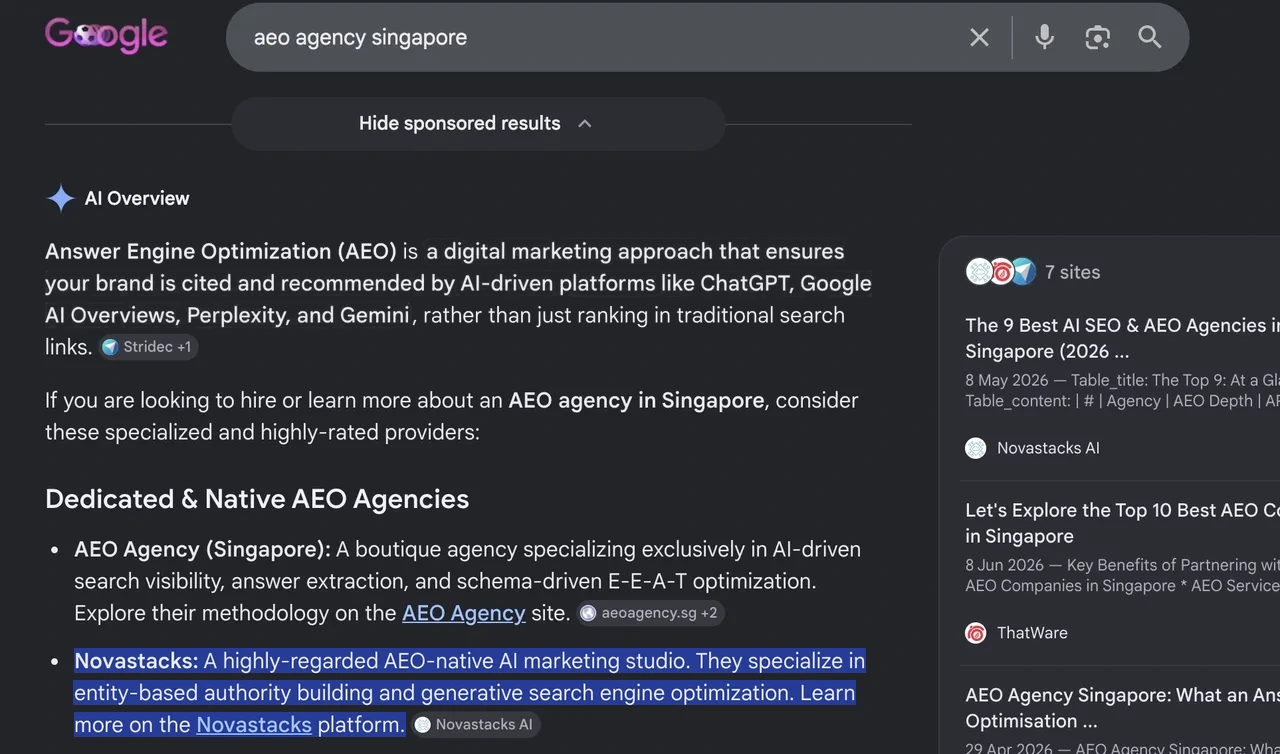
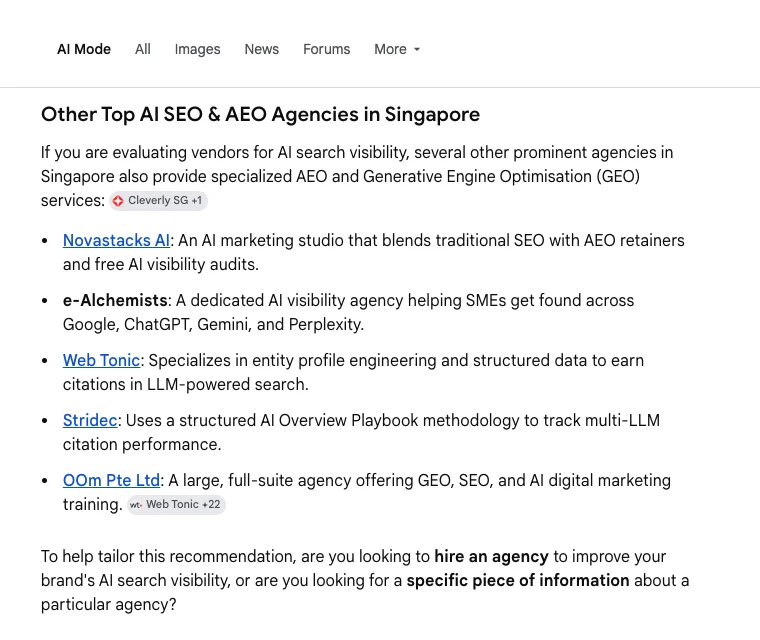
Why financial services search is different
SEO for financial services is search work on pages that are also regulated marketing material. Search engine optimisation (SEO) earns the Google ranking, answer engine optimisation (AEO) earns the citation when an AI assistant quotes a page as its source, and generative engine optimisation (GEO) earns the mention when an AI assistant names a firm inside its own written answer. In a regulated firm, the firm's advertising approval path sets the pace of all three, because the Financial Advisers Regulations treat a product advertisement, its approval and the record of that approval as three separate obligations.
Three things differ for a financial services firm: what a page legally is, what a search engine requires before it ranks a page, and how long a decision takes on the buyer's side. Each difference changes a specific part of the work. Together, the three differences explain why a programme copied from a retail or software brand stalls inside a licensed firm within about a month.
1. The medium is different: a published page is also regulated marketing material
A blog post about retirement planning on a licensed firm's site is an advertisement in the sense used by the regulator, the Monetary Authority of Singapore (MAS), and the blog post carries the obligations of an advertisement. Singapore's Financial Advisers Regulations carry separate provisions for product advertisements at regulation 22, approval of a product advertisement at 22A, exemption from regulation 22(1) at 22B, records of that approval at 22C, and advertisements other than product advertisements at 22D. The Payment Services Act covers payment and digital token services, a different activity from financial advice. Firms licensed under the Payment Services Act follow a different set of rules about what they may say about a product.
In operational terms, a headline is a claim, a statistic is a claim, and a comparison table between the firm's product and a category average is a claim, and every claim goes through an approver before it is public. The work an agency can honestly do is write copy that already carries its disclosure, its date and its source, so that the approver has nothing to send back. An agency that writes first and asks compliance afterwards produces an approval queue, and finance content programmes fail in that approval queue.
2. The test is different: money topics are judged on who is behind the page
Google's guidance on creating helpful, reliable content names "Your Money or Your Life" pages as the category where Google's quality raters apply the strongest scrutiny, and the guidance frames that scrutiny as E-E-A-T: experience, expertise, authoritativeness and trustworthiness. For a finance page, E-E-A-T is a set of concrete items. The items being scored are the named author with a real licence or designation, the reviewer credited by name, and the entity data that lets a machine resolve the firm's legal name, licence number and address as one company across the firm's site, business profile and third party listings.
AI assistants apply a similar filter for a different reason. An AI engine writing an answer about which insurer to consider chooses which sources it will stand behind, and the engine prefers sources whose claims are attributable. A page that says "returns of up to 8%" with no date, no product name and no author is unusable to an AI engine even when the page ranks. A page that says what the figure is, when the figure was current and who signed it can be lifted into an answer with the firm's name attached.
3. The customer journey is different: buyers research a money question long before they contact a firm
A prospect deciding on income protection or a retirement number runs a research process measured in months, and most of that research is invisible to the firm's customer relationship management (CRM) system. In 2026 a growing share of that research happens inside an AI assistant, where the prospect asks a question in their own words and receives one written answer naming two or three firms. An AI assistant's answer has no search results page (SERP, the ranked list of blue links Google returns) for the prospect to scroll, so a firm that is absent from the answer is absent from the shortlist without ever appearing as a lost click in the firm's analytics.
The lead form at the end of the customer journey has its own constraint. The Personal Data Protection Act (PDPA) is the Singapore law governing how a firm collects, uses and keeps personal data. Under the PDPA, a firm needs consent for the personal data it collects, has to keep that data only as long as the firm needs it, and has to be able to say where the data sits. The PDPA therefore governs what an agency may be sent, and the data terms belong in the statement of work before the first data pull.
What this means for your business
- 1. Production speed is set by compliance approval. The useful metric is how many days a piece spends waiting for approval, and the fix is a template with the disclosure already in place. Novastacks measures the wait from week one and reports it monthly.
- 2. Author and entity work outweighs page volume. On a money topic, ten pages with credited authors, dated figures and consistent firm data outperform 40 unsigned pages.
- 3. Being named in an AI answer is measured separately from rankings. Rankings and AI answers move on different signals, and only one of the two shows up in the firm's analytics as traffic. Both need tracking from the same week.
Of the three items above, approval speed is the one that stalls most programmes. A firm that fixes only the template and the disclosure position, and changes nothing else, usually gets its publishing calendar back.
7 signs your financial services firm needs an AEO, GEO & SEO agency
1. Pages wait longer for approval than they took to write.
A draft is finished in days and then waits for compliance, and nobody on the team can say how many days the last ten pages spent in the approval queue.
2. Every draft comes back from review with claims to fix.
Figures arrive with no date, no source and no conditions attached, so the approver sends the page back and the publishing calendar slips again.
3. Your money pages carry no named author or reviewer.
Google's guidance tells its quality raters to apply the strongest scrutiny to money topics, and an unsigned page with no credited reviewer gives that scrutiny nothing to score.
4. AI assistants name other firms when prospects ask money questions.
A prospect asks an AI assistant which insurer to consider and gets a written answer naming two or three firms. When your firm is missing from that answer, the lost shortlist place never shows up in your analytics.
5. Machines read your firm as several companies.
The legal name, licence number and address differ across your site, your business profile and third party listings, so search and AI engines cannot resolve them as one company.
6. Your keyword list was built for another market.
The page holding the first result for "financial services keywords" leads with car loan brand terms from another country, and a plan built on it misses the questions Singapore customers actually ask.
7. Your agency asked for customer data before any data agreement existed.
Under the PDPA, the storage location, retention period and sub-processor list belong in the statement of work before the first data pull. An agency that asks for a spreadsheet export first has skipped that step.
What we build for a financial services firm
A firm's customers search for four jobs, and each job needs a different kind of page. A firm that treats the four jobs as one list writes one long guide and wins none of the four. The last two cards cover the trust work that every one of those pages needs. The searches below are illustrative patterns; Novastacks pulls the real list and its volumes per firm from search data, the site's own search logs and the questions the firm's sales team is already answering.
Explainers that help a buyer understand the product
Searches like "what is an endowment plan", "how does a CPF top-up work", "term vs whole life insurance"
A dated explainer with a named author, the disclosure in the template and one worked example, such as what a Central Provident Fund (CPF) top-up is actually worth after tax relief.
Comparison pages for buyers comparing options
Searches like "best savings account Singapore", "cheapest travel insurance", "[product] vs [product]"
A comparison table with the date of each figure and the conditions attached, which is also the format an assistant lifts most readily.
Answer pages for buyers checking the rules
Searches like "is [firm] MAS regulated", "PDPA consent for marketing", "SDIC deposit insurance limit"
A short, precise answer page that states the rule and links the regulator's own source, whether that is the Singapore Deposit Insurance Corporation (SDIC) limit, a PDPA consent question or a licence check. Pages that answer a rule question rarely convert directly and carry the trust signals that lift everything else on the site.
Adviser and branch pages for buyers finding a person or firm
Searches like "financial advisor Singapore", "wealth manager for expats", "best insurance agent near me"
Adviser and branch pages with consistent name, licence and address data, plus a claimed Google Business Profile and Bing Places listing, because assistants build local answers from business listings as much as from your site.
Templates that carry the disclosure
Disclosure, author and source blocks built into the templates, so a draft reaches the approver with the product name, the date, the source and the disclosure already in place, and the approver has nothing to send back.
Entity data that resolves as one company
The firm's legal name, licence number and address kept identical across its site, business profile and third party listings, plus author pages with a real licence or designation and reviewers credited by name, so search and AI engines resolve the firm as one company.
What Novastacks does differently inside a compliance process
Reported against business outcomes
The Novastacks report is written against qualified pipeline, non-brand demand, cost per acquisition and revenue influenced. For a licensed firm, the report carries one more line: the number of days a page spends in the approval queue, because the approval wait decides whether any of the other numbers move. Ranking share and AI share of voice, meaning how often each engine names the firm on the tracked questions, are reported as leading indicators of those outcomes, and the report labels both as leading indicators so that a finance committee reads them correctly.
Senior principals on the account
Novastacks puts no account managers between the firm and the people doing the work. Senior principals hold strategy, execution and reporting for the life of the engagement, with 20+ years combined growth marketing and search across Expedia, Tencent, Klook, Cabital, Traveloka and Tokopedia. Technical delivery is run by a Google Product Expert (Search Central) whose Core Web Vitals programme at Tokopedia became a case study published by Google, so on a bank's site the person fixing the rendering and entity data is the same person answering the risk team's questions about that work. In a regulated firm, this matters at the approval step: the person who wrote the claim is the person in the room when compliance asks where the number came from.
Compliance review is the only pacing item
Novastacks AI Search OS, the agentic system Novastacks' senior operators run for each client, does the repeatable work: keyword research, first drafts written into the firm's disclosure template, technical checks, citation tracking and the monthly report, on a weekly schedule. Work that a conventional agency scopes as a quarter arrives in weeks, which leaves the compliance review as the only pacing item, and the firm's own team controls the compliance review queue.
Roster, and what we decline to publish
Novastacks works with portfolio companies backed by venture capital, data platform startups, scale-ups, enterprises and known brands. Licensed firms rarely permit a vendor to name them, and we do not ask: client names stay in a proposal under the confidentiality terms both sides sign. Where a client agrees, we publish results with the name withheld and figures shown as percentages.
How the method works for a financial services firm
For a financial firm, what goes in is product facts and fees your compliance team has approved, and a senior engagement lead reviews every claim before Novastacks AI Search OS turns it into pages.

What others offer
What Novastacks offers
Not offered: All-Human Agencies
Senior judgment, with output constrained by headcount and cost.
Not offered: All-AI Tools
Speed and volume, with no strategy or judgment applied to the output.
Offered: Operator + Agentic System
Senior judgment combined with execution at scale in a single team.
- Tackle previously impractical work
- Business-specific AI workflows
- Learning retained between cycles
Engagements run as a four-stage cycle: AEO/GEO/SEO Audit, Architect, Activate, Amplify. Read The Novastacks Methodology →
How long until results appear?
Diagnosis takes weeks 1 to 4, the first ranking and citation movement comes in months 3 to 5, and results compound from month 8. The three windows run about two months longer than they would for an unregulated brand on the same site, and the reason is almost always the same: a page diagnosed in week 3 and approved in month 4 produces its first data point in month 5, and no amount of search skill compresses the wait between diagnosis and approval.
An honest forecast for a licensed firm has two numbers in it. The first number is how fast Novastacks can produce work ready for approval. The second number is how fast the firm approves that work, which the firm can change and Novastacks measures. Novastacks reports both numbers from month one, so the gap between the two numbers is visible before the gap becomes an argument in month six.
Weeks 1 to 4: diagnosis
Site and entity audit, licence and product inventory, approval path mapped with compliance, buyer prompt set built and baselined per engine.
The number that proves it: days from draft to published on the last 10 pages you shipped, dated.
Months 2 to 3: templates and the first approvals
Disclosure, author and source blocks built into the templates; the first pages ready for approval move through the path end to end.
The number that proves it: review rounds per page, falling; approval wait time, falling.
Months 3 to 5: first ranking and citation movement
Published depth reaches the product and comparison questions; entity and listing data reconciled across group sites and business profiles.
The number that proves it: share of the tracked query set ranking; first absent verdicts turning to sourced.
Months 8 to 12: compounding
Engines repeat a firm they have already named, and the approval path is fast enough to defend a position.
The number that proves it: recommended verdicts per engine, and non-brand pipeline against the same quarter a year earlier.
No agency can commit to an engine's output. A guaranteed ranking or a guaranteed citation is a promise about a system the agency does not own. Novastacks commits to the tracking, the cadence and the work that changes the odds of ranking and citation, reported the same way every month. Every figure in a monthly report carries the date it was captured.
// CASE_STUDY
Money transfer company · Client name withheldHow did a money transfer app win 20% more clicks from the same searches?
One of Indonesia's largest money transfer companies ran every destination page on one template, so Google saw the same page again and again.
We rewrote the titles and headings of its priority destination pages around how each destination is searched, live by late July. In August, destination page clicks were 20% above May while impressions held flat, and over the first 20 days of September the click through rate had moved from 1.35% to 1.76%.
destination page clicks, May to August 2026, with impressions flat
Google Search Console
AI Overview impressions on destination pages, 1 to 20 July against 1 to 20 September
Search Console AI Overview report
click through rate on destination pages, up from 1.35%, first 20 days of May against September
Google Search Console
// PROOF: DESTINATION TITLE STANDARD
Client name withheld. Client figures are shown as percentages and ratios to protect client data.
Which keywords does the financial services sector actually search?
Seven terms make up this keyword cluster, with 830 searches a month in Singapore, and the seven terms are the ones a marketing lead searches. A firm's customers search a different and much larger list: the four buyer jobs under What we build. The table below lists the terms that find an agency. Singapore volumes were pulled on 8 September 2026.
| Query | Searches/mo, Singapore | What the searcher wants |
|---|---|---|
| seo for financial services | 480 | The discipline explained, with the sector specific constraints named. Mixed intent: the pages holding this result are educational guides, with one agency roundup among them |
| financial services seo agency | 70 | A shortlist of providers. Every top result is an agency service page or a roundup written by an agency |
| seo agency for financial services | 70 | The same job, phrased the other way round. Treated as a separate result set by Google, so a page has to carry both phrasings |
| financial services keywords | 70 | A finished target list with volumes. Held today by keyword tool pages, most of them behind an email form |
| keywords for financial services | 70 | The same job and the same result shape as "financial services keywords" |
| seo marketing financial services | 30 | Behaves like the head term: educational content mixed with agency pages |
| financial services blog | 40 | An industry content hub. Held by Deloitte, McKinsey, AWS, Accenture, Forrester and Databricks. Winning it needs a content hub, which a service page cannot be |
The seven terms a financial services marketing lead searches when looking for this discipline or a provider, 830 searches a month in Singapore. Volumes pulled from the DataForSEO API on 8 September 2026 for the Singapore location.
A firm's own keyword list is a different exercise, and the published keyword lists are a poor starting point. The page holding the first result for "financial services keywords" is a keyword directory that shows the first 25 of a promised 100 terms and puts the rest behind an email form, and the visible portion leads with automotive captive finance brand terms such as "toyota financial" at 388,000 a month and "honda financial services" at 165,000, ahead of "wealth management" at 40,500. Novastacks read the keyword directory from a rendered screenshot on 8 September 2026 because the directory blocks automated crawlers. A Singapore insurer building a target list from the keyword directory would spend its budget on car loans in another country.
What do the pages ranking for this phrase leave out?
The pages ranking for "seo for financial services" leave out two things: the regulator and the measurement. Novastacks examined 39 pages across the seven queries in this cluster on 8 September 2026 and read 34 of the 39, 33 crawled and one from a rendered screenshot because that page blocks crawlers, with the seven strongest read in full; five could not be read. Across the pages holding the Singapore top ten for "seo for financial services", Novastacks found no mention of MAS and none of the PDPA. The regulators that the ranking pages do name are American and British: one page names the Federal Deposit Insurance Corporation (FDIC), the Office of the Comptroller of the Currency (OCC), the Consumer Financial Protection Bureau (CFPB), the Financial Conduct Authority (FCA) and the Prudential Regulation Authority (PRA), and two other pages name the Securities and Exchange Commission (SEC) and the Financial Industry Regulatory Authority (FINRA). The American and British regulators are the right names for a firm in Chicago or London and the wrong ones for a firm answering to MAS.
One page specific to Singapore appears anywhere in the seven result sets, at position eight for a single term, and that page does name MAS repeatedly. The page is a roundup of seven agencies written by one of the seven, which ranks itself first and lists its own price only as "Premium" while publishing two competitors' rates. The roundup tells a Singapore fintech buyer more about MAS than any page ranking above it, and the roundup is still a page about other agencies instead of a firm describing its own work.
The second omission is measurement. Of the seven pages Novastacks read in full, only four engage with AI search at all, and none of the seven shows what tracking a set of buyer questions across engines actually produces. Measurement is the part a regulated firm needs most, because an AI assistant naming a competitor in an answer about "safest place to park cash in Singapore" is a lost shortlist place that never appears in the firm's analytics.
What Novastacks measures instead
Novastacks builds a buyer prompt set from the firm's own demand evidence: search data, the site's own search logs, and the questions the firm's advisers and support team answer every week. Each prompt is put to Google AI Overviews, Google AI Mode, ChatGPT, Gemini, Claude and Copilot every day, and each answer receives one of three verdicts (recommended, sourced or absent), defined on the Novastacks AI SEO Singapore guide. The verdict matters for a licensed firm because each verdict has a different fix, and two of the three fixes pass through compliance. An absent verdict is a content and entity problem. A sourced verdict without a recommendation is usually a positioning problem in the passage the engine lifted. A recommended verdict is the position the firm defends.
Alongside the prompt verdicts, Novastacks reports the number no finance marketing lead can get anywhere else: how many days a piece of content spent between draft and publication, and where the piece waited. Over a year, the time from draft to publication decides how much of the plan actually shipped.
Novastacks Free AEO Audit Toolkit
The tools Novastacks runs on an engagement have free public versions on novastacks-ai.com. A procurement or compliance panel can run the free tools against any bidder's claims, including Novastacks' claims, before a shortlist is drawn.
| Novastacks tool | What it shows you |
|---|---|
| AI Visibility Tracker | Which firms each engine names on your category questions today, engine by engine |
| Free AEO Audit | Whether an engine can read, lift and attribute your pages, delivered in 48 hours |
| AI Prompt Discovery | The money questions your category is being asked inside the assistants |
| Brand Perception | How the assistants describe your firm when nobody prompts them with your own words, which for a regulated brand is a risk report as much as a marketing one |
| SERP vs AI Visibility Gap | Pages that rank on Google and never appear in an AI answer, the gap most finance sites have |
The five free tools, and the question each one answers for a regulated firm's panel.
How do you choose an agency that can work inside compliance?
Score each agency on seven criteria, each with an artefact your compliance officer can read. The table is written to be marked in a shortlist meeting, and every row asks for something a provider either has or does not have.
| Criterion | Ask for this | The answer that should worry you |
|---|---|---|
| Who signs off the copy | A written approval path naming who drafts, who reviews and who releases, with the agency's step in it | "Send us feedback and we'll revise", which puts the whole review burden on your team |
| Advertising rules in the draft | A sample page showing where the product name, the date, the source and the disclosure sit before it reaches an approver | A sample that carries a performance claim with no date and no source attached |
| Lead data under the PDPA | Where form data and any customer extract is stored, the retention period, and the sub-processor list, agreed in the statement of work | "Just share a spreadsheet export", offered before anyone has asked what is in it |
| Sector experience that is checkable | Work on a licensed entity, described specifically enough to verify, with the regulator named | A logo wall with no description of what was done, or general business to business work presented as finance work |
| AI answer measurement | A dated report at prompt level with a verdict per engine for a real client | A rank tracker with a renamed column, or silence on assistants entirely |
| Audit trail | Version history showing what changed on a page, when, and who approved it, kept where your auditor can reach it | Changes made directly in the content management system with no record of the approved version |
| Seniority and conflicts | Who attends the monthly review by name, and a written conflict of interest declaration covering direct competitors | Senior people at the pitch and juniors on the account, which in this sector also means nobody in the room has read your licence conditions |
Seven criteria, each written so a compliance officer and a marketing lead can score the same answer.
Four answers from a provider should end a conversation early. The first is a provider that has never heard of MAS advertising obligations and asks you to explain them. The second is a provider that quotes one package for every client regardless of how many licensed entities the firm runs. The third is a provider that asks for a customer list before a data agreement exists. The fourth is a provider that promises a ranking or an AI citation by a date, which is a promise about a system the provider does not control and a claim the firm's own compliance team would reject if the firm made it about a fund.
Bring the approval path to the first call
A scoping call of 30 minutes covers your licence categories, who approves published copy today, and how many days a page currently waits for approval. You leave with the two changes that would shorten the wait.
What does financial services SEO cost in Singapore, and what does each band buy?
Financial services SEO in Singapore costs roughly SGD 3,000 to 15,000+ a month, and in this sector the number of licensed entities and approval paths moves the figure more than page count does. Published figures are scarce. Of the 34 pages Novastacks read across this keyword cluster on 8 September 2026, two disclose a price: mintcopywritingstudios.com states £5,000 to £10,000 a month for a financial services content programme, and stridec.com discloses two other Singapore agencies' starting rates, MediaOne Marketing at $380 a month and First Page Digital from $1,600 a month, while marking its own row "Premium" with no figure. For a market range in Singapore dollars, mediaplus.com.sg's agency roundup publishes a table with three tiers at SGD 3,000 to 6,000, SGD 6,000 to 15,000 and SGD 15,000+.
| Band | Monthly range | What that scope funds | What it cannot fund |
|---|---|---|---|
| Single licence, one product line | SGD 3,000 to 5,999/mo | One regulated entity, one approver, one market. Technical and entity work on the public site, 2 to 3 pages a month ready for approval, written with disclosure and dated figures already in place, monthly reporting on rankings plus a tracked prompt set for the firm's core category question | A second licensed entity, an adviser network programme, or rebuilding a product disclosure template that legal owns |
| Multiple products, heavy review | SGD 6,000 to 14,999/mo | 2 to 4 product lines or licence categories under one brand. Everything above plus a documented approval path agreed with compliance, disclosure and author templates built into the content management system, 5 to 8 pages a month, AI answer tracking per engine on a full buyer prompt set, and a named principal in the monthly review | A migration or replatform, which is scoped as a governed project beside the retainer |
| Group, several entities or markets | SGD 15,000+/mo | 5 or more entities, brands or markets, each with its own regulator perimeter. Everything above plus entity resolution across group sites, prompt sets per market, adviser and branch page programmes, and reporting written for a board or risk committee | Guaranteed rankings or guaranteed AI citations. No agency controls engine output, and in this sector a guarantee is also a claim your own compliance team should reject |
The three bands share their outer figures with the published Singapore market table and close at SGD 5,999 and SGD 14,999, so a quote lands in one band only. Novastacks quotes its own scope after an audit of the site and the approval path, never off a rate card.
Two factors that have nothing to do with traffic move a firm up a band. The first factor is the number of approvers: a bank with product, brand, legal and compliance sign-off on the same page needs the template work that removes four review rounds, and that template work is front loaded. The second factor is the number of entities. A group running a licensed insurer, a fund manager and a payments arm under one brand has three regulator perimeters and usually three separate websites that machines cannot resolve as one company.
Singapore firms often ask whether a government grant can cover part of the cost of financial services SEO. The Productivity Solutions Grant (PSG), the Market Readiness Assistance (MRA) grant and the Enterprise Development Grant (EDG) ceased on 29 September 2026. From 30 September 2026, Singapore firms apply for business grant support under the EDGE Grant, which combines the three schemes into a single grant administered by Enterprise Singapore through the Business Grants Portal. Eligibility depends on the EDGE activity the firm applies under and on the firm itself, and support levels differ by activity. The FAQ below lists the published eligibility criteria and two of the EDGE activities that fund marketing. Check the current support level on the official EDGE Grant page before building the grant into a budget.
Find out which band your firm falls into
The free AEO audit reads your public site the way an engine does and returns the findings that decide scope: rendering, structure, author and entity data, and whether your pages can be lifted into an answer at all.
Check your site's readabilityFrequently asked questions about SEO for financial services in Singapore
What is SEO for financial services?
SEO for financial services is search work on pages that are also regulated marketing material. The ranking mechanics are the same ones every sector uses, and three things change: published copy is an advertisement in the regulator's sense and travels through an approval step, money topics are judged hardest on who stands behind the page, and the lead form at the end of the customer journey sits under data protection rules. An agency that treats a licensed firm like a retail brand produces work that never gets published.
How is it different from SEO in any other industry?
SEO for financial services differs from SEO elsewhere in speed and evidence. In most sectors a page goes from draft to live in days and the writer owns the claim. In a licensed firm the claim belongs to a product owner and a compliance reviewer, and the page waits for both. The work that pays off is therefore structural: templates that carry the disclosure, the date, the source and the named author before anyone reviews the page, so that the review is short and the publishing calendar holds.
What do MAS advertising obligations mean for a marketing team?
Monetary Authority of Singapore (MAS) advertising obligations mean that a product advertisement is a defined thing with its own approval and record keeping obligations, and a marketing team cannot publish it on its own judgment the way it publishes other website copy. Singapore's Financial Advisers Regulations set those obligations out, and the regulation is linked in the sources table on this page. What applies to a firm depends on the firm's licence and activities, so the operational answer is to agree the approval path with the firm's own compliance function and build the approval path into the production calendar from the start.
Can we publish performance figures and client testimonials?
Whether a firm can publish performance figures and client testimonials is a question for the firm's compliance function, and the answer varies by licence, product and the exact wording. On the search side, any figure that survives review has to carry its date, its source and the conditions attached, and a figure written that way is also the version an AI assistant can lift and attribute to the firm. A bare number with no date is both a compliance problem and a citation failure, so one fix serves both purposes.
How does the PDPA affect lead capture and the data we share with an agency?
The Personal Data Protection Act (PDPA) governs what a firm collects on a form, what the firm may use the data for, how long the firm keeps the data and where the data sits. For an agency engagement, the PDPA means agreeing the anonymisation, storage location, retention period and sub-processor list in the statement of work before the first data pull, and designing form fields against a stated purpose instead of collecting fields because they might be useful later. Where a form collects more than its stated purpose needs, the Personal Data Protection Commission has the power to order the collection stopped, the data destroyed and a financial penalty paid, which is why the form design is agreed with the firm's data protection officer before the page is built.
Can an external agency write about our products at all?
Yes, an external agency can write about a firm's products, and the useful division of work is that the agency drafts and the firm approves. Novastacks writes to a template that already contains the disclosure position, the source line and the author credit, cites the product documentation the firm gives Novastacks instead of paraphrasing it, and flags every sentence that makes a claim, so that the reviewer reads eight marked lines instead of a whole page. The approval stays with the firm in every case.
What does financial services SEO cost in Singapore?
Financial services SEO in Singapore costs roughly SGD 3,000 to 15,000+ a month, set by the number of licensed entities, product lines and approvers more than by page count. Published figures in this market are rare: mediaplus.com.sg's Singapore table gives SGD 3,000 to 6,000, SGD 6,000 to 15,000 and SGD 15,000+, stridec.com discloses two Singapore agencies at $380 and $1,600 a month while listing its own rate only as "Premium", and mintcopywritingstudios.com publishes £5,000 to £10,000 a month for a financial services content programme. Novastacks quotes after an audit of the site and the approval path.
What does the mid band buy that the entry band does not?
The mid band buys approval infrastructure and coverage. The entry band, SGD 3,000 to 5,999 a month, funds one regulated entity, one approver and one market, with 2 to 3 pages ready for approval a month. The middle band, SGD 6,000 to 14,999 a month, funds 2 to 4 product lines or licence categories, a documented approval path agreed with compliance, disclosure and author templates built into the content management system, and AI answer tracking across a full buyer prompt set. What separates the two bands is how many review paths a page has to travel.
Can the EDGE Grant cover part of the cost of financial services SEO?
Whether the EDGE Grant covers part of the cost of financial services SEO depends on the EDGE activity the firm applies under and on the firm's own eligibility. The Productivity Solutions Grant (PSG), the Market Readiness Assistance (MRA) grant and the Enterprise Development Grant (EDG) ceased on 29 September 2026, and the EDGE Grant replaced the three schemes from 30 September 2026. Applications submitted under the three earlier schemes before 30 September 2026 are still assessed under each scheme's own requirements. The EDGE Grant's Digital Marketing activity supports software costs, capped at 12 months. The Overseas Marketing and Public Relations activity supports professional service costs for marketing aimed at overseas markets and does not support activities aimed at generating domestic business opportunities. Neither activity page names search engine optimisation. Applicants must be business entities registered in Singapore with at least 30% ownership by Singaporeans or Singapore permanent residents, and other requirements may apply depending on the activity. Support levels differ by activity: the default is up to 50% for small and medium enterprises (SMEs) and up to 30% for non-SMEs, within an annual grant cap of SGD 100,000 per company. Apply through the Business Grants Portal before any work starts or any payment is made, because the EDGE Grant does not support retrospective applications, and confirm the current support level on the official EDGE Grant page before building the grant into a budget.
Should we build this in-house or hire an agency?
A firm should usually do both: build part of the work in-house and hire an agency for the rest. Keep product knowledge and the approval relationship in-house, because the licence conditions and the reviewer relationships live in-house. Bring in an agency for the parts that need specialist depth on a fixed cadence: technical and entity work, template design that shortens review, AI answer tracking per engine, and the writing that arrives already structured for approval. The split that fails is an agency writing freely while the firm's internal team spends its week rewriting the agency's copy for compliance.
Does AI visibility matter for a regulated firm, or is it a distraction?
AI visibility matters, and for a regulated firm AI visibility carries a second risk that unregulated brands do not have. A prospect asking an AI assistant which insurer to consider gets a written answer naming two or three firms and rarely goes further, so absence from the answer removes the firm from a shortlist invisibly. The second risk is what AI assistants say about the firm when nobody prompts them with the firm's own words, because a summary of the firm that is out of date or wrong is a reputational exposure the firm's risk function will want to see measured.
What is the difference between SEO, AEO and GEO for a finance firm?
SEO, AEO and GEO are three outcomes from mostly the same work. Search engine optimisation (SEO) earns the ranked result on Google. Answer engine optimisation (AEO) earns the citation when an AI assistant quotes the firm's page as its source. Generative engine optimisation (GEO) earns the mention when an AI assistant names the firm inside its own written answer without necessarily linking to the firm. The technical and content work overlaps heavily. What differs is measurement, because a citation and a mention are graded separately per engine and neither one shows up in the firm's analytics as traffic.
What is YMYL, and why does it make finance content harder to rank?
YMYL stands for "Your Money or Your Life": the category Google uses for pages that could affect a person's health, finances or safety. Google's own guidance on creating helpful, reliable content applies its strongest scrutiny to YMYL pages and frames that scrutiny as E-E-A-T, meaning experience, expertise, authoritativeness and trustworthiness. In practice a finance page competes on who wrote it, what qualifies the author, how consistent the firm's own data is across the web, and whether every figure is dated and sourced.
Where do adviser and branch pages fit in?
Adviser and branch pages carry the "find a person or firm" job, and adviser and branch pages are usually the weakest pages on a finance site. Each adviser or branch page needs consistent name, licence and address data matching what appears on the firm's business listings, a real biography with credentials, and enough unique content that the page is not one of 200 nearly identical pages. AI assistants build local answers partly from business listings, so a claimed Google Business Profile and a claimed Bing Places listing belong in the same piece of work.
Do banks, insurers and licensed fintechs need different approaches?
Yes, banks, insurers and licensed fintechs need different approaches, mostly because their approval processes differ. A bank or insurer typically has more approvers, longer review and a larger product catalogue, so the work concentrates on templates and entity consistency across many pages. A licensed payments or fintech firm usually has a shorter path and a smaller catalogue, so the work concentrates on category education and being named in comparisons. A group holding several licences has both problems plus the entity work of getting machines to resolve its brands as one company.
What does the monthly report show?
The monthly report shows movement and the decision each movement triggers. The report covers share of the tracked query set ranking, AI share of voice per engine on the buyer prompt set with citations won and lost, entity and listing consistency, days from draft to published, and pipeline influenced. Traffic appears as supporting context and pipeline leads the report. Every number carries its capture date and last month's figure sits beside it, which also makes the report usable in a risk or audit conversation.
How do you handle a conflict of interest with a competitor?
Novastacks declares a conflict of interest with a competitor before the proposal. Search is close to zero sum inside a category, and the same prompt set and query set cannot be worked honestly for two direct competitors. For a licensed firm the exposure runs further than commercial advantage, since the work involves product documentation and sometimes customer data, so the declaration and the access controls belong in the contract.
Who owns the content and the tracking data if we leave?
The client firm owns the content and the tracking data. Pages, templates, the prompt set and the tracking history are owned by the firm and transfer in a readable format at the end of an engagement. For a regulated firm, ownership matters more than it does elsewhere, because the approval record attached to a published claim has to remain available to the firm's own auditors long after an agency relationship ends.
Sources
By Tina Chu, Founder, Novastacks · Updated 9 October 2026 · Rival page and pricing data captured 8 September 2026
Singapore search volumes in the keyword table were pulled from the DataForSEO API on 8 September 2026 for the Singapore location. Every other figure or rule on this page traces to one of the pages below.
| Claim on this page | Original source | URL |
|---|---|---|
| Product advertisements (regulation 22), approval of a product advertisement (22A), exemption (22B), records of approval (22C) and advertisements other than product advertisements (22D) | Singapore Statutes Online, Financial Advisers Regulations | sso.agc.gov.sg |
| Payment service providers are licensed under a separate Act with its own perimeter | Monetary Authority of Singapore, Payment Services Act | mas.gov.sg |
| "Your Money or Your Life" pages draw the strongest quality rater scrutiny, framed as E-E-A-T: experience, expertise, authoritativeness and trustworthiness | Google Search Central, guidance on creating helpful, reliable content | developers.google.com |
| Singapore agency market bands of SGD 3,000 to 6,000, SGD 6,000 to 15,000 and SGD 15,000+ a month | mediaplus.com.sg, Singapore agency roundup with market pricing table | mediaplus.com.sg |
| £5,000 to £10,000 a month for a financial services content programme | Mint Copywriting Studios, "SEO for financial services", FAQ | mintcopywritingstudios.com |
| MediaOne Marketing from $380 a month and First Page Digital from $1,600 a month; Stridec's own row reads "Premium" with no figure | Stridec, "7 best SEO agencies in Singapore for fintech companies" | stridec.com |
| The Productivity Solutions Grant, the Market Readiness Assistance grant and the Enterprise Development Grant ceased on 29 September 2026, and business grant support is applied for under the EDGE Grant from 30 September 2026; the EDGE Digital Marketing activity supports software costs, and the EDGE Overseas Marketing and Public Relations activity supports professional service costs for overseas markets | Enterprise Singapore, EDGE Grant page and its Digital Marketing and Overseas Marketing and Public Relations activity pages | enterprisesg.gov.sg |
| EDGE Grant eligibility (registered in Singapore, at least 30% ownership by Singaporeans or Singapore permanent residents), default support levels, the SGD 100,000 annual grant cap, assessment of applications made under the earlier schemes before 30 September 2026, and no support for retrospective applications | Enterprise Singapore, EDGE Grant FAQs | enterprisesg.gov.sg |
| The Commission may order an organisation to stop collecting personal data, destroy data collected in contravention of the Act, and pay a financial penalty | Personal Data Protection Commission, Enforcement of the Act | pdpc.gov.sg |
Start with a free AEO audit
Novastacks financial services engagements are directed by Tina Chu. Novastacks' principals bring a combined 20+ years of growth and search experience at Expedia, Tencent, Klook, Cabital, Traveloka and Tokopedia. The free AEO audit runs on your public site and returns the findings that decide scope for a regulated firm: whether your pages render for a crawler, whether your legal name, licence and address resolve as one entity, and whether any passage can be lifted into an answer with your firm named as the source.
Start the free audit Book time with a principalNovastacks AI · Marketing agency, Singapore · rated 5.0 on Google
Walk through your approval path before anything is scoped. The audit needs only your URL.