Free AI prompt discovery. Find which AI prompts to track.
In Google, you have keyword tools. Our AI Prompt Discovery tool analyzes your domain and generates 30 to 50 strategic prompts across 5 funnel stages, from brand awareness to purchase decisions. Your prompt list lands in 48 hours.
- 30+prompts, up to 50
- 5funnel stages
- 48hrdelivery
- $0no cost
Get Your Free AI Prompt Discovery Report
We analyze your domain and deliver 30 to 50 strategic prompts in 48 hours.
What you get. 30 to 50 strategic prompts across 5 buyer stages.
8 Branded Prompts
How AI describes, evaluates, and compares your brand. Includes competitor matchups.
12 TOFU: Awareness
Industry awareness questions buyers ask before they even know solutions exist.
13 MOFU: Consideration
Feature evaluation questions. How buyers compare your solution to competitors.
11 BOFU: Decision
Purchase decision questions. Pricing, ROI, contracts, switching costs.
6 Blind Spots
Competitive gaps and brand perception probes AI might expose about you.
How it works. From submission to your prompt list in 48 hours.
Tell Us About Your Brand
Your domain and target market. Two minutes, max.
We Analyze Your Domain
Our system fetches your homepage, discovers competitors, extracts keyword signals, and classifies your business type automatically.
Get Your Prompts
Delivered within 48 hours. 30 to 50 buyer-focused prompts mapped to your industry, ready to feed into AI visibility tracking.
Why this matters. You can't optimize for AI if you don't know what to track.
In Google, people type keywords. In AI, they ask full questions. "Best CRM for startups" vs "I run a 10-person startup and need a CRM that integrates with Slack. What should I use?"
Google has SEMrush, Ahrefs, Keyword Planner. AI has no equivalent keyword tool.
What lands in your inbox
Full prompt list organized by funnel stage. Each prompt is written as a real buyer would ask AI: conversational, specific, and actionable.
- Auto-detected brand, industry, competitors, and keyword signals
- Prompts mapped to Branded, Awareness, Consideration, Decision, and Blind Spots
- A clear action plan: run visibility tracking with these prompts, create content targeting gaps, then request a new tracker report to compare
Inside your report. What your prompt discovery report looks like.
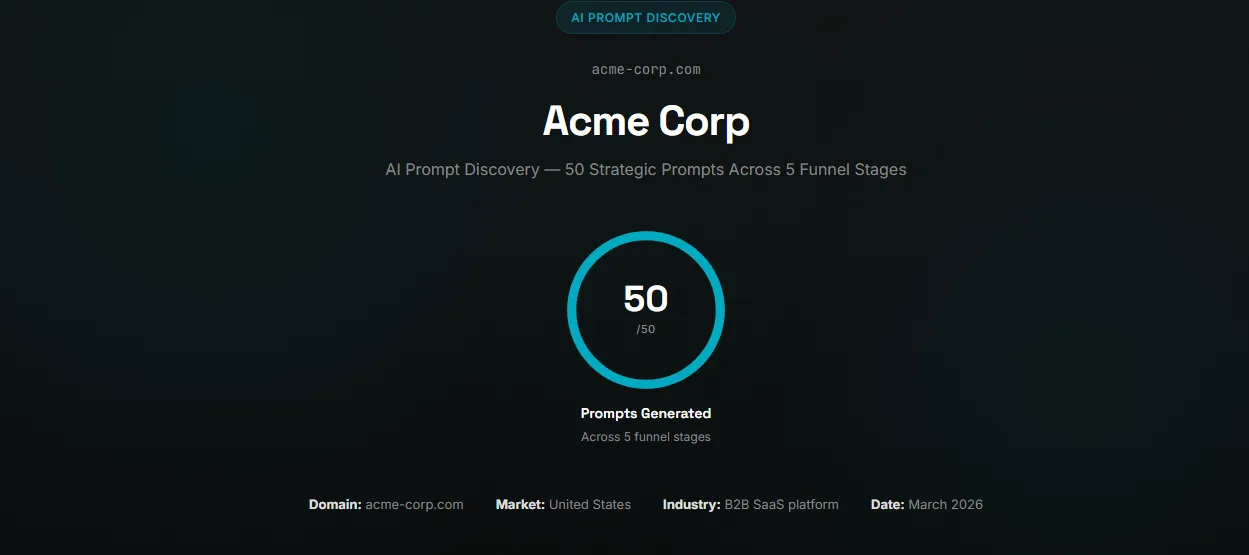
Your 5 funnel buckets at a glance, Branded, Awareness, Consideration, Decision, and Blind Spots. See exactly how many prompts target each stage.
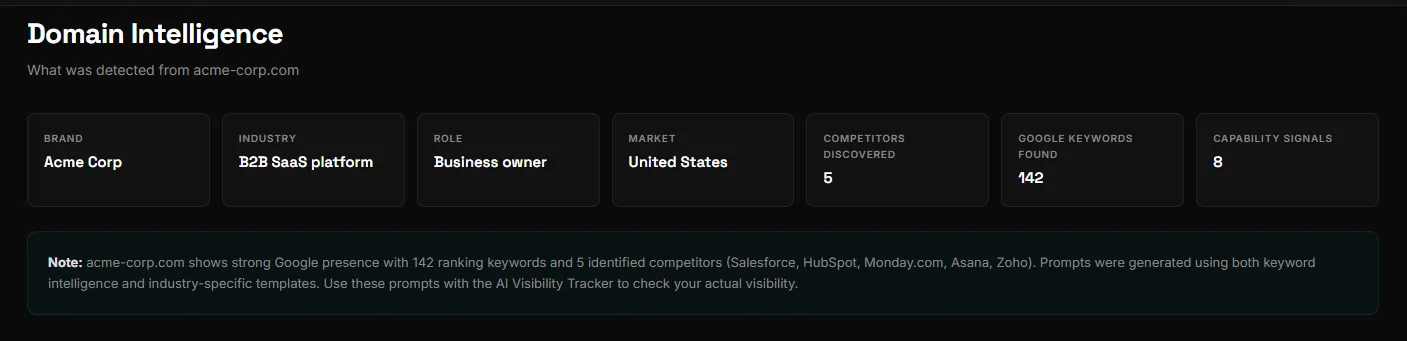
Auto-detected brand, industry, competitors, and keyword signals. The intelligence layer that makes your prompts specific to your business.
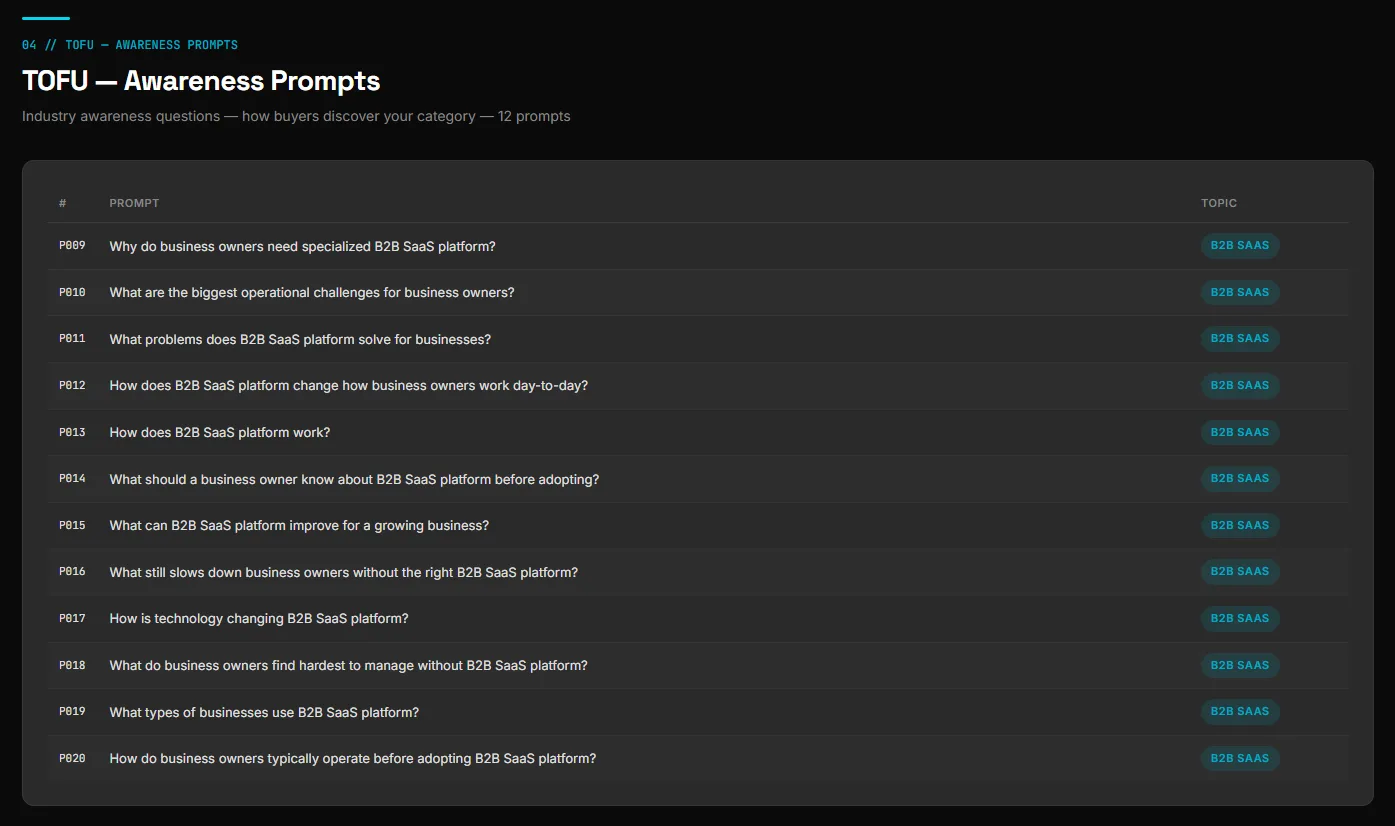
Full prompt list organized by funnel stage. Each prompt is written as a real buyer would ask AI, conversational, specific, and actionable.
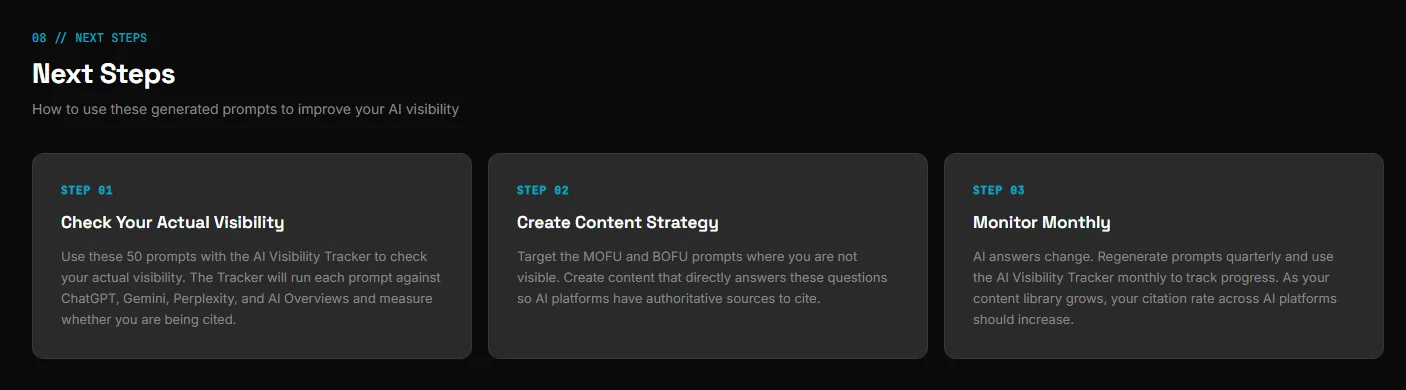
Clear action plan: run visibility tracking with these prompts, create content targeting gaps, then request a new tracker report to compare.
*This is a sample report for illustration purposes only. It does not reflect actual results. Your report will be customized based on your domain, industry, and target market.
Next steps. From prompt list to content plan.
A prompt list becomes useful when each prompt has an owner and a page. These four steps turn your 30 to 50 prompts into work your team can ship.
Map each prompt to a page
Match every prompt to the page on your site that should answer it. A prompt with no matching page is a gap.
Turn gaps into briefs
Write a content brief for each unanswered prompt, or add the question and a direct answer to the FAQ of an existing page.
Use Blind Spots to find competitor topics
The Blind Spots stage shows topics where competitors are the ones AI describes. Build pages for those topics early.
Measure the result
Request the AI visibility tracker report to see whether AI answers to buyer prompts in your market now mention or cite your brand.
Managing your list. How many AI prompts to track, and how to manage them.
Start with the 30 to 50 strategic prompts in your report. They cover all five stages, so they show where you are visible and where you are missing across the buying journey. Once the core set is answered on your site, you can grow to a larger tracked set, in the hundreds if your market calls for it.
- Keep a mix across Branded, TOFU, MOFU, BOFU and Blind Spots so no buying stage goes unmeasured.
- Review the list when your products, markets or competitors change.
- Retire prompts that no longer match how your buyers ask.
To compare tools for a larger set, read Best AEO Tools & Trackers for 2026.
Prompt volume. Is there search volume for AI prompts?
No AI assistant publishes how often a given prompt is asked, so there is no prompt volume number to look up. Four sources work as proxies for which questions matter to your buyers.
| Source | What it shows | Where to look |
|---|---|---|
| Google Search Console | Long, question style queries people typed before reaching your site | Performance report, Queries tab |
| People Also Ask boxes | Related questions Google shows for a topic | Google results for your main topics |
| Bing Webmaster Tools | Query reports in its AI performance data | AI performance reports in your Bing Webmaster Tools account |
| Sales and support questions | Questions buyers ask in their own words | Call notes, chat logs, support tickets and email threads |
These sources show which questions matter to your buyers. They do not give exact counts of AI usage.
Frequently asked questions.
What is AI Prompt Discovery?
AI Prompt Discovery is a free tool that analyzes your domain and generates 30 to 50 strategic prompts that map to how real buyers ask AI about your industry. These are the exact prompts you should track to understand your AI visibility.
How is this different from the AI Visibility Tracker?
The AI Visibility Tracker checks if AI platforms cite you for specific prompts. But first, you need to know WHICH prompts to track. AI Prompt Discovery solves that, it generates the prompts. Think of it as Step 1 before running visibility tracking.
What are the 5 funnel stages?
Branded (how AI describes your brand), TOFU/Awareness (how buyers discover your category), MOFU/Consideration (how buyers evaluate features), BOFU/Decision (pricing, ROI, contracts), and Blind Spots (competitive gaps AI exposes). Together they cover the full buyer journey.
Is this tool free?
Yes. AI Prompt Discovery is 100% free. No credit card, no trial period. You submit your domain and we deliver 30 to 50 prompts within 48 hours. There is zero obligation to purchase anything.
How many prompts do I get?
Between 30 and 50 prompts across 5 funnel stages. The exact count depends on your market and your domain's Google presence, since domains with more ranked keywords and competitors generate richer, more specific prompts.
What do I do with the prompts?
Use them with our AI Visibility Tracker to check which AI platforms cite you. Create content targeting the prompts where you're not visible. Re-run discovery quarterly as AI answers evolve.
Which AI prompts should I track?
Track the questions your buyers actually ask AI before they choose a supplier: questions about the problem you solve, comparisons between options, pricing and switching, and questions that name your brand. This tool builds that list from your website, your search footprint and your competitors, sorted into five buying stages.
What is an AI prompt tracker?
An AI prompt tracker runs a fixed list of prompts through AI assistants such as ChatGPT, Gemini and Perplexity on a schedule, and records whether your brand is mentioned or cited in each answer. The results are only as useful as the prompts you give it, which is why prompt discovery comes first.
Do I need a prompt tracking tool, or can I start with this list?
Start with the list. This free tool tells you which prompts are worth tracking. You can then test them by hand, load them into any prompt tracking tool, or run them through our free AI visibility tracker, which tests buyer prompts across four AI platforms.
How do I discover the real prompts buyers ask AI tools?
AI platforms do not publish what people ask them, so prompts have to be built from evidence. This tool starts from what your site already ranks for in Google, the competitors that rank for the same searches, and the features buyers look for, then writes the questions in the way buyers phrase them.
How many AI prompts should I track?
Start with 30 to 50 strategic prompts spread across the five buying stages. That is enough to show where you are visible and where you are missing. Once those prompts are answered on your site, you can grow to a larger tracked set, such as several hundred, and review the list whenever your products, markets or competitors change.
Is there search volume for AI prompts?
No, AI assistants do not publish how often a prompt is asked. Useful proxies are long question queries in Google Search Console, People Also Ask boxes, query reports such as Bing Webmaster Tools AI performance data, and the questions your sales and support teams hear. Use them to decide which prompts matter most.
How do I track prompt results across AI search engines?
Run each prompt in every AI engine and record whether your brand is mentioned or cited in the answer, then repeat when you want to compare. Our AI visibility tracker does this once per report, testing buyer prompts across four AI platforms. For a short list you can also run the prompts by hand and log the results in a spreadsheet.
How do I use prompt data in my content workflow?
Map each prompt to the page that should answer it. Turn prompts with no answer into briefs or FAQ entries, and use the Blind Spots stage to find topics your competitors cover. Then run the list through a tracker to check results. Our guide on how to measure AEO covers the metrics to follow.
Know a team that doesn't track AI prompts yet?
One form. Up to 50 prompts. Your free prompt list.
Delivered within 48 hours, ready to feed into AI visibility tracking.
Discover Your AI Prompts, Free