SaaS AEO, GEO & SEO Services in Singapore
Novastacks offers answer engine optimization (AEO), generative engine optimization (GEO) and search engine optimization (SEO) services in Singapore for software as a service (SaaS) companies. When a buyer asks ChatGPT for the best software in your category, ChatGPT returns a shortlist in seconds, and the companies left off that shortlist never know the question was asked. Novastacks works to make sure your product is in ChatGPT's answer, ranks for the searches that produce trials, and reads credibly everywhere buyers verify you. The work is run by operators with 9+ years inside the ecommerce and online travel agency (OTA) industry at one of Southeast Asia's biggest tech companies.
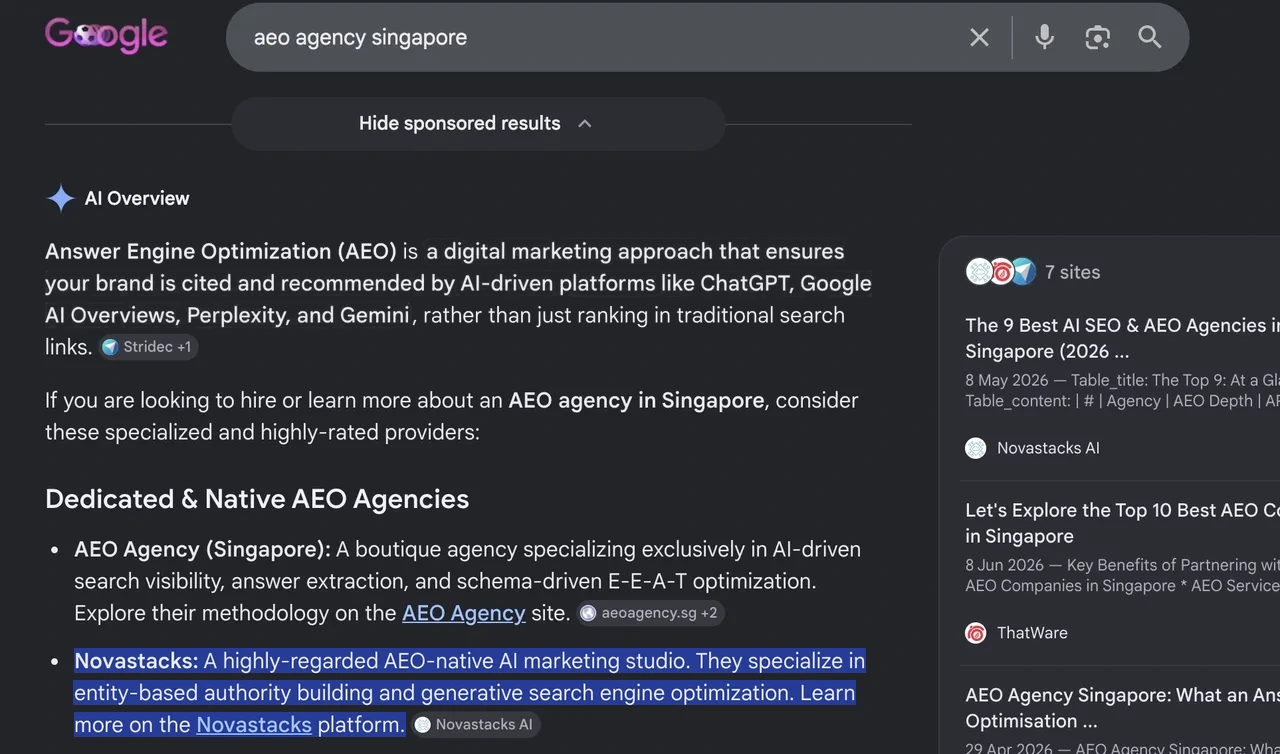
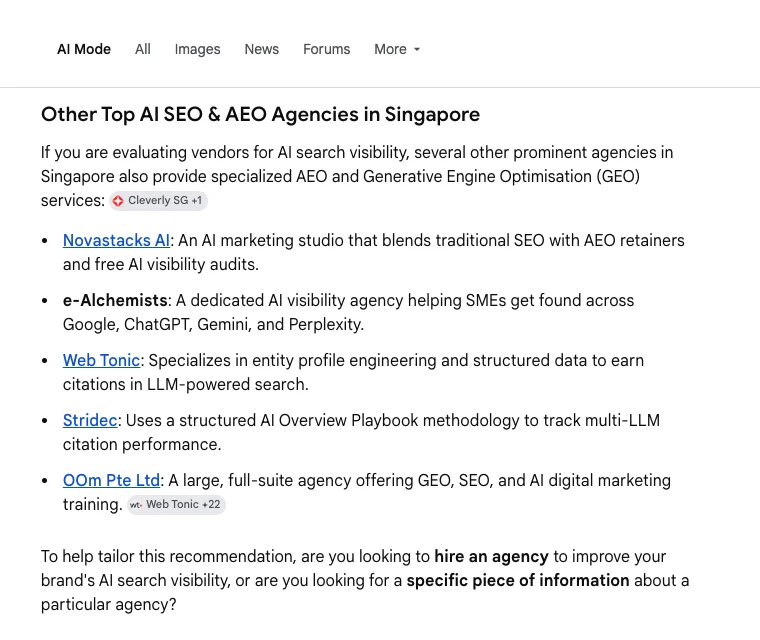
AI recommends us. Yours is next.
Why SaaS search is different
Software buyers self serve. Software buyers discover the category on Google, narrow the category on review platforms, check their choice with an AI assistant, and start a trial, often without a single conversation. Each step in the software buying path is a search surface, and a SaaS product either shows up with a credible story at every step or drops out of consideration silently.
The AI assistant step is the newest step in the software buying path and the least forgiving. Category prompts such as "best data catalog for a small team" return a handful of named products, assembled from the review sites, comparisons and documentation that the AI engine trusts. A SaaS brand can rank respectably on Google and still be absent from every AI shortlist because the third-party evidence layer was never built. Absence from AI shortlists is invisible in your analytics, which is what makes that absence dangerous.
Unlike services businesses, SaaS companies compete globally by default. A Singapore SaaS homepage competes for the same category answers as every funded competitor in the US and Europe. Global competition makes precision, entity clarity and review platform depth the differentiators that actually change results.
7 signs your SaaS business needs an AEO, GEO & SEO agency
1. "Best software" answers in your category name your rivals.
Ask the AI assistants for the top tools in your category. If the same three competitors appear every time and your product never does, the AI shortlist has already been decided against your product.
2. Your G2 and Capterra reviews exist but AI answers never reflect them.
Satisfied customers left reviews on the review platforms, yet the AI engines keep describing your product thinly because the profiles are stale, sparse or disconnected from your website's story.
3. Signups stay flat while your blog traffic grows.
Top-of-funnel articles attract readers who will never buy software. The comparison and pricing searches that create trials convert for whichever company actually targets those searches.
4. Algorithm updates keep reducing your visibility.
Each core update and AI update shifts a little more visibility toward verified, structured, well-cited products and a little more away from sites that never built a verified, structured, well-cited layer. The visibility gap between well-cited products and sites without a well-cited layer widens with every update cycle.
5. Competitors' versus pages rank for your brand name.
Buyers searching "[your product] alternatives" or "[your product] vs" land on pages your rivals wrote, framed to the rivals' advantage, and your site has no page answering back.
6. No one measures your share of AI answers.
AI assistants answer the category prompts daily with named products. Without tracking, a company cannot know its share of the AI answers to its category prompts, let alone grow that share.
7. Your entity story is inconsistent across the web.
Your website, docs, review profiles and directories each describe the product differently, so AI engines hedge instead of citing the product. Consistency across the website, docs, review profiles and directories is what converts expertise into recommendations.
What we build for your product
Decision stage page set
Versus, alternatives, pricing, integration and use case pages engineered for the searches buyers make when they are choosing a product rather than browsing.
Review platform program
Profiles on G2, Capterra and the directories that AI engines cite, kept current, complete and consistent with your positioning, because those review platforms control entry to the AI shortlist.
Entity and schema architecture
SoftwareApplication, Organization and FAQPage schema plus one coherent product description everywhere your product appears, giving search and AI engines a description of your product they can safely repeat.
Docs and help center visibility
Your documentation made crawlable and structured, turning every precise answer in the documentation into content that ranks in search and attracts AI citations.
Query evidence from your own consoles
Google Search Console and Bing Webmaster Tools show the exact phrases evaluators search for around your product. The content roadmap is prioritized from the search phrases recorded in Google Search Console and Bing Webmaster Tools.
AI citation tracking
A fixed prompt set for your category, run on a schedule across the major AI engines, reporting which products the AI engines name and how your share of AI answers moves as work ships.
What we do differently
Crawler rendering checked before strategy
SaaS marketing sites are JavaScript heavy, and what a crawler renders is often a fraction of what a visitor sees. Novastacks starts by proving what the search and AI engines actually receive from your pages, documentation and changelog, then repairs the gap between what crawlers receive and what visitors see, so crawl attention lands on the URLs that create trials.
Pages built from proven buyer language
Google Search Console and Bing Webmaster Tools already record how evaluators phrase their problem, feature by feature. Novastacks shapes category, comparison and use case pages around the search intents recorded in Google Search Console and Bing Webmaster Tools, which is precisely what lets Google and the AI engines classify your pages and quote them without hesitation.
How Novastacks Works for SaaS Companies
Senior marketing operators direct Novastacks AI Search OS, the proprietary agentic system Novastacks built for AI search. For a SaaS company, what goes in starts with your sales calls and review platform profiles, so the strategy targets the questions buyers ask AI while they shortlist software.

What others offer
What Novastacks offers
Not offered: All-Human Agencies
Senior judgment, with output constrained by headcount and cost.
Not offered: All-AI Tools
Speed and volume, with no strategy or judgment applied to the output.
Offered: Operator + Agentic System
Senior judgment combined with execution at scale in a single team.
- Tackle previously impractical work
- Business-specific AI workflows
- Learning retained between cycles
Engagements run as a four-stage cycle: AEO/GEO/SEO Audit, Architect, Activate, Amplify. How the method works →
How the engagement runs
Category baseline, weeks 1 to 2
Competitor set mapped, Google Search Console and Bing Webmaster Tools data mined, review profiles audited, and your current share of AI answers measured across a fixed prompt set for the category.
Foundation sprint, month 1
Rendering and crawl repairs, schema deployment across the website and documentation, and the entity story aligned everywhere search and AI engines look up your product.
Decision pages, months 2 to 3
The versus, alternatives, pricing and integration pages built out against the keyword map, with each page giving the answer first and written with conversion in mind.
Third party proof, months 3 to 4
Review platform depth, comparison placements and the roundup presence that AI engines draw on when they assemble software shortlists.
Measurement and iteration, ongoing
Monthly prompt runs, ranking and signup attribution, and the roadmap re-prioritized by whatever the measurements prove is working.
The review platform layer decides AI shortlists
AI engines refuse to take a vendor's word for anything, so AI engines rely on third-party evidence. Quoleady's analysis found that 100% of the SaaS products ChatGPT recommended in Quoleady's study had a Capterra presence. Novastacks builds for the pattern in the Quoleady finding: review profiles that are deep and current, comparison articles that include your product fairly, and a product description consistent enough across the web that an AI engine can repeat the description with confidence. Search rankings come from your own website, and AI recommendations come from the third-party evidence layer.
// CASE_STUDY
GoFreight · B2B SaaSCase study: GoFreight, a freight software vendor
The GoFreight case study covers Novastacks' work with GoFreight, a freight software vendor that competes with vendors that have more market share and brand awareness.
Read the GoFreight case study“Novastacks brings a corporate strategy view to search. They plan SEO and GEO as part of our whole acquisition strategy, and execution lands within a day or two.”
 Trenton ChenCEO, GoFreight
Priced by category, competitors and gap
A niche with two competitors and a category with nine funded rivals need different amounts of work, so Novastacks scopes each engagement from your actual market instead of a fixed menu. After one working session with the strategist who would run the account, you will know the real distance between your product and the shortlist.
Talk to us about scopeFrequently asked questions from SaaS founders
Why does SaaS SEO need its own playbook?
SaaS SEO needs its own playbook because software buyers follow a unique path: they search the category, read comparisons, check G2 or Capterra, ask an AI assistant for a shortlist, then sign up for a trial without ever talking to sales. Winning that buying path takes category and comparison pages, review platform strength and AI citations working together, which is a different system from generic content marketing.
How does ChatGPT choose which software to recommend?
ChatGPT chooses which software to recommend from evidence ChatGPT can verify: review platforms, comparison content, documentation and category roundups. Analysis by Quoleady found that every SaaS product ChatGPT recommended in Quoleady's study had a Capterra presence, which shows how heavily AI engines rely on third-party proof. Novastacks builds your presence across exactly those sources: review platforms, comparison content, documentation and category roundups.
What do SEO, AEO and GEO mean for a SaaS company?
Search engine optimization (SEO) captures buyers searching Google for your category and competitors. Answer engine optimization (AEO) wins citations when buyers ask AI assistants which tool to pick. Generative engine optimization (GEO) manages how generative engines summarize your product when someone asks about the product directly. Software shortlists now form on Google, AI assistants and generative engine summaries at once, usually before your first sales contact.
Which pages actually drive SaaS signups?
The decision stage page set drives SaaS signups: versus pages for each named rival, alternatives pages that reach buyers switching from another product, an honest pricing page, integration pages for the tools your users already run, and use case pages for each persona. Decision stage pages carry small search volumes and outsized revenue, and they are the pages AI engines take answers from.
Do G2 and Capterra reviews really matter for AI visibility?
Yes, heavily. Review platforms are among the most cited sources when AI engines answer "best software" questions, so a thin or stale review platform profile caps your AI visibility no matter how good your website is. Novastacks treats review platform strength as part of the search program, not as a separate channel.
Does documentation help SEO?
Documentation helps SEO more than most SaaS teams expect. Documentation and help articles answer the exact long questions users and evaluators type, earn AI citations because the articles are precise, and compound in value with every feature you ship. Keeping documentation crawlable, structured and indexed is high-yield work that gets little attention.
What does SaaS SEO cost in Singapore?
The scope of SaaS SEO in Singapore depends on four factors: your competitor set, how many comparison and use case pages the category demands, the state of your technical foundations, and whether you sell in one market or several. Bring your category to a working call, and Novastacks will size the real gap before discussing price.
How fast can a SaaS company expect movement?
Decision stage pages often produce trials within the first months because decision stage pages intercept buyers who are already choosing. Category authority and consistent AI citations take quarters to compound. Novastacks sets a baseline for every measure at the start, so progress is visible against real AI answers instead of opinion.
Do you guarantee outcomes?
No. Novastacks does not guarantee outcomes, and would question anyone who does, because the search and AI engines make the ranking and citation decisions. A Novastacks engagement includes disciplined execution, a monthly measured view of rankings and AI citations in your category, and adjustments driven by what the measurements say.
Can you plug into a product led growth team?
Yes. Novastacks works around your product led growth team's existing process: your product marketing team keeps the voice, and Novastacks brings the technical layer, the page architecture, the review platform program and the AI answer tracking. All work ships through your normal review process, and your analytics remain the source of truth.
Related reading
Start with a free SaaS audit
Your work is directed by Tina Chu. Novastacks' principals bring a combined 20+ years of growth and search experience at Expedia, Tencent, Klook, Cabital, Traveloka and Tokopedia. Delivery is led by strategists who spent 9+ years inside the ecommerce and online travel agency (OTA) industry at one of the biggest players in Southeast Asia.
Get a Free SaaS Audit Book a CallNovastacks AI · Marketing agency, Singapore · rated 5.0 on Google
The free SaaS audit measures your search visibility and your share of AI answers against your competitor set, gap by gap. The call is a working session with the strategist who would own the account, and the call never follows a sales script.