AEO vs GEO: Are They Different, and Does It Matter?
Agencies quote different prices for what sounds like the same job. Here is what separates AEO from GEO, where agencies disagree and where to start.

Key Takeaways
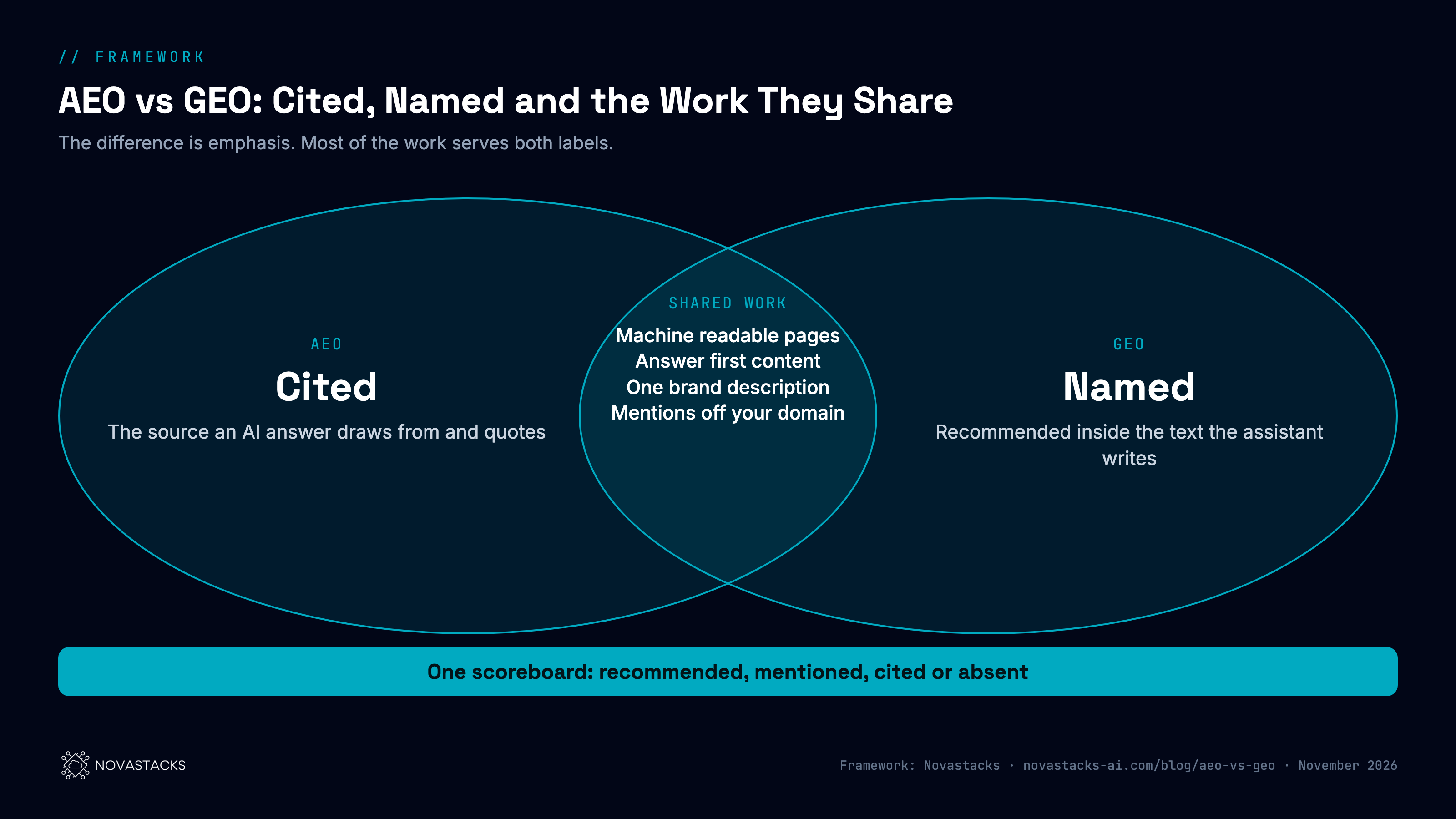
- AEO aims at being cited; GEO aims at being named. The work overlaps heavily and the difference is emphasis.
- The industry disagrees. Profound calls them the same thing, Jasper separates them; we run one programme with one scoreboard.
- Cited is not recommended. An assistant can use your page and name a competitor, and ChatGPT cited nothing on informational questions in our 500 query study.
- Start with the shared work. Machine readable pages, answer first content and a consistent brand description serve both labels.
What is the difference between AEO and GEO?
Two agencies pitch you in the same week. One sells answer engine optimization, the other generative engine optimization, and neither can say why the quotes differ. Before you buy either, it helps to know how much of the difference is substance.
Short answer
AEO (answer engine optimization) is the work of getting your pages cited as the source that AI assistants draw an answer from. GEO (generative engine optimization) is the work of getting your brand named and recommended inside the text the assistant writes. The two overlap heavily. The difference is emphasis, source citation for AEO and brand mention for GEO, and it does not justify two separate programmes.
If the comparison you need is with classic search, see GEO vs SEO instead; this page stays on the two AI terms.
AEO vs GEO side by side
The table shows where the emphasis lands. Read it as two ends of one scale, since most real work sits in the middle.
| Dimension | AEO | GEO |
|---|---|---|
| Goal | Be the source an AI answer draws from and quotes | Be named and recommended inside the generated answer |
| Where the answer appears | Citations and source links in ChatGPT, Perplexity, Google AI Overviews and Copilot | The prose of longer answers: shortlists, comparisons and recommendations in ChatGPT, Gemini and Google AI Mode |
| What is measured | Citation rate per assistant for a fixed set of questions | Recommended, mentioned, cited or absent per assistant, plus share of voice |
| Ranking signals | Direct answers, structured data, crawl access, freshness, authority | Entity clarity, mentions and reviews on sites you do not own, source shaped content, machine access |
| Content format | Question headings with the answer in the first sentence, definitions, tables | One question per page answered in depth, with statistics and named sources |
| Timeline | Page level fixes can move within weeks | Page fixes move within weeks; the trust behind a recommendation builds over months |
| Tools | Citation trackers such as WorkDuo and our own free AEO checker (a one time check) | The same trackers, read for named recommendations as well as citations |
The overlap is the point: the same crawl access, the same structured pages and the same off site mentions feed both columns.
Where did AEO and GEO come from?
GEO has a documented origin. Aggarwal and colleagues coined it in a paper first posted in November 2023 and published it at KDD 2024. They built a benchmark called GEO-bench and reported that the right content changes lifted source visibility in generated answers by up to 40 percent.
AEO has no single origin paper. In AI search it centres on being cited as the source of an answer. Two labels with different histories, applied to one new behaviour, produced the confusion buyers now meet.
Do agencies agree that AEO and GEO are different?
They do not. Profound's own blog argues that AEO and GEO are the same thing and says it prefers AEO. Jasper's guide to GEO and AEO keeps them as separate columns, with GEO centred on brand citations and AEO on direct answers (both pages checked on 2026-11-09).
Our position sits between the two. The work overlaps so much that running it as two budgets is selling the same thing twice, and the emphasis still matters when you decide what to measure. Ask any agency what it tracks. The label it uses tells you little.
Why does cited versus named matter?
Because an assistant can use your page and still name someone else. Every generated answer resolves into one of four states for your brand: recommended, mentioned, cited or absent. Cited means you are linked as a source while a competitor is recommended. You supplied the evidence for someone else's sale.
Citation is also unavailable on some questions. In our study of three AI search channels, ChatGPT returned zero citations for informational and health or money questions across 500 queries, answering from its own training instead. On those questions there is no citation to win, and being named from the model's memory is the only play. That is the situation where GEO emphasis matters most.
Being cited is mainly a content achievement and being recommended is mainly a trust achievement, and they are earned in different places. Our guides to what AEO is and to what GEO is cover each side.
Do you need both, and where should you start?
You need the shared work first, then you lean by where your gap sits.
- Make the pages readable by machines. Content in the raw HTML, AI crawlers allowed by robots.txt and your CDN, accurate schema. This feeds both labels.
- Write answer first pages for the questions buyers ask. A direct answer in the opening, then depth, statistics and named sources. This is the AEO lean.
- Make the brand description consistent. The same story on your site, LinkedIn, review profiles and press, so an assistant can describe you without contradiction. This is the GEO lean.
- Build mentions off your own domain. Reviews, community answers and independent comparisons. Around 85 percent of brand mentions inside AI answers come from domains the brand does not own (AirOps, 21,311 brand mentions, October 2025).
The acronym map around these two terms, including AIO, is in AEO vs GEO vs SEO vs AIO, and the effect of both on classic rankings is in AEO vs SEO.
How does Novastacks measure AEO and GEO?
One scoreboard serves both. At Novastacks we fix a set of buyer questions, run them across the assistants your buyers use, and record for every answer whether your brand is recommended, mentioned, cited or absent. The citation count answers the AEO question and the recommendation count answers the GEO question, from the same runs.
An AEO agency and a GEO agency should show you that table for your own category before they quote. That table turns a sales claim into a baseline you can check.
How does Novastacks run AEO and GEO as one programme for a client?
Cited and named are two outcomes of one body of work, so The Novastacks Methodology treats them as one programme. The Decision layer selects the buyer questions to track with Prompt Radar Pro and specifies which pages to create or improve. The Execution layer then delivers the shared work described earlier: Machine Readability prepares the site for AI crawlers, content production writes pages built to be quoted, and Echo Network builds presence on the sources AI engines trust.
The Measurement layer is the single scoreboard. Proof Loop tracks whether AI engines cite and recommend the brand, reported per engine. A citation means an engine used your page as a source, and a recommendation means it named you in the answer. Each tracked buyer question is checked several times and reported as a range, beside pipeline, non brand demand and revenue influenced. Each market gets its own question set and measurement, and the results define the next round of work.
FAQ: AEO vs GEO
What is the difference between AEO and GEO?
AEO (answer engine optimization) focuses on getting your pages cited as the source AI assistants draw an answer from. GEO (generative engine optimization) focuses on getting your brand named and recommended inside the text the assistant writes. The work overlaps heavily, and the difference is emphasis, source citation versus brand mention.
Are AEO and GEO the same thing?
Largely, yes. Profound argues they are the same strategy, and Jasper treats them as separate columns, so the industry is split. Novastacks runs them as one programme because crawl access, structured pages and off site mentions feed both, and measures both from the same set of buyer questions.
Which is better for my business, AEO or GEO?
Start with the shared work that serves both: machine readable pages, answer first content and a consistent description of your brand. Lean toward AEO if buyers ask factual questions where assistants show sources. Lean toward GEO if buyers ask for shortlists and recommendations, where being named decides the outcome.
Do I have to pay for both AEO and GEO?
No. Two separate budgets for the same crawl fixes, content and mentions is paying twice. Ask the agency which outputs differ and which metrics it reports for each. If the answer is the same tasks under two names, buy one programme.
Who coined the terms AEO and GEO?
GEO was coined by Aggarwal and colleagues in a paper first posted in November 2023 and published at KDD 2024, which introduced the GEO-bench benchmark. AEO has no single documented origin; in AI search it refers to being cited as the source of an answer.
Does AEO or GEO replace SEO?
Neither replaces it. AI assistants retrieve from the crawled, indexed web, so SEO decides whether your pages can be found at all. AEO and GEO decide whether those pages are quoted or whether your brand is named once they have been found.
Sources
- Aggarwal et al., GEO: Generative Engine Optimization (November 2023, published at KDD 2024), GEO-bench and the up to 40 percent source visibility lift
- Profound, AEO vs. GEO: Why they're the same thing, checked on 2026-11-09
- Jasper, What is Generative Engine Optimization? GEO vs AEO vs SEO, checked on 2026-11-09
- AirOps, The influence of offsite signals in AI search, 21,311 brand mentions, October 2025
- Novastacks AEO Study, 500 queries across five intent types, 6,083 unique URLs cited by AI engines, US market and English, collected April 2026
Find Out Which One Your Buyers Need
The free audit shows which AI assistants cite and name your brand today and what is blocking the rest. It takes minutes and carries no obligation.