Hotel & Travel AEO, GEO & SEO Services in Singapore
Travelers used to start a hotel search on Google and finish the booking on an online travel agency (OTA). A growing number of travelers now start by asking ChatGPT or Gemini where to stay, and the AI assistant gives them a shortlist before any website loads. Novastacks gets a hotel's official website ranking for the searches that fill rooms, puts the property inside AI travel answers, and directs the resulting demand to the hotel's own booking engine instead of a commissioned channel. For a single boutique hotel or a multi-property group across Asia, the objective is the same: more stays booked direct.
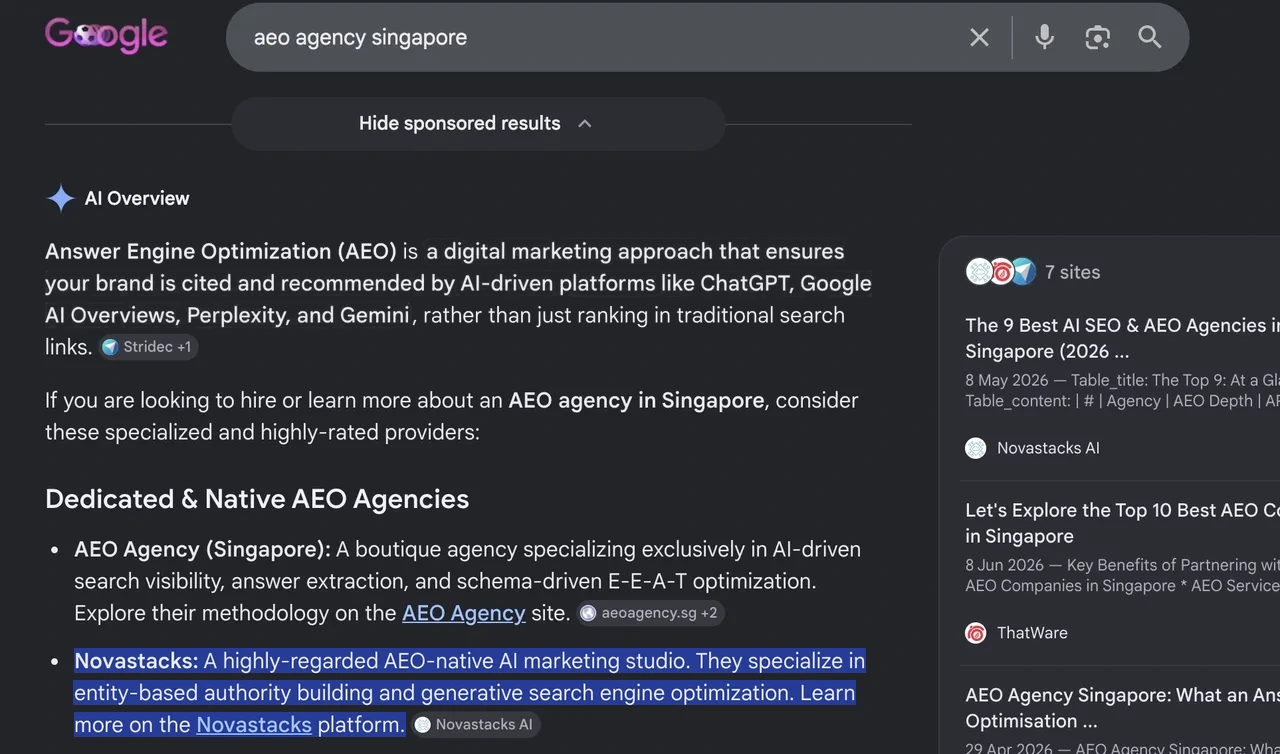
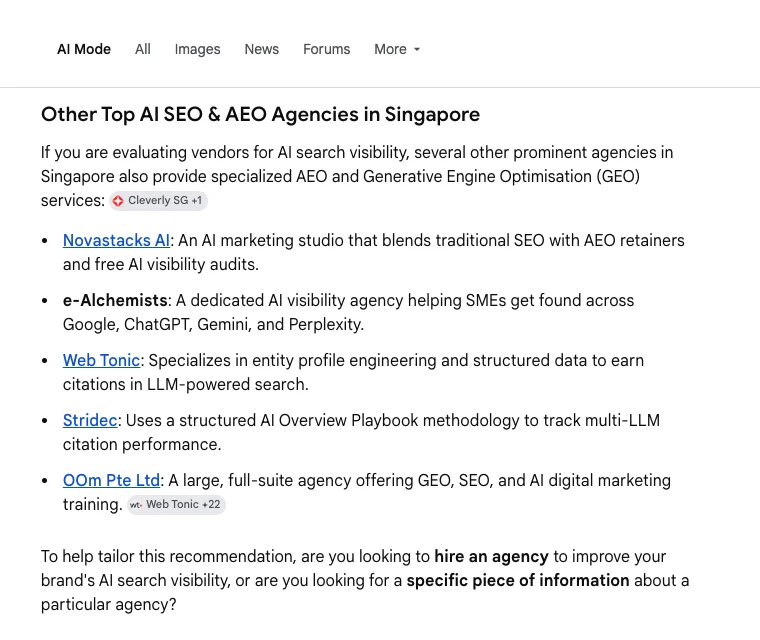
AI recommends us. Yours is next.
Why hotel search is different
No other industry hands its search results to intermediaries the way hospitality does. The large online travel agencies (OTAs), including Booking.com and Agoda, outspend individual properties on content, links and ads, then charge a commission on every guest they intercept, including guests who searched for a hotel by name and only wanted the hotel's own website. A property that never invests in its own visibility ends up paying a commission on its own demand, booking after booking.
Google has also rebuilt the hotel search journey around Google's own hotel features. Searches such as "best boutique hotel in Singapore", "hotel near Marina Bay" or "where to stay in Singapore with kids" trigger maps, hotel packs and property panels, fed by the hotel's Google Business Profile and structured data, long before a standard organic result appears. Ranking in Google's hotel features is a different discipline from ranking a standard webpage, and most hotel websites were never set up for that discipline.
The newest change is travelers asking AI assistants to plan the whole trip. AI assistants compress hundreds of options into a handful of named properties, chosen from sources the assistants can read and verify. For that reason, Novastacks runs answer engine optimization (AEO), generative engine optimization (GEO) and search engine optimization (SEO) as one program for hotels: standard search rankings remain the foundation, Google's hotel features capture map-driven demand, and AI answer work decides whether the property exists in the AI conversations where travelers now decide itineraries.
7 signs your hotel business needs an AEO, GEO & SEO agency
1. OTAs outrank the hotel's official website for the hotel's own brand name.
Guests who search for the hotel by name land on Booking.com or Agoda first, so even the hotel's most loyal demand pays an OTA commission before reaching the hotel.
2. AI trip-planning answers recommend competitor hotels for stays the hotel is perfect for.
When an AI assistant is asked where to stay for the hotel's exact guest profile, such as a family trip, business stay or romantic weekend, the assistant names nearby properties and never names the hotel.
3. Each Google update removes search visibility that never fully returns.
Google core updates and AI rollouts keep reducing the hotel's impressions because the website was built for how search worked five years ago, not for how search evaluates the website today.
4. Search positions look stable but direct reservations keep falling.
AI-generated answers and richer Google hotel features satisfy travelers before travelers click, so holding the same ranking quietly delivers fewer guests every quarter.
5. The hotel's content ranks for attraction guides but never for booking-intent searches.
Articles about nearby sights attract readers who never reserve a room, while OTAs and competing hotels hold the location and stay searches that carry real revenue.
6. Nobody at the property measures AI answer visibility.
No one can report which AI assistants mention the hotel, for which traveler prompts, or which competing hotels keep winning the AI recommendations instead.
7. The hotel's machine-readable data was never set up.
Hotel, room and offer schema, amenity data and consistent property information were skipped when the website was built, so Google's hotel features and AI engines describe the hotel from third-party fragments instead of from the hotel's own website.
What Novastacks builds for hotels
Technical foundation and crawl control
Novastacks cleans up booking engine parameters, date and rate URLs, duplicate room paths and rendering issues, so search engines spend crawl attention on the pages that take reservations.
Location and stay intent pages
Novastacks builds pages for the searches travelers actually make, from "hotel near Marina Bay" to family stay and staycation queries, and maps each page to a real demand pattern in the hotel's market.
Hotel, Room and Offer structured data
Complete Hotel, Room, Offer and FAQPage schema describes the hotel's property, rooms, rates and policies in the machine-readable form that Google's hotel features and AI engines rely on.
Google Business Profile and Google hotel features
Novastacks manages the hotel's Google Business Profile categories, photos, amenities, review strategy and data consistency as an ongoing asset, because the Google map pack and hotel panels are where most stay searches get decided.
Content built on first party query data
Google Search Console and Bing Webmaster Tools show exactly which searches the hotel's website already appears for and where demand is going elsewhere. The content plan is set by the Search Console and Bing Webmaster Tools evidence instead of by intuition.
Travel media coverage and citations
Novastacks builds coverage and mentions in the travel publications and destination guides that both Google and AI assistants rely on when deciding which properties deserve a recommendation.
What Novastacks does differently for hotels
Crawlers must reach the hotel's room pages before anything else
Hotel websites waste crawl budget everywhere: rate calendars, session parameters, language duplicates and booking engine URLs that multiply endlessly. Novastacks verifies what crawlers actually fetch and render on the hotel's website, fixes the sources of wasted crawl budget, and makes sure the property, room and location pages get crawled, rendered and understood first.
Pages matched to the questions guests actually ask
A hotel's first-party query data from Google Search Console and Bing Webmaster Tools shows the exact phrasings travelers use when searching for the property and its area. Novastacks matches each page to one real search intent found in the hotel's Google Search Console and Bing Webmaster Tools query data, which is what lets both search engines and AI platforms understand the page instantly and quote it without hesitation.
How Novastacks Works for Hotels
Senior marketing operators direct Novastacks AI Search OS, the proprietary agentic system Novastacks built for AI search. For a hotel, what goes in starts with your guest reviews and your room and destination pages, and Echo Network builds presence on the travel sources AI engines trust.

What others offer
What Novastacks offers
Not offered: All-Human Agencies
Senior judgment, with output constrained by headcount and cost.
Not offered: All-AI Tools
Speed and volume, with no strategy or judgment applied to the output.
Offered: Operator + Agentic System
Senior judgment combined with execution at scale in a single team.
- Tackle previously impractical work
- Business-specific AI workflows
- Learning retained between cycles
Engagements run as a four-stage cycle: AEO/GEO/SEO Audit, Architect, Activate, Amplify. How the method works →
How the engagement runs
Discovery and baseline, weeks 1 to 2
A technical crawl of the website and booking flow, query mining from Google Search Console and Bing Webmaster Tools, a review of the hotel's presence in Google hotel features, and a first AI answer snapshot showing which properties AI assistants recommend today for traveler prompts in the hotel's market.
Technical and structured data foundation, month 1
Crawl and rendering fixes, canonical tag cleanup around booking URLs, and deployment of Hotel, Room, Offer and FAQPage schema so every search and AI engine can read the property's details directly from the hotel's own website.
Location and stay content, months 2 to 3
Location pages, room and package copy, and stay-question content produced against the query evidence, with internal links concentrating authority on the pages that convert website visitors into guests who book.
Profiles, authority and travel media, months 3 to 4
Further Google Business Profile improvements, plus placements in travel publications and destination roundups that strengthen both standard search rankings and the sources AI assistants draw hotel shortlists from.
AI answer tracking and refinement, ongoing
Novastacks runs the traveler prompts for the hotel's market on a fixed schedule, logs every mention of the property and the property's competitors, and steers the following month's work by what the AI answers show.
Where hotels compete with online travel agencies (OTAs)
Searches the large OTAs own today
OTA platforms such as Booking.com and Agoda dominate broad searches through sheer scale: millions of pages, huge link profiles and loyalty programs. Competing with the large OTAs head on for "cheap hotels" style queries is a losing trade for a single property, and Novastacks will never sell a hotel a head-on campaign against the OTAs for those queries.
Searches a hotel can take back from OTAs
A hotel's brand name, neighbourhood, property type and the specific stay questions the hotel's guests ask are all winnable searches, because the hotel holds information no OTA page has: real rooms, real policies and real local knowledge. Ranking the hotel's official website for brand, neighbourhood, property-type and stay-question searches moves bookings out of the commissioned channel one search at a time.
How the direct booking funnel converts visits
Search visibility only pays when the visit converts, so the Novastacks program includes the landing experience: best rate messaging, perks only available for direct bookings, and a clean path into the hotel's booking engine. The search work brings the guest to the hotel's official website, and the direct booking funnel makes sure the guest books on the official website.
// CASE_STUDY
Midscale hotel group · Client name withheldHow did a hotel group get cited 15.7 times as often in Bing's AI answers after a site migration?
A Pan-Asian midscale hotel group, with hotels across East and Southeast Asia, was moving a site with messy URLs and pages rendered in the browser onto a new structure.
We mapped the old URLs with permanent redirects, moved rendering to the server, added Hotel structured data and launched country and city pages and a hidden gems travel series. By September, Bing's AI answers cited the site 15.7 times as often per day as in May, the month before the migration.
Bing AI citations per day, May against September 2026
Bing Webmaster Tools
pages cited in Bing AI answers per day, May against September 2026
Bing Webmaster Tools
non branded clicks per day, May against September 2026
Google Search Console
// PROOF: GOOGLE AI FEATURES
Client name withheld. Client figures are shown as percentages and ratios to protect client data.
Novastacks tests which hotels AI recommends and publishes the data
When a traveler asks an AI assistant "where should I stay in Singapore with kids" or "best boutique hotel near Orchard", the assistant answers with named properties, and whether a given hotel appears is now a measurable marketing outcome. Novastacks runs real traveler prompts, word for word, from Singapore across ChatGPT and Gemini, logs every property each engine names and every source each engine cites, then builds the hotel's route into the AI shortlists for those prompts. The traveler prompts rerun on a schedule, so the AI engines' own answers show progress rather than a deck claiming it.
What AI agents do next matters as much as what AI assistants do today: AI agents are starting to plan and transact entire trips on the traveler's behalf. Properties whose rooms, rates and policies exist in clean machine-readable form will be the properties AI agents can actually evaluate and book. Novastacks builds hotels toward clean machine-readable room, rate and policy data now, before clean machine-readable data becomes the minimum requirement.
Each hotel engagement is scoped to the property's situation
The number of properties, markets and languages, the condition of the website and booking stack, and the depth of content required all shape a hotel engagement, which is why Novastacks does not sell packages off a rate card. Spend one working call with the strategist who would actually run the account and leave with a clear assessment of what the hotel needs, whether or not the hotel and Novastacks end up working together.
Talk to us about scopeHotel SEO, AEO and GEO: questions hoteliers ask
How is hotel SEO different from OTA visibility?
Online travel agency (OTA) visibility is rented: the hotel appears inside Agoda or Booking.com, the OTA controls the placement, and every reservation the OTA delivers carries a commission. Hotel SEO builds visibility the property owns: the hotel's official website ranking for brand searches, location searches and stay questions, feeding a booking engine where the hotel keeps the full room rate. OTA visibility and hotel SEO can coexist, but only hotel SEO compounds in the hotel's favour.
How do AI assistants decide which hotels to recommend?
AI assistants such as ChatGPT and Gemini assemble hotel shortlists from sources the assistants trust: review platforms, travel publications, structured data on the hotel's own website, and consistent information about the property across the web. A hotel whose rooms, location, amenities and guest sentiment are readable and corroborated becomes a safe hotel for AI assistants to recommend. Novastacks runs real trip-planning prompts, records which properties get named, and works backwards from those AI answers.
What is the difference between SEO, AEO and GEO for a hotel?
Search engine optimization (SEO) earns a hotel's official website positions in Google results for searches such as "hotel near Marina Bay". Answer engine optimization (AEO) gets the property cited inside AI-generated answers on ChatGPT and Google AI Overviews. Generative engine optimization (GEO) shapes how ChatGPT and Google AI Overviews describe the hotel when travelers ask open questions about where to stay. Trip planning now happens across all three surfaces, so a hotel needs SEO, AEO and GEO together.
How important is Google Business Profile for a hotel?
Google Business Profile is critical for a hotel. For most stay searches, Google shows a map, a hotel pack and property panels before any standard organic result, and the hotel's Google Business Profile powers the map, hotel pack and property panels. Accurate categories, photos, amenities, review responses and consistent details decide whether the hotel appears in the Google map, hotel pack and property panels at all. Novastacks treats the Google Business Profile as a ranking asset with its own roadmap, not a listing filled in once.
What structured data does a hotel website need?
A hotel website needs, at minimum: Hotel schema describing the property, address and geo coordinates; room-level markup for what guests can book; Offer data that search and AI engines can interpret; and FAQPage markup on pages that answer stay questions. Done well, Hotel, room-level, Offer and FAQPage structured data is what lets Google's hotel features and AI assistants read the property directly instead of relying on what OTAs publish about the hotel.
How much direct booking growth should we expect?
Direct booking growth depends on where the hotel starts. A property whose brand searches currently resolve to OTA pages has more headroom than a property already capturing its own brand searches. Direct booking growth also depends on rate parity, the booking engine experience and how competitive the hotel's market is. Novastacks measures the direct share of bookings from the first month and reports movement against that baseline instead of promising a percentage upfront.
How much do hotel SEO services cost in Singapore?
The cost of hotel SEO services is set by scope: how many properties, how many markets and languages the websites serve, the state of the current website and booking stack, and how much content needs creating versus fixing. A single boutique property and a regional group with a dozen hotels are very different engagements. Book a call, and Novastacks will scope the work honestly against the hotel's situation.
How long until a hotel sees results?
Results from technical corrections and Google Business Profile improvements often move within weeks. Results from location and content work typically compound from the second or third month. Recognition inside AI travel answers tends to follow once the property's data is fully readable and corroborated. Anyone quoting a guaranteed date for hotel search results is guessing, and Novastacks chooses not to guess.
Do you guarantee rankings or bookings?
No. Google's systems and AI engine models set search positions, and no agency controls either. Novastacks delivers and documents the work and tracks the hotel's actual rankings, presence in Google hotel features and AI answer mentions transparently, with the plan adjusted against that tracking evidence every month.
Can you work alongside our in-house team?
Yes. Working alongside a hotel's in-house team is the usual setup. Some hotels have Novastacks drive strategy, technical SEO and AI answer tracking while the hotel's marketing team handles creative and campaigns. Other hotels want everything delivered ready to publish so the hotel's web vendor only deploys the work. Novastacks adapts to the hotel's team, content management system (CMS) and approval chain.
Can Singapore grants help fund this work?
The Productivity Solutions Grant (PSG), the Market Readiness Assistance (MRA) grant and the Enterprise Development Grant (EDG) ceased on 29 September 2026. From 30 September 2026, Singapore businesses apply for grant support under Enterprise Singapore's EDGE Grant. An EDGE applicant must be a business entity registered in Singapore with at least 30% ownership by Singaporeans and/or Singapore permanent residents, and other requirements may apply depending on the activity. The EDGE Digital Marketing activity supports software costs, capped at 12 months, and the EDGE Overseas Marketing and Public Relations activity supports publicity aimed at overseas markets and does not support activities aimed at generating domestic business opportunities. EDGE support levels and cost caps differ by activity, and an EDGE application must be submitted before any work starts or any payment is made. Raise grant funding during the call, and Novastacks will walk through which EDGE activity, if any, fits the planned scope for the property.
Start with a free hotel visibility audit
Tina Chu directs each hotel engagement. Novastacks' principals bring a combined 20+ years of growth and search experience at Expedia, Tencent, Klook, Cabital, Traveloka and Tokopedia. The wider Novastacks team brings years of professional experience handling many websites across many types of business, the majority of that experience at some of the biggest companies in Southeast Asia.
Get a Free Hotel Audit Book a CallNovastacks AI · Marketing agency in Singapore · 5.0 rating on Google
The free hotel visibility audit maps the property's current rankings, presence in Google hotel features, structured data health and AI answer visibility, with each gap named specifically. The follow-up call is a working session run by the strategist who would own the engagement, never a handoff to a sales script.