Technical SEO Services in Singapore
You publish a strong page, and nothing happens. Google shows it to nobody, and ChatGPT never quotes it. Often the content is fine and the cause sits underneath: a crawler cannot reach the page, cannot see what is on it, or never adds it to the index. Novastacks audits the technical foundation of your important pages and fixes what stops search engines and AI assistants from finding them.
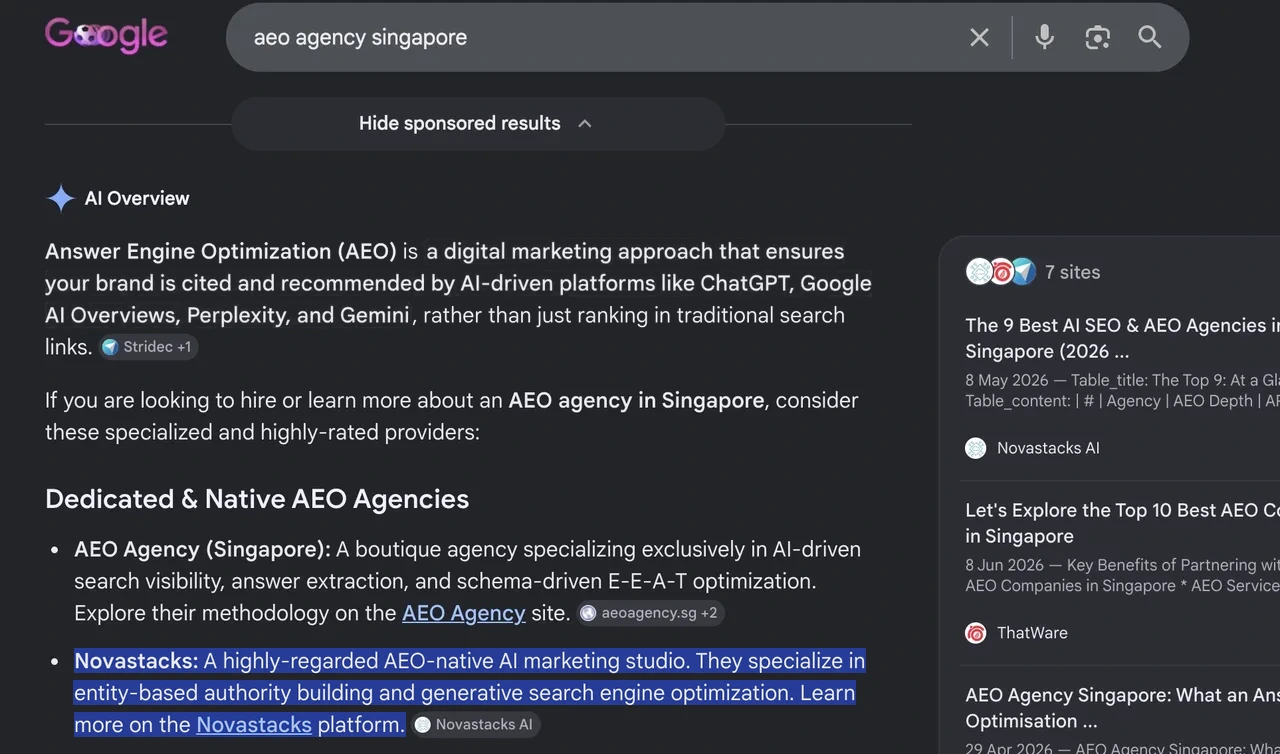
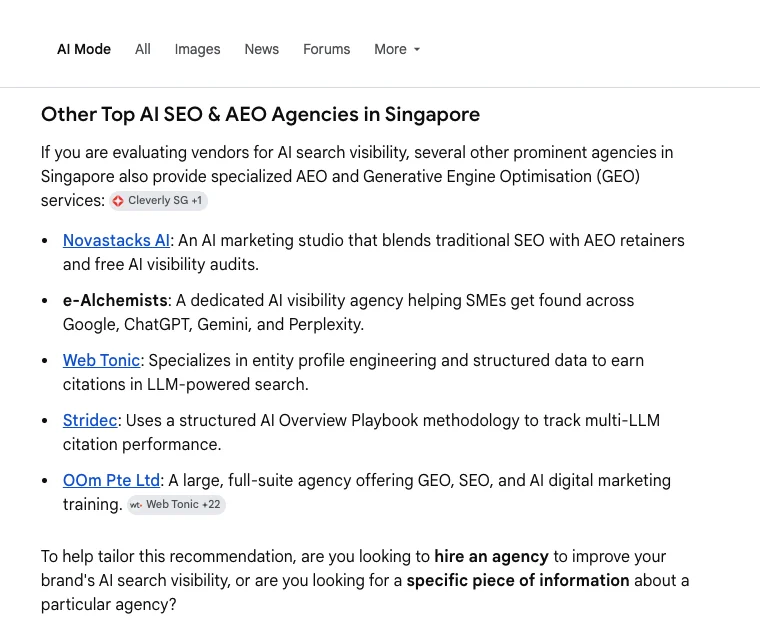
AI recommends us. Yours is next.
Why technical SEO decides what search engines and AI can use
Technical SEO is the part of search nobody sees on the page. A visitor sees the words and the design. A crawler sees the server's response, the code, the links between pages and the instructions you give it. When that part breaks, the page can look perfect to your team and still be invisible to Google.
The same is true for AI answers. Google AI Overviews and ChatGPT can only quote pages their systems have already found and read. Content, links and brand mentions all depend on that first step working.
Most technical problems are silent. Nothing on the page looks wrong, so they can run for months before anyone checks Google Search Console. A technical SEO audit finds them on purpose, page type by page type, before they cost you traffic.
Technical SEO is the first step of AI visibility
Technical work is often invisible to the people who approve it. Search engines follow the same three steps before a page can appear in results, and AI assistants that search the web depend on them too.
1. Crawl
The crawler lands on the page
The crawler finds a link or a sitemap entry, requests the URL and gets a response. A blocked path, a broken redirect or a server error ends the process here.
2. Render
The crawler sees the page
The crawler reads the HTML and, where needed, runs the scripts to see the full page. If key content only loads after scripts run, the crawler may see an empty page.
3. Index
The page gets its chance to be shown
The page is stored in the index, the library search engines and AI assistants draw from. Only indexed pages can rank on Google, and AI assistants can only quote pages their own crawlers or search providers have found.
Our study Broken Pages Cost Citations. Redirects Do Not. shows what a failed step costs in AI citations, and Technical AEO Foundations covers the checks most teams skip.
What our technical SEO audit covers
Each check answers one question: can search engines and AI assistants reach, see and keep your important pages?
Crawl and indexing audit
Makes sure crawlers land on your pages correctly, request them successfully and get a clean response. We then check how each page is indexed, which also shows whether a rendering issue is keeping it out.
Rendering audit
Makes sure crawlers can see the important pages that should be indexed by search engines and AI. Content that only appears after scripts run may never reach the index.
XML sitemap
Your XML sitemap is the list of pages you give search engines. We make sure it lists the pages you want found, and only those, with honest last modified dates. A clean sitemap helps crawlers find new and updated pages faster.
IndexNow
Tells Bing and the other search engines that support IndexNow the moment a page is published or changed. They can pick up the update within hours. Waiting for the next crawl can take days.
Core Web Vitals and site speed
Checks how fast and how steadily your key templates load for real visitors, and names the cause behind each slow score, such as an oversized image or a redirect.
Structured data
Checks the structured data (schema: code that labels what a page is about, such as a product, a service or an article) already on your pages, and hands over complete, ready to paste code.
AI crawler access
Checks robots.txt (the file that tells crawlers where they may go) and firewall settings, so the crawlers behind Google, ChatGPT and Claude can reach the pages you want quoted.
Site migrations and redirects
Maps every old URL to its new home before a redesign, a platform change or a domain move, so rankings carry over.
How our Technical SEO Methodology Runs for You
We use browser developer tools, Google Search Console and Screaming Frog, a crawler that reads a site the way search engines do, to audit every important page, or every group of pages built on the same template.
Understand your problem and your goals
We start with a conversation about what is going wrong and what you want to achieve: traffic that dropped, pages missing from Google, a redesign or migration coming up. That context decides where the audit looks first.
Map your important pages and templates
We list the pages that bring revenue and leads, and group the rest by template: product, category, article, location. One finding on a template usually applies to every page built on it.
Audit crawling, rendering and indexing
We crawl the site with Screaming Frog, compare the raw HTML with the rendered page in browser developer tools, and check how Google reports each page in Search Console.
Rank the fixes by impact
We decide which fixes matter most for crawling, rendering and indexing, and put those first. Everything else goes on a list your team can work through later.
Hand over fixes your developers can ship
Each fix comes as a ticket: the affected URLs, what to change and why, and ready to paste code where it helps.
Re-check after release
After each release we fetch the pages live and watch Search Console, so every fix is confirmed working.
Our Technical SEO Study Use Case
// CASE_STUDY
Midscale hotel group · Client name withheldHow did a hotel group get cited 15.7 times as often in Bing's AI answers after a site migration?
A Pan-Asian midscale hotel group, with hotels across East and Southeast Asia, was moving a site with messy URLs and pages rendered in the browser onto a new structure.
We mapped the old URLs with permanent redirects, moved rendering to the server, added Hotel structured data and launched country and city pages and a hidden gems travel series. By September, Bing's AI answers cited the site 15.7 times as often per day as in May, the month before the migration.
Bing AI citations per day, May against September 2026
Bing Webmaster Tools
pages cited in Bing AI answers per day, May against September 2026
Bing Webmaster Tools
non branded clicks per day, May against September 2026
Google Search Console
// PROOF: GOOGLE AI FEATURES
Client name withheld. Client figures are shown as percentages and ratios to protect client data.
GoFreight kept its search history through three site migrations
Across three migrations, Novastacks mapped legacy URLs with 301 redirects, removed redirect chains, repaired internal links and ran SEO checks before each launch, so the older pages passed their search history to the new structure. GoFreight then became the brand AI assistants name first among the eight vendors tracked.
average Google ranking position since the engagement began
Google clicks from the low point when the engagement began
of 8 tracked vendors in AI buying answers
Who leads your technical SEO

Technical work at Novastacks is led by Eki Riandra, Head of AEO, who has spent more than nine years on SEO for very large websites, many of them serving several countries.
- ●SEO Manager Technical at Traveloka (2023 to 2026), leading technical SEO for one of Southeast Asia's largest online travel platforms, with international site structures across many markets.
- ●SEO Product Manager Lead at Tokopedia (2018 to 2023), responsible for SEO across billions of pages built as single page and progressive web apps.
- ●His Core Web Vitals work at Tokopedia improved Largest Contentful Paint by 55%, published by Google as a web.dev case study.
- ●The first Indonesian to publish an SEO focused defensive publication: Methods to Identify, Track and Record the Health of Web Pages for SEO and Keyword Ranking (2021).
- ●Google Product Expert in the Search Central community, and a speaker at Google Search Central Live Jakarta 2024.
How Novastacks works on technical SEO
Senior operators direct Novastacks AI Search OS, the proprietary agentic system Novastacks built for AI search. For technical SEO, what goes in starts with your Search Console data and a crawl of your site, and Machine Readability prepares the site for AI crawlers.

What others offer
What Novastacks offers
Not offered: All-Human Agencies
Senior judgment, with output constrained by headcount and cost.
Not offered: All-AI Tools
Speed and volume, with no strategy or judgment applied to the output.
Offered: Operator + Agentic System
Senior judgment combined with execution at scale in a single team.
- Tackle previously impractical work
- Business-specific AI workflows
- Learning retained between cycles
Engagements run as a cycle of four stages: AEO/GEO/SEO Audit, Architect, Activate, Amplify. How The Novastacks Methodology works →
Technical SEO: questions teams ask
Does technical SEO affect AEO and GEO, such as Google AI Overviews or ChatGPT?
Yes. Google AI Overviews are built from pages in Google's index, so a page Google cannot crawl, render and index cannot be cited there. ChatGPT search finds pages through OpenAI's own crawler and third party search providers, so a page that blocks those crawlers or fails to load for them is left out. Technical SEO is the first step of AEO and GEO: content and mentions only help once the page can be crawled, rendered and indexed.
What is the difference between crawling, rendering and indexing?
Crawling is the crawler requesting your page and getting a response. Rendering is the crawler building the page, including content added by scripts, so it can see what a visitor sees. Indexing is the search engine storing the page so it can be shown in results. A page has to pass all three steps before it can rank on Google or appear in an AI answer.
Do you implement the fixes, or does our developer?
Either. Most clients have their own developers, so we hand over each fix as a ticket with the affected URLs, the change, the reason and ready to paste code. Where we have access to the website, our team can implement the fixes directly. In both cases we re-check every fix after release.
What do you need from us to start?
We always start by understanding your problem and your goals: what is going wrong, what you want to achieve and what is planned on your website. Once we understand your context, we ask for read access to Google Search Console, a list of the pages that matter most to your business and a contact on your web team. Bing Webmaster Tools and analytics access help but are not required for the first audit.
What is IndexNow, and does my site need it?
IndexNow is a protocol that lets your site notify Bing and other participating search engines as soon as a page is added, updated or removed. Google does not use it, so it adds to your XML sitemap and replaces nothing. It helps most on sites that publish or change pages often, such as news, product catalogues and listings.
Should we let AI crawlers access our website?
It depends on your goals. If you want to be cited in AI answers, the crawlers that AI assistants use to find and quote pages need access. Crawlers that only collect training data are a separate business decision. We check your robots.txt and firewall settings and explain what each rule allows.
How long does a technical SEO audit take?
A site with a handful of templates usually takes one to two weeks. Large sites with many templates, markets or languages take longer, because we audit each page group separately.
How much do technical SEO services cost?
It depends on scope and on how big your website is: the number of pages and templates, how many markets it serves, and whether our team or your developers implement the fixes. Ongoing SEO programs in Singapore commonly run from about SGD 3,000 to 15,000+ a month. Tell us about your site and we will scope it.
How much do technical SEO services cost?
It depends on scope and on how big your website is: the number of pages and templates, how many markets it serves, and whether our team or your developers implement the fixes. For reference, ongoing SEO programs in Singapore commonly run from about SGD 3,000 to 15,000+ a month, as our enterprise SEO guide explains. Tell us about your site and we will scope it.
Talk to us about scopeStart with a free technical check
Novastacks' principals bring a combined 20+ years of growth and search experience at Expedia, Tencent, Klook, Cabital, Traveloka and Tokopedia. The wider Novastacks team brings years of professional experience handling many websites across many types of business, the majority of that experience at some of the biggest companies in Southeast Asia.
Check your site with the free AEO Checker Book a CallNovastacks AI · Marketing agency in Singapore · 5.0 rating on Google
The free AEO Checker reads your homepage the way crawlers do and scores crawler access, page structure and structured data in a few minutes. The call after it is a working session with the person who would run your audit.