How Much Does SEO, AEO and GEO Cost in Singapore?
Ask three Singapore agencies what answer engine optimisation costs and you will get three answers an order of magnitude apart. None of them is necessarily lying. Here is what sits behind the spread, and how to work out what your own number should be.
Key takeaways
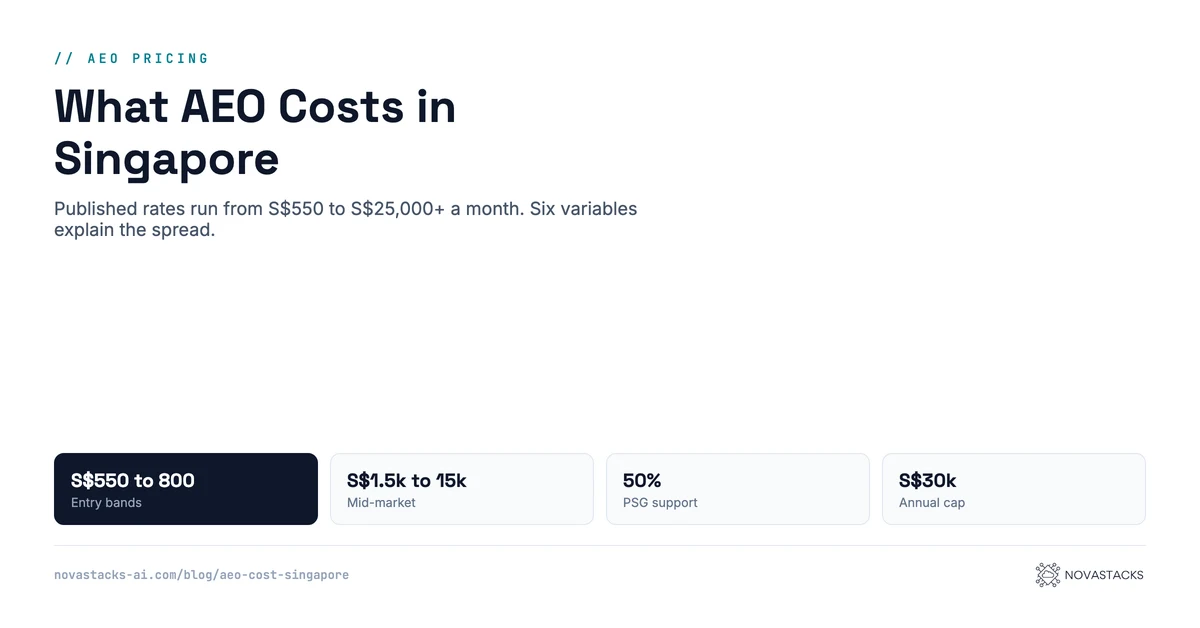
- The published range is enormous: S$550 to over S$25,000 a month, and S$3,000 to S$60,000 for one-off projects. What that money buys depends on the delivery model rather than on the number itself.
- Scope explains the spread, not greed: six variables decide where in that range you land, and the entry tiers differ eightfold because they describe different work.
- Only one grant applies: PSG covers up to 50% against a S$30,000 cap. EDG names SEO as an ineligible cost, and MRA funds overseas expansion only. Budget as if PSG is the only lever.
- You are buying an asset, not a subscription: crawling, rendering and indexing have to work before authority can accumulate, and published break-even sits between five and fourteen months.
- Cheap is not the risk, vague is: a quote with no baseline measurement is the one to walk away from.
- Start with the measurement: a free audit tells you the size of the problem before anyone quotes a number.
SEO, AEO and GEO work in Singapore is published at between S$550 and over S$25,000 a month, with one-off projects running from S$3,000 to S$60,000. The two agencies in this market that publish rates put their entry tiers at S$550 to S$800 and at S$4,000 to S$7,000, roughly an eightfold gap for what is nominally the same service. The reason is scope rather than quality: they are describing genuinely different work under the same word. This page shows what sits inside each band, what moves your own number, and which of the government grants you have been told about actually apply.
Why Nobody Can Quote You Over Email
You have probably had this experience already. You email three agencies asking what SEO and AEO cost. One replies with a package at a few hundred dollars a month, one says it starts at five thousand, and one says they need a call first. The instinct is to assume the expensive one is padding and the cheap one is cutting corners.
Usually neither is true. Pricing for this work is unusually sensitive to the condition of your site, because a meaningful share of the work is repair rather than production. Two companies asking for the same outcome can need completely different amounts of labour to get there: one has content sitting in clean HTML with schema already in place, the other has a JavaScript application that AI crawlers receive as a blank page. The second company is not paying a premium for identical work; the scope in front of it is simply larger.
That is also why the honest agencies push for a call. It is not a sales tactic in every case; it is that the quote depends on facts that are not visible from your homepage.
Four Ways This Gets Delivered, and What Each One Costs You
A monthly number tells you very little on its own, because the same figure buys wildly different work depending on who is behind it. There are four delivery models in this market. Comparing them is more useful than comparing quotes, because the model is what determines whether the money turns into anything. The table below describes how each type of provider typically operates, not any particular company.
| Novastacks | Tooling-led platform | Generalist digital agency | Solo consultant | |
|---|---|---|---|---|
| First audit and consultation | Free AI visibility audit, plus a free 30 minute consultation to read the results together. You keep the audit either way. Run the free AEO audit | Free automated scan, no conversation attached. Whether it is useful depends on you being able to interpret it. | Typically a paid discovery or scoping phase before any recommendation is made. | Varies by individual. Often a paid audit is the first billable engagement. |
| Who actually does the work | Senior practitioners only. The founder has 20+ years across Expedia, Tencent, Klook and Traveloka, including VP of Acquisition Marketing at Traveloka leading a 100 person growth organisation. Delivery is led by a Google Product Expert in the Search Central community whose Core Web Vitals work is a published Google case study. | Software, with a support desk for questions. No practitioner is assigned to your account. | Senior people appear in the pitch. Day to day execution usually sits with junior executives. | One person, often genuinely expert in their specialism, with no bench for the parts outside it. |
| How the work gets done | Twelve specialised AI agents, ten plus custom skills and connected data pipelines, orchestrated by the senior team. Research feeds content, content feeds SEO, SEO feeds AEO, and analytics closes the loop. | One fixed product workflow, identical for every customer regardless of what the site needs. | Manual execution, bounded by the number of retainer hours you bought. | Manual execution, bounded by one person's calendar. |
| What is in scope | SEO, AEO and GEO run as one programme, because the same pages have to rank in search, be quotable by answer engines and be retrievable by generative ones. | Usually a single score against one engine's checklist. | SEO as the core service, with AEO added later as a separate line item. | Whatever that practitioner specialises in, which is rarely all three. |
| What the method rests on | Technical diagnosis plus topical mapping built from your business, your audience, your ICP and your actual sales call transcripts, tested against our own published studies. | The vendor's scoring rubric, which is the same rubric sold to your competitors. | A general playbook applied across a client roster. | That individual's personal experience. |
The row that decides most engagements is the last one. A scoring rubric and a general playbook both produce recommendations that are correct in the abstract and wrong for your business, because neither has looked at who your buyers are or what they say on a sales call. That is the part that cannot be automated, and it is the part that determines whether the content you pay for gets quoted by anything.
The Six Things That Change Your Quote
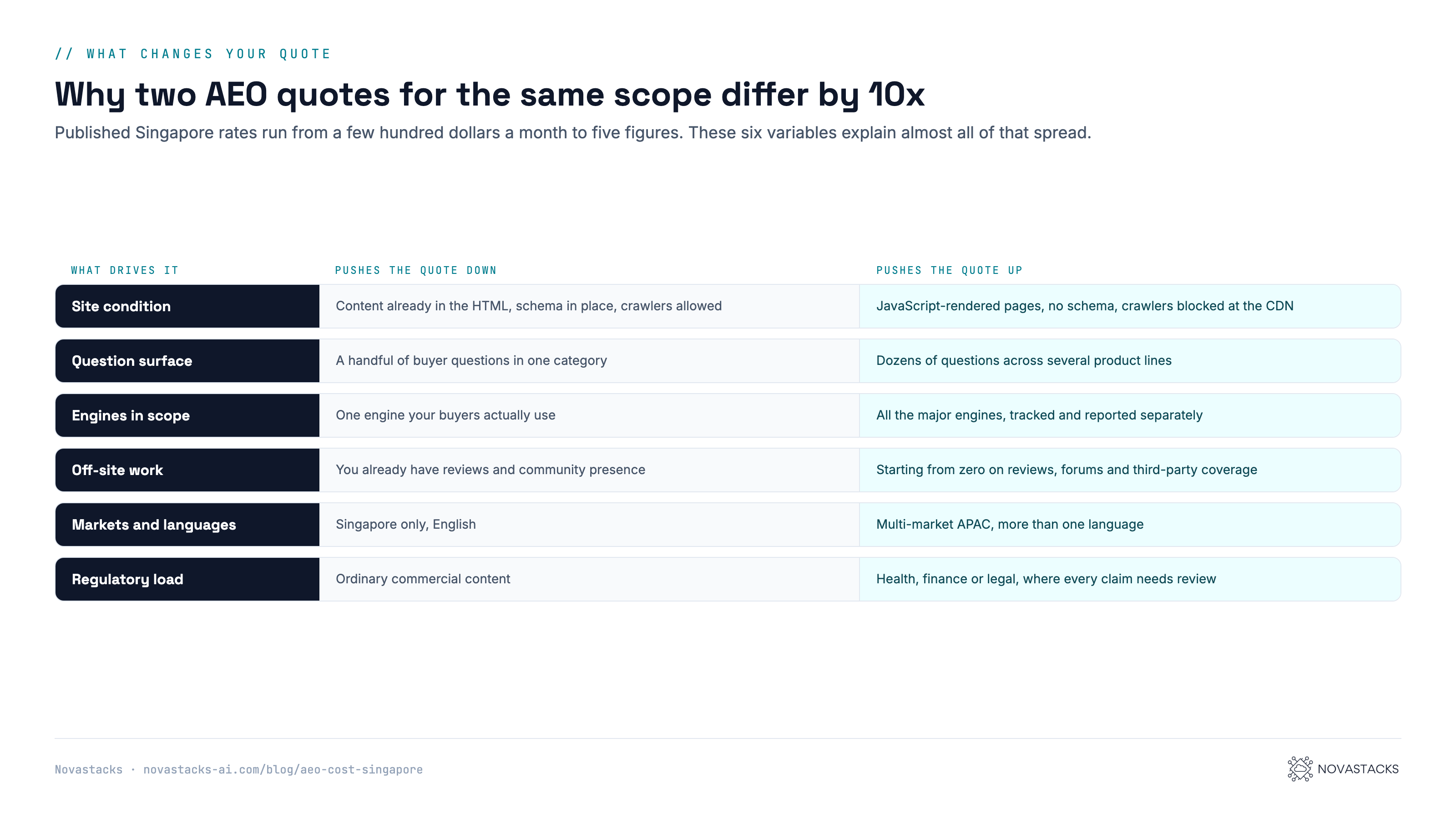
When we scope an engagement, these are the variables that actually move the number. They are worth knowing before you take any agency call, because they let you predict roughly where you will land.
1. The condition of your site
The single largest swing factor. If your pages only assemble in the browser, AI crawlers receive an empty shell, and no amount of writing fixes that. Repairing rendering, crawler access and schema is engineering work that has to happen before content work has any effect. A site already in good technical shape can skip most of it.
2. How many questions you need to own
AEO is priced closer to content production than to traditional SEO retainers, because engines break each buyer prompt into sub-questions and reward pages that answer one of them completely. A company with one product and six real buyer questions needs a fraction of the output of a company with four product lines and forty.
3. How many engines are in scope
Visibility does not transfer between engines. Our own 500-query study found 94.2% of cited pages appeared in exactly one engine, and none appeared in all three. Tracking and optimising for three engines is close to three separate measurement jobs, which is real recurring cost. The upside is that most businesses do not need all of them, and a good agency will tell you which ones your buyers actually use.
4. How much off-site work is needed
Roughly 85% of what AI says about a brand comes from sources you do not own: reviews, forums, third-party coverage. If you already have a healthy review profile and people discussing you, that work is maintenance. If you are starting from nothing, it is a programme, and it is the slowest and most expensive part of AEO.
5. Markets and languages
Singapore-only English is the cheapest configuration. Add Malaysia, Indonesia or a second language and you multiply the question set, the measurement and the content.
6. Regulatory load
Health, finance and legal content carries review overhead on every claim. In Singapore that is not optional: clinics operate under MOH and SMC advertising rules, and finance under MAS guidance. Expect a premium, and be suspicious of any agency in those sectors that does not raise compliance before you do.
Why This Is an Asset You Build, Not a Fee You Pay
The question underneath "how much does it cost" is almost always "when can I stop paying". It is a fair question and it deserves a straight answer: this behaves much more like construction than like a subscription. A monthly figure looks like software rental on an invoice, but what it buys is a compounding asset, and the compounding does not begin on day one.
Three things have to be true before any of the money does anything, and they happen in strict order. The engines have to be able to fetch your pages. They have to be able to read those pages once fetched, which is where a great many Singapore sites quietly fail, because a site assembled in the visitor's browser reaches most AI crawlers as an empty shell. Then the pages have to be kept and indexed. Nothing downstream, no ranking, no citation, no recommendation, works until all three are true, and the crawling, rendering and indexing layer is where a competent first engagement spends its early weeks. This is also why a quote given before anyone has looked at your site is a guess.
After that comes the slow part, and it is slow for a structural reason. Authority is other people's behaviour, not your own. It accumulates when other sites, forums, reviews and write-ups point at you, and when the engines have seen you answer the same question consistently enough to treat you as the source for it. There is no version of that which completes inside a month, and any pitch implying otherwise is selling you the wrong thing. What you should be measuring at month three is not revenue, it is whether the technical floor is fixed and whether the first pages have started being quoted.
The right question is therefore not "when can I stop" but "what do I own at month twelve that I did not own at month zero". A page that has earned citations keeps earning them without further spend. A technical foundation, once fixed, stays fixed. That is the case for treating this as capital expenditure with a maintenance line, rather than as a monthly cost centre to be trimmed the first quarter things get tight, which is the single most common way Singapore companies waste the money they have already spent on it.
What the ROI Numbers Actually Say
Cost pages tend to close with a large return figure, and the same handful of numbers circulate across the Singapore market. They are worth looking at properly, because the most quoted version of them is not what the source says.
The most cited dataset is First Page Sage's SEO ROI report, drawn from their own campaigns between Q1 2021 and Q3 2025. It does not publish a single median return. It publishes a range across nineteen industries, from 317% for ecommerce to 1,389% for real estate, with most sectors clustering between 600% and 900%. On payback it gives five months for construction at the fast end and fourteen months for legal services at the slow end, and by service type it separates technical SEO at roughly six months from basic content marketing at roughly fifteen. A widely repeated comparison of cost per lead against paid search does not appear in that report at all.
Two caveats matter more than the numbers. The campaigns behind them are built on a baseline of around US$120,000 a year, which is well above what most Singapore SMEs are considering when they land on a page like this, and the sample is the agency's own client base rather than an independent study. Treat the figures as evidence that the channel can return well, and as a guide to how payback varies by sector and by type of work. Do not put them in a board deck as your forecast.
The number that should drive your decision is your own. Take your average deal value and your close rate from qualified enquiries, and work out how many additional enquiries a month would cover the monthly figure you have been quoted. For most B2B businesses in Singapore that number turns out to be small enough to be uncomfortable, because it forces the real question, which is not whether the return exists but whether this particular provider can produce the enquiries.
Which Singapore Grants Actually Cover This
This is where cost pages get careless, and it is expensive carelessness because a buyer who budgets around a grant that does not apply has mispriced the whole project. Three schemes come up in conversation. Only one of them can fund this work.
PSG: yes, within limits
For qualifying Singapore SMEs the Productivity Solutions Grant covers up to 50% of eligible costs, against a cap of S$30,000 per company across all Enterprise Singapore supported solutions. Two practical notes that vendor pages tend to skip. The cap is per company rather than per solution, so if you have already claimed against it for another digital project this financial year, less is available to you. And both the vendor and the solution have to be pre-approved, which narrows your choice of provider before price enters the conversation. The full eligibility logic, timelines and claim process are in our PSG grant guide for SEO and AEO.
EDG: no, and it says so explicitly
The Enterprise Development Grant is regularly listed on Singapore agency pricing pages as a way to fund SEO. It is not. EDG names among its ineligible costs the "implementation of marketing or PR campaigns, including retainer fees of consultants, advertising and media buys", and names "Search Engine Optimisation (SEO), and Search Engine Marketing (SEM)" directly. EDG funds capability building projects, so consultancy to develop a brand or market strategy can qualify. The execution of that strategy, and any ongoing retainer, cannot. If a proposal tells you EDG will cover your monthly fee, that is a reason to check what else in the proposal has not been verified.
MRA: only if you are leaving Singapore
The Market Readiness Assistance grant supports up to 70% of eligible costs for local SMEs from 1 April 2026, capped at S$100,000 per company per new market, split across overseas market promotion at S$20,000, overseas business development at S$50,000 and overseas market set-up at S$30,000. The 70% figure is real and it is generous, which is why it gets quoted. What gets left out is that every eligible category is an overseas one. MRA exists to defray the cost of entering a market that is not Singapore. If you are running search work to open Malaysia, Indonesia or the Gulf, the overseas portion may qualify. It cannot fund optimisation aimed at Singapore buyers.
What You Should Be Paying For
Price is the wrong first question. The better one is what arrives each month. These are the line items worth paying for, and the ones that quietly are not.
Worth paying for
- A measured baseline before anything else. Your real buyer questions, run across the engines, recorded as recommended, mentioned, cited or absent. Without this nobody can prove improvement later, including you.
- Technical repair with evidence. Rendering, crawler access and schema, with before and after proof from server logs rather than a screenshot of a validator.
- Content that owns a question. Pages built against specific buyer questions, not a monthly quota of blog posts.
- Off-site work with named targets. Which review platforms, which communities, which publications, and what "done" looks like.
- Per-engine reporting. Because a single blended "AI visibility score" hides the only thing that matters, which engine changed.
Not worth paying for
- Keyword rankings relabelled as AI visibility. Related, but not the same measurement, and easy to pass off as one.
- FAQ schema as the headline deliverable. Useful structure, but our research found FAQ markup separates almost nothing between cited and uncited pages.
- Guaranteed placement in AI answers. Nobody controls the output. A guarantee is a sign the agency either misunderstands the channel or expects you not to check.
- A monthly report that only goes up. Real AEO reporting includes the questions you are still losing.
How We Price It
We do not publish a rate card, and it is worth being direct about why. Every site arrives in a different condition, and the largest cost driver is the one we cannot see from outside: whether the engines can read your pages at all. A number quoted before that is known is not a price, it is a guess that one of us will end up absorbing.
So the sequence we use is deliberately backwards from a typical sales process. First we measure, then we scope, then we quote. The measurement is free and you keep it either way.
If you would rather do the first pass yourself, everything needed is in this article and in our guide to measuring AEO. The point of the audit is speed, not secrecy.
Frequently Asked Questions
How much does SEO cost in Singapore?
The two Singapore agencies that publish rates show S$550 to S$800 a month at the entry tier on one side and S$4,000 to S$7,000 on the other, rising above S$25,000 for enterprise scope, with one-off projects between S$3,000 and S$60,000. Those entry tiers differ eightfold because they describe different work rather than different quality: the lower band buys a technical audit, basic schema and light on-page fixes, while the higher band assumes an ongoing content programme, off-site authority work and per-engine measurement. Compare what is produced each month, not the number at the bottom of the quote.
How much does AEO cost in Singapore?
Published rates from Singapore agencies range from S$550 to over S$25,000 per month, with one-off project work between S$3,000 and S$60,000. The spread is explained by scope rather than quality: the lower bands typically cover a technical audit, basic schema and light on-page fixes, while the higher bands assume an ongoing content programme, off-site authority work and per-engine measurement. Where you land depends mostly on the condition of your site, how many buyer questions you need to own, and how many engines are in scope.
Why will agencies not give a price without a call?
Because the largest cost driver is invisible from outside: whether AI crawlers can read your pages at all. A site whose content only appears after JavaScript runs needs engineering repair before any content work has an effect, and that can double the first phase of a project. An agency quoting before it knows this is either padding for the worst case or will discover the problem later and ask for more.
Can the PSG grant be used for SEO or AEO work?
For qualifying Singapore SMEs, PSG covers up to 50% of eligible costs against an annual cap of S$30,000 per company across all Enterprise Singapore supported solutions, on a financial year from 1 April to 31 March. Both the vendor and the solution must be pre-approved, and the cap is shared with any other supported digital projects you claim for in the same year.
Does the EDG grant cover SEO?
No. Enterprise Singapore lists 'Search Engine Optimisation (SEO), and Search Engine Marketing (SEM)' among the Enterprise Development Grant's ineligible costs, alongside the implementation of marketing campaigns and consultant retainer fees. EDG funds capability building projects, so consultancy to develop a brand or market strategy can qualify, but executing that strategy and paying an ongoing retainer cannot. A pricing page telling you EDG will cover your monthly SEO fee has not checked the scheme's own conditions.
Does the MRA grant cover SEO in Singapore?
Not for Singapore buyers. The Market Readiness Assistance grant supports up to 70% of eligible costs for local SMEs from 1 April 2026, capped at S$100,000 per company per new market, but every eligible category is an overseas activity: overseas market promotion, overseas business development and overseas market set-up. If you are running search work to enter Malaysia, Indonesia or another new market, the overseas portion may qualify. Optimisation aimed at Singapore buyers does not.
How long before SEO and AEO pay for themselves?
Published payback data from First Page Sage puts it between five months for construction and fourteen months for legal services, and separates technical SEO at roughly six months from basic content marketing at roughly fifteen. Those are the firm's own US campaigns on a baseline of around US$120,000 a year, so treat them as a guide to how payback varies by sector and by type of work rather than as a forecast. The structural reason for the lag is that crawling, rendering and indexing have to work before authority can accumulate, and authority is other people's behaviour rather than your own.
Is cheap SEO worth it?
It depends entirely on what is in it. A S$600 monthly engagement that delivers a technical audit, schema and crawler access is genuinely useful if those are your gaps, and it may be all a small site needs. The same price attached to a vague promise of AI visibility, with no baseline measurement, is not cheap work but unmeasurable work. The thing to check is whether the first deliverable is a baseline you could re-run yourself.
What should be in an SEO or AEO proposal?
A measured baseline of your buyer questions across the engines, technical repair with before and after evidence, content built against specific questions rather than a post quota, off-site work with named platforms and targets, and reporting split by engine. If a proposal leads with FAQ schema or guarantees placement in AI answers, treat both as warning signs.
Does Novastacks publish its prices?
No, and deliberately. Every site arrives in a different condition and the biggest variable is one that cannot be seen from the outside, so a published number would be a guess. We measure first with a free AI visibility audit, then scope, then quote. The audit and a 30 minute consultation are free, and if the honest answer is that you do not need an agency yet, we say so.
Sources
- AI Studio, AEO Pricing Singapore: What It Costs (2026), published monthly bands of S$550 to S$800, S$1,500 to S$2,500 and S$5,000 to S$25,000+, plus one-off foundation projects at S$3,000 to S$10,000
- Stridec, AEO Agency Singapore, published monthly bands of S$4,000 to S$7,000, S$7,000 to S$15,000 and S$15,000+, plus project engagements at S$15,000 to S$60,000
- Enterprise Singapore, Productivity Solutions Grant, up to 50% support for eligible SMEs against a S$30,000 annual company cap
- Novastacks AEO Study, 500 queries across five intent types, 6,083 unique AI-cited URLs, collected April 2026
- Enterprise Singapore, Productivity Solutions Grant, up to 50% of eligible costs for local SMEs against a S$30,000 cap, pre-approved vendors and solutions required.
- Enterprise Singapore, Enterprise Development Grant, ineligible costs include marketing and PR campaign implementation, consultant retainer fees, and Search Engine Optimisation (SEO) and Search Engine Marketing (SEM).
- Enterprise Singapore, Market Readiness Assistance grant, up to 70% for local SMEs from 1 April 2026, capped at S$100,000 per company per new market; all eligible categories are overseas activities.
- First Page Sage, SEO ROI Statistics (published 25 September 2025), returns of 317% to 1,389% across nineteen industries, payback of five to fourteen months, drawn from the firm's own campaigns Q1 2021 to Q3 2025 on a baseline of around US$120,000 a year.
Find Out What Your Situation Actually Requires
The free audit shows which engines name you today and what is blocking the rest. It takes minutes and there is no obligation attached to it.