International & Multilingual SEO Services in Singapore
Your site serves Singapore, Malaysia and Hong Kong, but Google keeps showing the Singapore page everywhere. The Chinese pages exist, yet nobody finds them. A new market launched months ago and still brings almost no traffic. Novastacks fixes the structure and the signals, such as hreflang (the tags that tell Google which page is for which country and language), that tell search engines and AI assistants which page belongs to which market and language, then builds content for the way people in each market search.
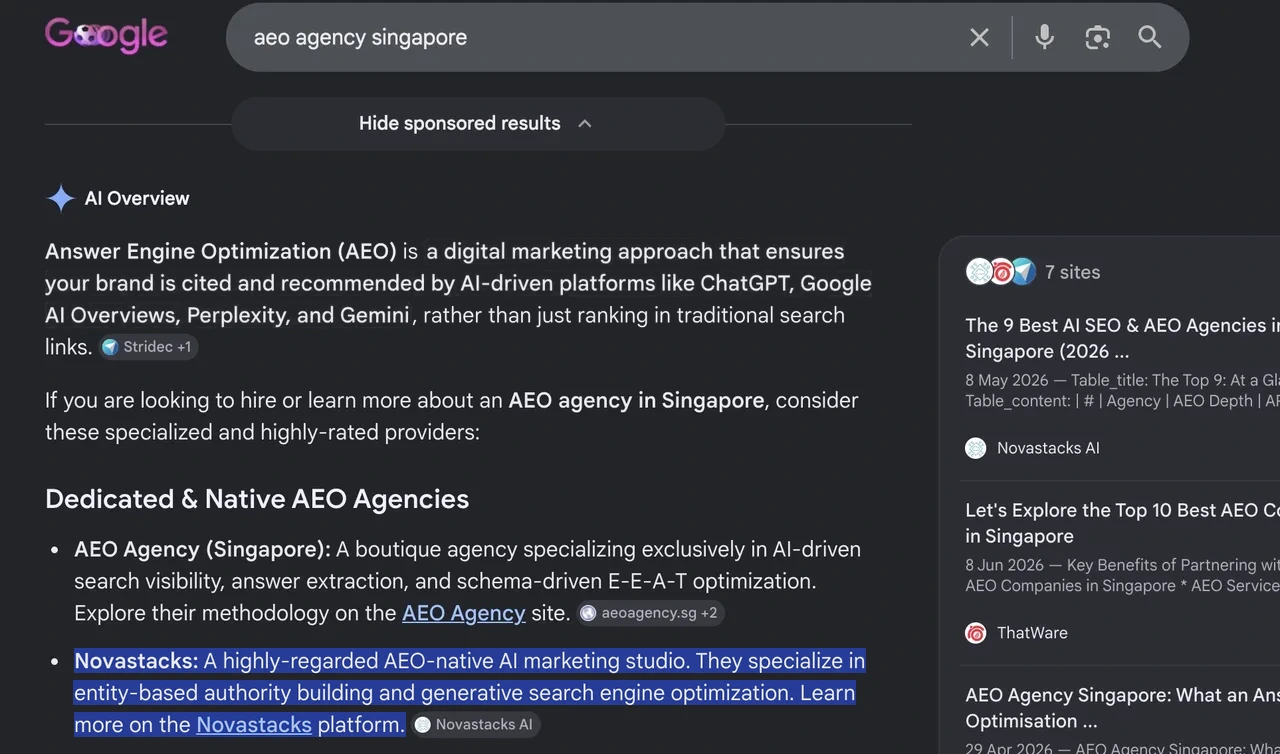
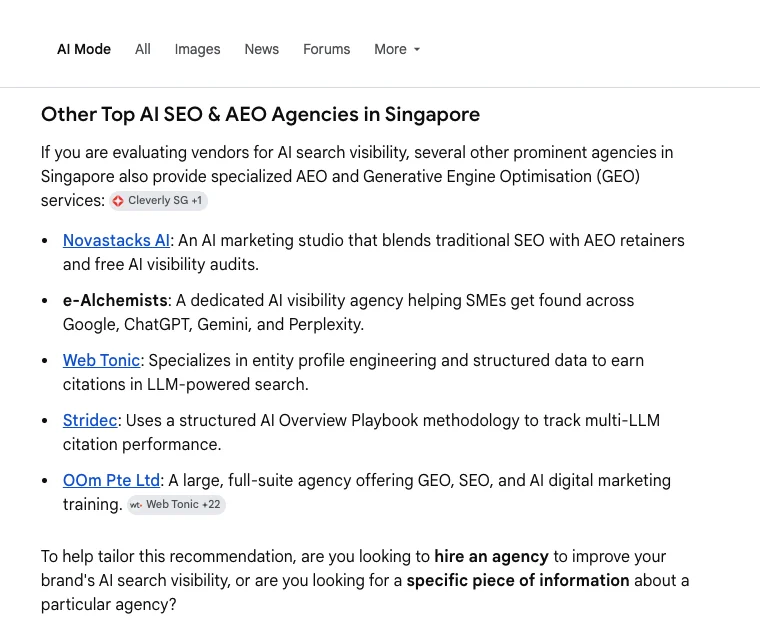
AI recommends us. Yours is next.
Why international sites lose search visibility
A site that serves several markets has to answer a question for every search: which version of this page should this person see? Search engines answer it from signals you set, such as hreflang tags, the language of each page, the site structure and the way your servers respond. When those signals are missing or contradict each other, the engine guesses, and it often guesses wrong.
Most of these problems are technical and silent. Hreflang tags that point to redirected pages, return tags that are missing, automatic redirects that send crawlers to a single country, translated pages that keep English titles. Each one sends people to the wrong page or hides a market's pages from the index.
AI assistants add another complication. They answer the same question differently in each country and language, so a brand can be recommended in Singapore and missing in Malaysia. Each market needs its own check.
AI assistants answer differently in every market
Novastacks AI Search OS is configured per market and per language. Each market gets its own buyer question set and its own measurement.
1. Language
Buyers ask in their own language
A buyer in Jakarta asks in Bahasa Indonesia, and a buyer in Taipei asks in Traditional Chinese. We track the questions in the language each market actually uses.
2. Sources
Each market trusts different sources
AI assistants draw on local publications, directories and review sites. A brand needs credible mentions in the sources each market relies on.
3. Measurement
Visibility is measured per market
We record which brands AI assistants name for each market's buyer questions, so a gap in one country never hides behind a win in another.
What our international SEO service covers
We start with how your website is built for each market, then work on what each market's audience needs to find.
Website structure review
Reviews how markets and languages are organised (subfolders, subdomains or country domains), so each market has a clear home that search engines can tell apart.
hreflang and x-default audit
Checks that every language and country version points to the others correctly. Each page must link back to the pages that link to it (return tags), and an x-default tag names the page for everyone else. Google then shows each searcher the version meant for them.
Crawler and visitor routing
Checks automatic redirects by location or language, and how your servers respond. Crawlers and visitors then reach the right market page, and no market is hidden from crawlers.
Market keyword research
Researches demand in each market's own language and wording, including the local terms people use to search, buy and pay.
Localised content and metadata
Makes sure titles, descriptions and page content are written for each market, beyond a translation of the English page.
New market launches
Plans the structure, pages and measurement for a market you are entering, so it starts indexed and tracked from day one.
Measurement per market
Reports Search Console performance and AI answer visibility separately for each market and language, so you see where each one stands.
How our International SEO Methodology Runs for You
Every international site is set up differently, so we always start by understanding your goals and your site before recommending a change.
Understand your problem and your goals
We start with a conversation about the markets you serve or plan to enter, what is not working today and what each market needs to deliver for your business.
Understand the website structure
We map how markets and languages are organised today, how hreflang and redirects are set, and how Google indexes each version.
Understand each market's audience
We review search demand, competitors and buyer questions in each market's language, and how well your content serves them.
Fix the signals first
We correct the structure, hreflang, language tags and routing so search engines can tell each market's pages apart.
Build and localise content per market
We plan and write pages for each market's demand, using local terms, currencies and payment methods.
Measure each market separately
We report Search Console and AI answer visibility per market and language, and set each market's next priorities from that data.
Our International SEO Study Use Case
// CASE_STUDY
Game top up marketplace · Client name withheldHow did a marketplace grow its home market and open a new one at the same time?
One of Indonesia's largest game top up marketplaces also serves the Philippines and Malaysia. Indonesia needed more of the searches made by people who do not yet know the brand. The Philippines, a newer market, needed early rankings turned into real traffic.
We ran one catalogue and one measurement system across all three markets, then set different priorities for each. Every product title in the newer markets now uses that market's own buying verb and payment terms. From May to August, non branded clicks grew 153% in Indonesia and 194% in the Philippines.
non branded clicks in Indonesia, the home market, May to August 2026
Google Search Console
non branded clicks in the Philippines, the newer market, May to August 2026
Google Search Console
clicks on retitled Philippine product pages, 17 days after the change against 17 days before
Google Search Console
// PROOF: NON BRANDED CLICKS BY MARKET
Client name withheld. Client figures are shown as percentages and ratios to protect client data.
A hotel group serving markets across East and Southeast Asia moved to a new site structure
Novastacks mapped the old URLs with permanent redirects, moved rendering to the server, added Hotel structured data and launched country and city pages for the group's markets. Client name withheld; client figures are shown as percentages and ratios.
Bing AI citations per day, May against September 2026
non branded clicks per day, May against September 2026
impressions per day in Google's generative AI features
Who leads your international SEO

International work at Novastacks is led by Eki Riandra, Head of AEO, who managed SEO for some of Southeast Asia's largest websites serving many countries and languages.
- ●SEO Manager Technical at Traveloka (2023 to 2026), leading technical SEO for one of Southeast Asia's largest online travel platforms, with international site structures across many markets.
- ●SEO Product Manager Lead at Tokopedia (2018 to 2023), responsible for SEO across billions of pages built as single page and progressive web apps.
- ●His Core Web Vitals work at Tokopedia improved Largest Contentful Paint by 55%, published by Google as a web.dev case study.
How Novastacks works on international SEO
Senior operators direct Novastacks AI Search OS, the proprietary agentic system Novastacks built for AI search. For an international site, what goes in starts with search demand and competitor pages in each market, and Prompt Radar Pro selects the buyer questions to track in each market's language.

What others offer
What Novastacks offers
Not offered: All-Human Agencies
Senior judgment, with output constrained by headcount and cost.
Not offered: All-AI Tools
Speed and volume, with no strategy or judgment applied to the output.
Offered: Operator + Agentic System
Senior judgment combined with execution at scale in a single team.
- Tackle previously impractical work
- Business-specific AI workflows
- Learning retained between cycles
Engagements run as a cycle of four stages: AEO/GEO/SEO Audit, Architect, Activate, Amplify. How The Novastacks Methodology works →
International and multilingual SEO: questions teams ask
Why does Google show our Singapore page to searchers in Malaysia?
Usually because Google cannot tell the two versions apart. Pages in the same language with nearly the same content look like duplicates unless hreflang tags, a clear structure and local details tell Google which page serves which market. We check those signals page by page and fix the ones that are missing or contradict each other.
Our hreflang tags are in place. Why is the wrong page still ranking?
Hreflang only works when every detail is right. Common problems are missing return tags, invalid language or country codes, tags that point to redirected pages or pages blocked from the index, and tags that disagree with the canonical tag (the tag that names the main version of a page). A missing return tag can make Google ignore the affected pair of pages. We audit the full set across every version.
Should we redirect visitors automatically by country or language?
Automatic redirects often cause more problems than they solve. Google crawls mostly from the United States, so a redirect based on location can hide your other market pages from Google entirely. A suggestion banner that lets visitors choose their market is usually safer. We check how your site handles this before recommending a change.
Subfolders, subdomains or country domains: which is best?
It depends on your business. Each option has trade offs in authority, cost and local trust, and some cases need a different answer from the usual one. Novastacks checks your website, your markets and your team's resources first, then recommends the option that fits.
Should we use Simplified or Traditional Chinese?
It depends on the markets you serve. Mainland China and Singapore mostly read Simplified Chinese, while Taiwan and Hong Kong mostly read Traditional Chinese, and each needs its own hreflang code. We look at your audience and your current pages before recommending a setup.
Do we need hreflang if we only have one English website?
No. Hreflang connects different language or country versions of the same page. With a single English version there is nothing to connect, and adding tags that all point to the same page does nothing. Hreflang becomes useful once you publish separate pages for different markets or languages.
How does Novastacks work on an international or multilingual site?
We start by understanding the website structure: how markets and languages are organised, how hreflang and redirects are set, and how Google indexes each version. Then we look at the content through the eyes of each market's audience, in their own language. Fixes to the structure and signals come first, followed by content and measurement for each market.
What do you need from us to start?
We always start by understanding your problem and your goals: the markets you serve or plan to enter and what each one needs to deliver. Once we understand your context, we ask for read access to Google Search Console for each market's version of the site, the list of markets and languages in scope and a contact on your web team.
How long until a new market starts performing?
Fixes to structure and signals can show in Search Console within weeks, once Google recrawls the affected pages. Traffic in a new market usually builds over several months, depending on competition and on how much local content the market needs.
How much do international SEO services cost?
It depends on scope and on how big your website is: how many markets and languages it serves, how many pages each version has, and how much content each market needs. Ongoing SEO programs in Singapore commonly run from about SGD 3,000 to 15,000+ a month, with programs across several markets at the upper end. Tell us about your markets and we will scope it.
How much do international SEO services cost?
It depends on scope and on how big your website is: how many markets and languages it serves, how many pages each version has, and how much content each market needs. For reference, ongoing SEO programs in Singapore commonly run from about SGD 3,000 to 15,000+ a month, with programs across several markets at the upper end, as our enterprise SEO guide explains. Tell us about your markets and we will scope it.
Talk to us about scopeStart with a free international site audit
Novastacks' principals bring a combined 20+ years of growth and search experience at Expedia, Tencent, Klook, Cabital, Traveloka and Tokopedia. The wider Novastacks team brings years of professional experience handling many websites across many types of business, the majority of that experience at some of the biggest companies in Southeast Asia.
Get a free international site audit Book a CallNovastacks AI · Marketing agency in Singapore · 5.0 rating on Google
The free audit looks at how your markets and languages are set up, how search engines see each version, and where AI assistants name your brand. The call after it is a working session with the person who would run your account.