How to Measure AEO: Tools and Metrics for AI Visibility
69% of searches are zero-click. Only 1% click AI citations. Traditional analytics can't track AEO. What to measure instead, and the tools that work.

Key Takeaways
- Analytics has a blind spot: 69% of searches are zero-click and only 1% of users click AI Overview citations, so click-based tools miss the value.
- Google Analytics can't see it: GA is built around clicks, so citation-without-click and AI-driven brand exposure go untracked.
- Two first-party reports now exist: GSC's Generative AI report and Bing Webmaster Tools' grounded queries show AI visibility straight from the engines, free.
- Track different metrics: citation rate, share of voice, and content velocity indicate AI visibility instead of pageviews.
- A tool category is emerging: Otterly, Gauge, and Profound monitor AI responses for brand mentions and citations.
- No budget? Use proxies: branded search, "how did you hear about us?" surveys, and manual spot-checks give directional signal.
The Attribution Problem
AI-referred visitors often don't show a clear referral source. When ChatGPT summarizes your content to answer a user's question, that user may never click through to your site. They got their answer. Your content was the source. You see nothing in analytics.
- 69% of searches are now zero-click (up from 56% in 2024) Source: Digiday 2025
- 1% of users click AI Overview citations Source: Search Engine Land
The numbers get worse. Research shows 92% of Gemini answers have no clickable citation at all. Cloudflare's CEO called getting referral traffic from OpenAI "750x harder than traditional web."
Why Google Analytics Doesn't Capture It
Google Analytics is built around clicks. It tracks when someone lands on your site, where they came from, and what they do. But answer engine optimization value often happens without a click:
- Citation without click: AI summarizes your content; user gets answer; no pageview
- Brand exposure: User sees your brand mentioned by ChatGPT; later searches for you directly (shows as "direct" or "branded search", not attributed to AI)
- Trust transfer: AI recommends your product; user converts later via another channel
The value is real, but it's invisible to click-based analytics. This is why many teams struggle to justify AEO investment, they're looking for the wrong signal.
What about Google Search Console? Until mid-2026, GSC folded all AI-feature traffic into its general Web totals with no way to separate it. That changed in June 2026. There are now two first-party reports worth checking before you spend anything on tools, covered next.
Where You Can See AI Visibility for Free: Search Console and Bing Webmaster Tools
Before evaluating paid trackers, exhaust the two first-party sources. They come straight from the engines, cost nothing, and show which of your pages are actually being surfaced or cited inside AI experiences.
Google Search Console: the Generative AI performance report
In June 2026 Google launched dedicated Generative AI performance reports in Search Console: a separate view under Performance that breaks out impressions your pages earn inside AI Overviews and AI Mode, plus generative AI features in Discover. It shows impressions by page, country, and device. Two current limits to know: there is no query or click breakdown inside the generative view yet, and Google is rolling it out gradually, so not every property has the tab today. AI Mode clicks that do reach your site appear in the standard report, but the queries behind them stay anonymized.3
Why it matters: this is the first first-party confirmation of which of your URLs Google's AI features actually use. If a page you consider strategic never appears here, that is a visibility gap no amount of ranking data will reveal.
Bing Webmaster Tools: grounded queries from AI answers
Bing Webmaster Tools reports the queries where your content was used to ground AI-generated answers in Copilot and Bing's AI experiences. This matters twice over: it is currently the only first-party report with query-level AI data, and ChatGPT's web search grounds on Bing's index, so Bing-side grounding doubles as your best available proxy for ChatGPT exposure.
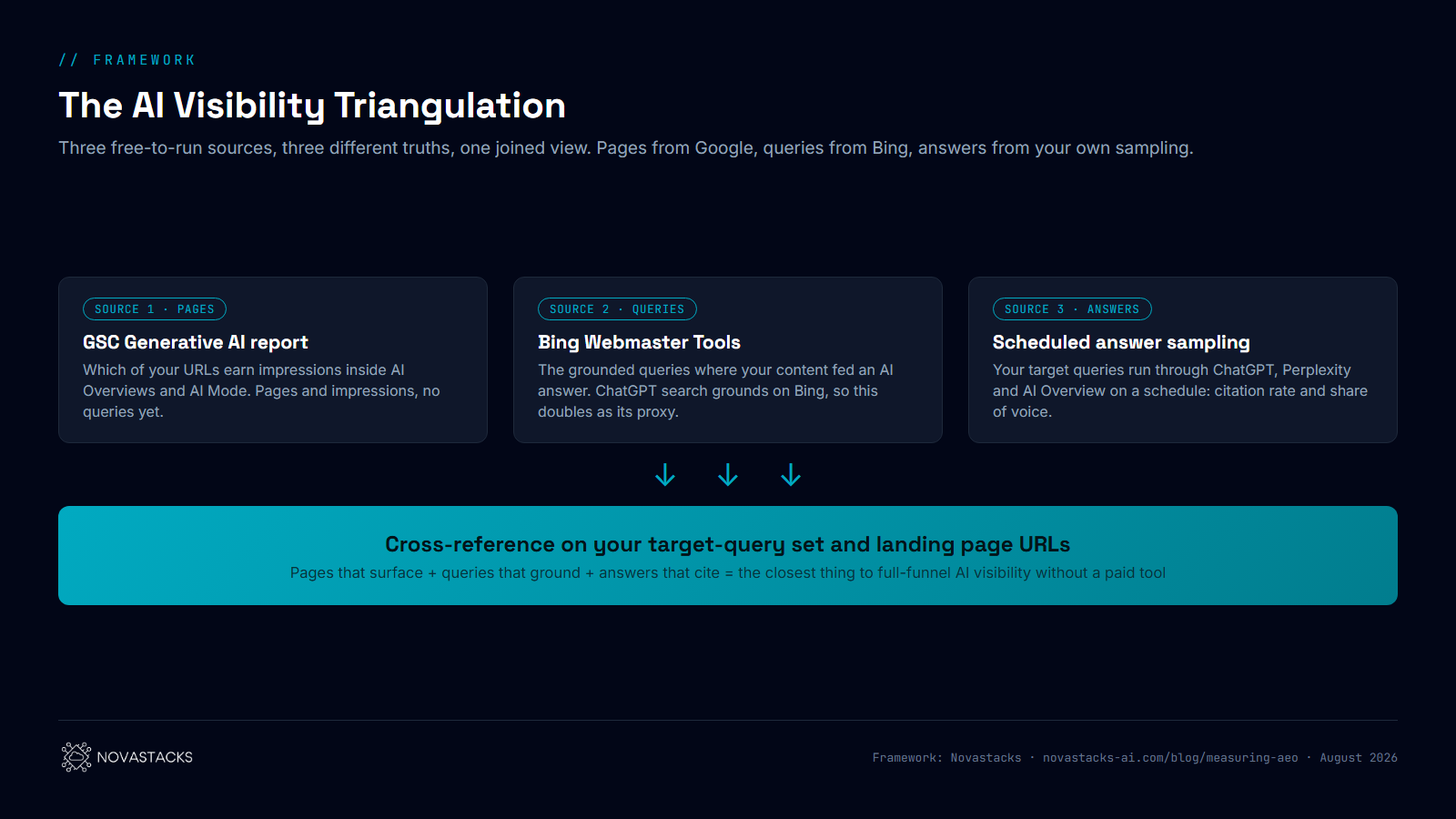
Use the two together: pull the pages surfacing in GSC's generative report, pull the grounded queries from Bing, and cross-reference both against the target-query set you track with the metrics below. That triangulation, pages from Google, queries from Bing, answers from your own sampling, is the closest thing to full-funnel AI visibility available without a paid tool.
1. What to Track Instead
AEO measurement requires different metrics. These are the metrics that actually indicate AI visibility, each with how to track it and why that method is the right one:
2. Citation Rate
How often your domain is mentioned in AI responses for target queries. This is the core AEO metric.
How to track it: run a fixed set of target queries through ChatGPT, Perplexity, and Google AI Overview on a schedule, either with a dedicated tracker (Otterly, Gauge, Profound) or with our free AI visibility tracker. The rationale: citations exist only inside the generated answers, so the answers themselves have to be sampled. No analytics package can see them, because nothing fires on your site when a citation happens.
3. Brand Mention Correlation
If AI is citing you, branded searches often increase even without direct referral traffic.
How to track it: Google Search Console Performance report, filtered to queries containing your brand name, charted month over month. The rationale: users who meet your brand inside an AI answer rarely click the citation, but a meaningful share search your name afterwards, so branded query volume is the downstream echo of AI exposure.
4. Share of Voice
Your citations vs competitors for the same queries. Are you the primary recommendation, or buried in a list? Position matters.
How to track it: the same scheduled query runs as citation rate, but scored against a fixed competitor set: who is named, in what order, and who gets the recommendation slot. The rationale: a citation alongside seven competitors and a citation as the sole recommendation are very different commercial outcomes, and only a competitor-scored sample distinguishes them.
5. Content Velocity
How quickly AI picks up new/updated content. Sites publishing frequently create more citation surface area, and letting pages go stale costs citations outright: AirOps found 83% of citations for commercial queries come from content updated within the past year, and pages left more than a year without an update see citation likelihood fall by over half.1
How to track it: your server logs, filtered to AI crawler user agents (GPTBot, ClaudeBot, PerplexityBot) hitting newly published or updated URLs, paired with the date each URL first appears in a tracked answer. The rationale: crawl pickup precedes citation, so if the logs show AI crawlers ignoring your new content, no freshness strategy can pay off downstream.
6. Description Accuracy
Citation tracking answers whether you appear. It does not answer what the engine says about you. Record what it claims you do, who it says you serve, and which competitors it names alongside you. A confident but wrong description does more commercial damage than absence does, and the fix is the same on-site entity work that earns the citation in the first place.
How to track it: a monthly prompt battery asking each engine what your brand does, who it serves, and how it compares to competitors, recorded verbatim. Our free AI brand perception checker automates the first pass. The rationale: description drift is invisible until a prospect repeats it back to you in a sales call, and by then it has already cost pipeline.
7. Common Crawl Rank
Your domain's position in Common Crawl's authority index correlates with training data inclusion.
How to track it: check your rank at metehan.ai/blog/cc-rank/, an analysis of roughly 607 million domains. Treat a low rank as a hypothesis rather than a threshold: the analysis raises the question of whether it correlates with citation difficulty, and stops short of claiming a measured ceiling.2
Emerging AEO Tracking Tools
A new category of tools is emerging to track AI visibility. Here's the current landscape (based on Nick Lafferty's comparison):
| Tool | Focus | Best For |
|---|---|---|
| Otterly | AI search monitoring | Brand visibility tracking across ChatGPT, Perplexity |
| Gauge | AI visibility analytics | Citation tracking and competitive analysis |
| Profound | LLM tracking | Deep analysis of how LLMs reference your content |
| DataForSEO API | Programmatic access | Building custom dashboards, automated monitoring |
The Proxy Metrics Approach
If dedicated tools aren't in your budget yet, you can track proxy metrics using existing tools:
Free/Low-Cost Tracking Methods
- Brand search volume (GSC)
Track branded search queries in Google Search Console. Unexplained increases may correlate with AI exposure.
- "How did you hear about us?" surveys
Add this question to contact forms. Look for responses mentioning "ChatGPT," "AI," or "Perplexity."
- AI platform referral traffic
Check GA for referrals from chat.openai.com, perplexity.ai, and similar. Small numbers, but directional.
- Manual spot-checks
Regularly ask ChatGPT/Perplexity your target queries. Screenshot results. Track changes over time.
These methods aren't perfect, but they provide directional signal while the measurement ecosystem matures.
Setting Realistic Baselines
Before investing in AEO, establish your current visibility baseline:
- Test 10-20 target queries in ChatGPT/Perplexity, are you cited?
- Note your current branded search volume in GSC
- Document competitor citations for the same queries
- Set 90-day review cycles to measure progress
For the full comparison of AEO vs SEO measurement approaches, see our AEO vs SEO guide.
AEO Measurement Checklist
- Establish citation baseline (manual spot-checks)
- Check the Generative AI report in GSC and grounded queries in Bing Webmaster Tools
- Track branded search volume trends in GSC
- Add "How did you hear about us?" to forms
- Monitor AI platform referral traffic in GA
- Evaluate dedicated AEO tools (Otterly, Gauge, Profound)
- Set 90-day review cycles
FAQ
Why can't Google Analytics track AEO?
Google Analytics tracks clicks, not citations. When AI assistants summarize your content, users often get their answer without clicking through, 69% of searches are now zero-click. GA sees nothing, even when your content is being cited thousands of times.
What tools can track AI visibility?
Emerging tools include Otterly (otterly.ai), Gauge (withgauge.com), and Profound (tryprofound.com). These monitor AI responses for brand mentions and citations. DataForSEO also offers an AI Optimization API for programmatic tracking.
How do I measure AEO without dedicated tools?
Start with the two free first-party reports: the Generative AI performance report in Google Search Console (which pages surface in AI Overviews and AI Mode) and grounded queries in Bing Webmaster Tools (which queries your content grounds AI answers for). Then add proxy metrics: brand search volume in Google Search Console (increases suggest AI exposure), "How did you hear about us?" survey responses mentioning AI, referral traffic from chat.openai.com and perplexity.ai, and manual spot-checks of AI responses for your target queries.
Sources
- AirOps, The Impact of Stale Content on AI Visibility (4,000+ ChatGPT-cited pages, 900 queries, 15 industries), publishing cadence and citation decay
- Metehan Yesilyurt, SEO Consultant, Common Crawl rank tool and analysis (7 January 2026; ~607 million domains)
- Jean-Christophe Chouinard: GSC AI Mode tracking limitations (12 January 2026)
Comparing agencies? See the ranking of the 9 best AI SEO and AEO agencies in Singapore (2026): comparison table, methodology, and detailed top-5 profiles.
Get Your AEO Visibility Baseline
We'll assess your current AI visibility, identify gaps vs competitors, and set up tracking for meaningful progress measurement.