Free AI visibility tracker. Built for your market.
Choose your market. We study it first: your competitors, what your buyers search for and how they phrase it, in their language. Then we test 30 to 50 of their questions across ChatGPT, Gemini, Perplexity and Google AI Overview, and show who gets named and cited. Free report in 48 hours.
- 32markets to choose from
- 30+buyer prompts, up to 50
- 4AI platforms covered
- $0no cost, no catch
Get Your Free AI Visibility Report
We test your brand across 4 AI platforms and deliver the results in 48 hours.
What is AI visibility. And what an AEO tracker measures.
Buyers now ask ChatGPT, Gemini, Perplexity and Google's AI Overview questions like "which software should we use for this" before they visit a single website. AI visibility is how often those answers name your brand or use your website as a source.
AEO, answer engine optimisation, is the work of earning that visibility. An AEO tracker measures the result: it runs a fixed set of buyer questions through the AI engines and records, for every answer, whether your brand appears and which websites were used as sources. Repeat the check later and you can see whether your work moved anything.
Mentions and citations are different signals
- Mention: the AI names your brand in its answer, for example in a shortlist of vendors.
- Citation: the AI links to a page on your website as a source for its answer.
You can have one without the other. An AI can name you while quoting a review site, or quote your article without recommending you. Your report scores both separately.
Platforms we analyze. Same prompts, four AI engines.
Each platform pulls from different data sources and prioritizes different content signals.
ChatGPT
GPT-4o
AI Overview
Google Search
Gemini
Gemini 2.0 Flash
Perplexity
Sonar
How the tracker works. From submission to intelligence in 48 hours.
Tell Us About Your Brand
Your domain, target market, and what keeps you up at night about AI visibility. Two minutes, max.
We Interrogate 4 AI Engines
We study your market and competitors, write 30 to 50 buyer prompts across five buying stages, and run them through ChatGPT, Gemini, Perplexity, and Google AI Overview.
Your Report Arrives
A branded, interactive HTML report lands in your inbox.
How we build your prompts. Market first, then the questions.
Generic prompts give generic results. Before a single question is tested, the tracker studies your market the way a strategist would.
1. Read your business
Your homepage tells us your brand, your category and the buyer you sell to.
2. Map your market's search demand
We pull the searches your site already ranks for in the market you chose.
3. Find your real competitors
The sites competing with you for those same searches, with marketplaces and review sites set aside.
4. Find what buyers look for
The features, use cases and workflows that show up in your market's search data.
5. Write the buyer's questions
30 to 50 prompts in your market's main language, phrased the way buyers actually ask, and checked so no two test the same thing. The number depends on your market and how much localisation it needs.
Every prompt sits in one of five buying stages
- Branded: what AI says about you, your reviews and your alternatives
- Awareness: why your category matters and the problems it solves
- Evaluation: features, capabilities and comparisons
- Decision: pricing, ROI, switching and support
- Blind spots: questions where competitors appear and you do not, and how AI describes your brand
The blind spot. Your SEO dashboard can't show you this.
Google Search Console tracks clicks and impressions. Analytics tracks sessions. Neither one tells you what happens when a prospect asks ChatGPT "best [your category] in [your market]" and the AI builds a shortlist without including your brand.
The only way to know is to test.
The same system our clients use
The NOVASTACKS AI Visibility Tool Tracker runs the same analysis we use in our client AEO engagements, checking how four major AI platforms cite and recommend your brand across 30 to 50 buyer prompts built for your market.
Every report is reviewed before delivery. Some premium sections of the report are gated. To see them, schedule a free call with our team.
- 30 to 50 prompts tailored to your market, industry and competitors
- Citation tracking across ChatGPT, Google AI Overview, Gemini, and Perplexity
- Per prompt breakdown: cited, mentioned, or absent for your brand vs competitors
- Results segmented by funnel stage: branded, awareness, consideration, decision, and blind spots
We cap this at 25 free reports per day to maintain data quality and review standards. If today's spots are taken, please try again tomorrow.
Inside your report. Everything you need to own the AI conversation.
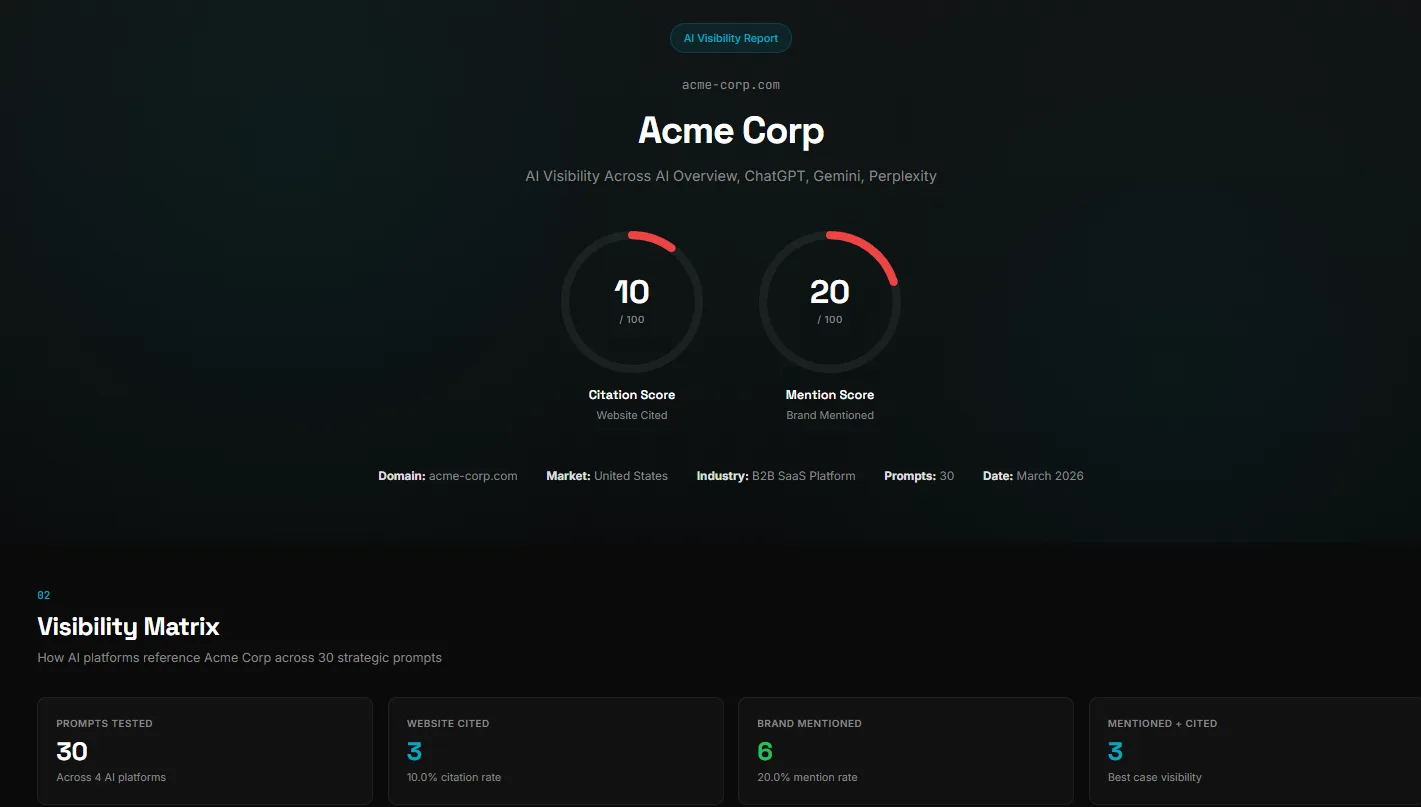
What you get: your starting point in AI search, in two numbers.
- Citation Score out of 100: the share of the prompts tested where an AI engine used your website as a source
- Mention Score out of 100: the share where an AI engine named your brand
- Totals for prompts tested, website cited, brand mentioned, and both
- Your domain, market, industry and test date on the report
How to use it: keep it as your baseline. Request a new report after you publish or fix pages, and compare it with this one.
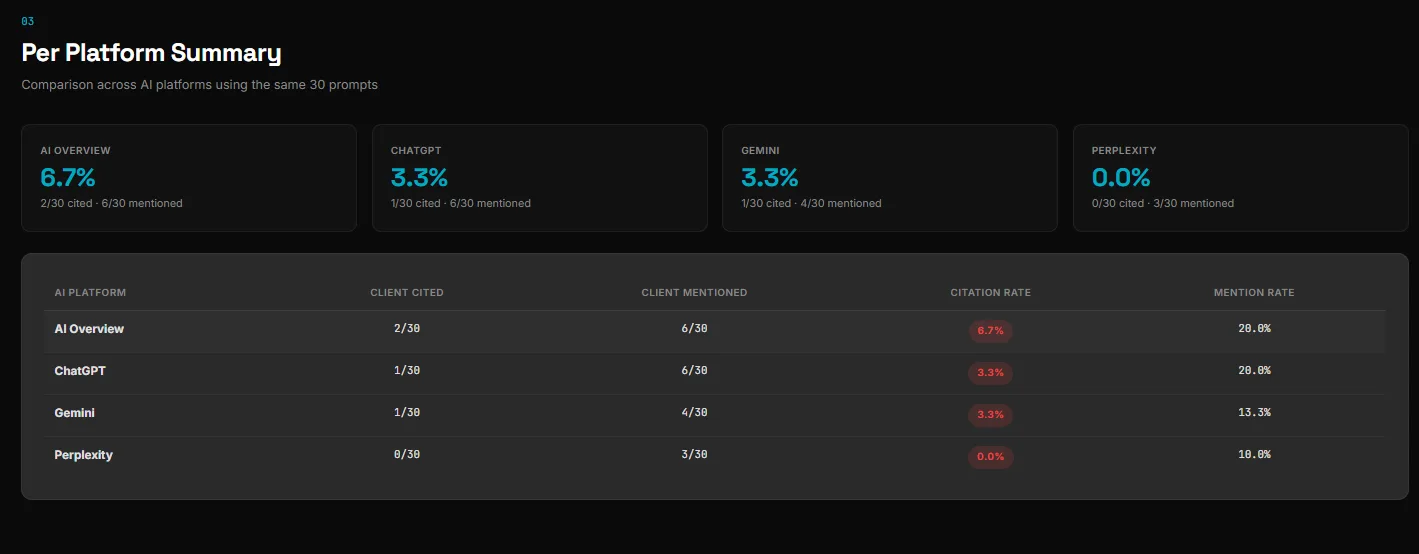
What you get: the same prompts, compared engine by engine.
- Citation rate and mention rate for ChatGPT, Gemini, Perplexity and Google AI Overview
- Counts behind every rate, for example cited in 2 of 30 answers and mentioned in 6 of 30 in the sample report
- A side by side table, so the strongest and weakest engine is obvious
How to use it: each engine picks sources differently. Start where your buyers ask most, and where the gap to your competitors is widest.
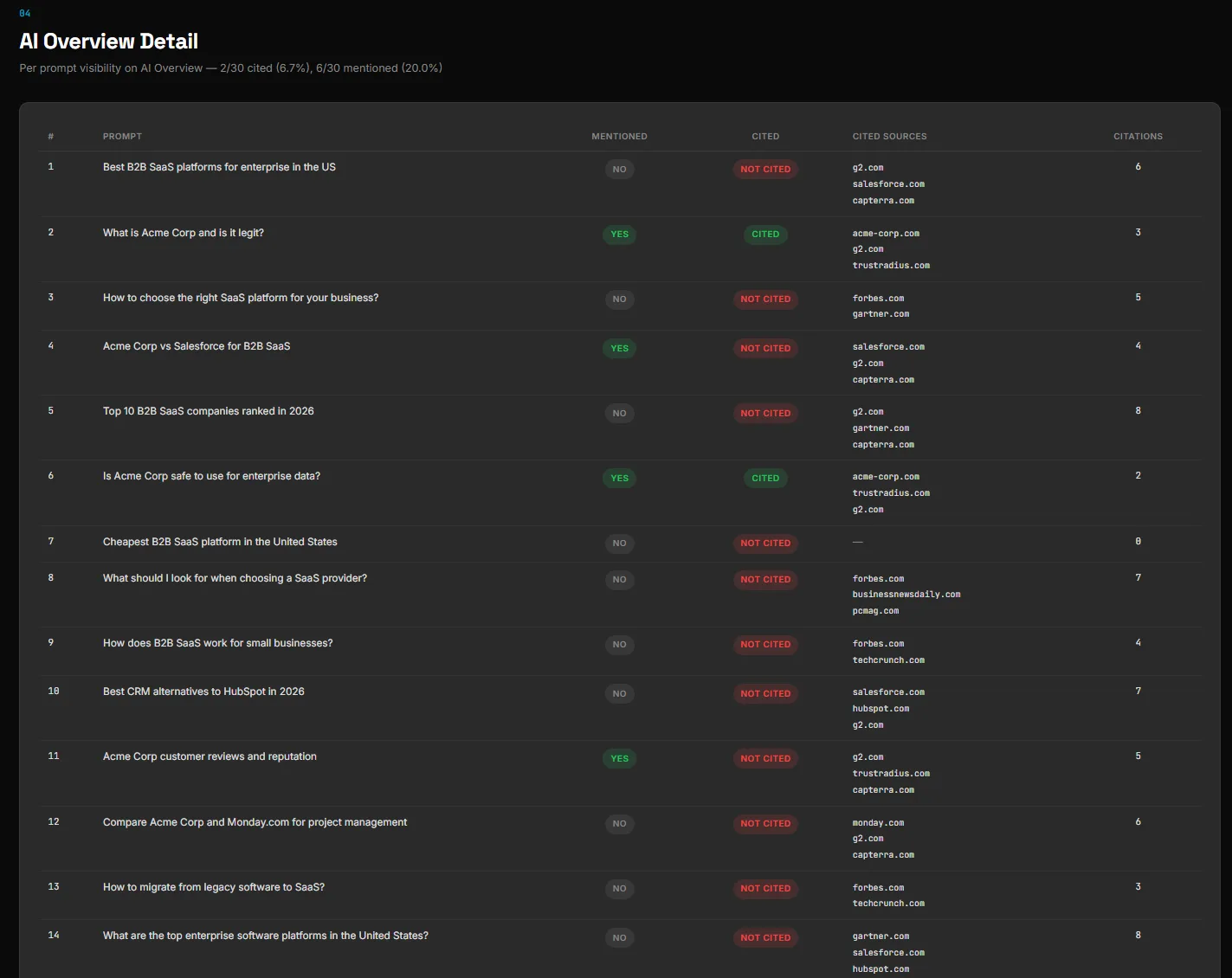
What you get: every prompt, every engine, answer by answer.
- The exact prompt that was tested
- Whether your brand was mentioned and whether your website was cited
- The websites the AI cited instead, such as review sites, publishers and competitors
- How many sources each answer used
How to use it: the cited websites show which sources AI trusts in your category. They become your list of pages to improve and sites where your brand should appear.
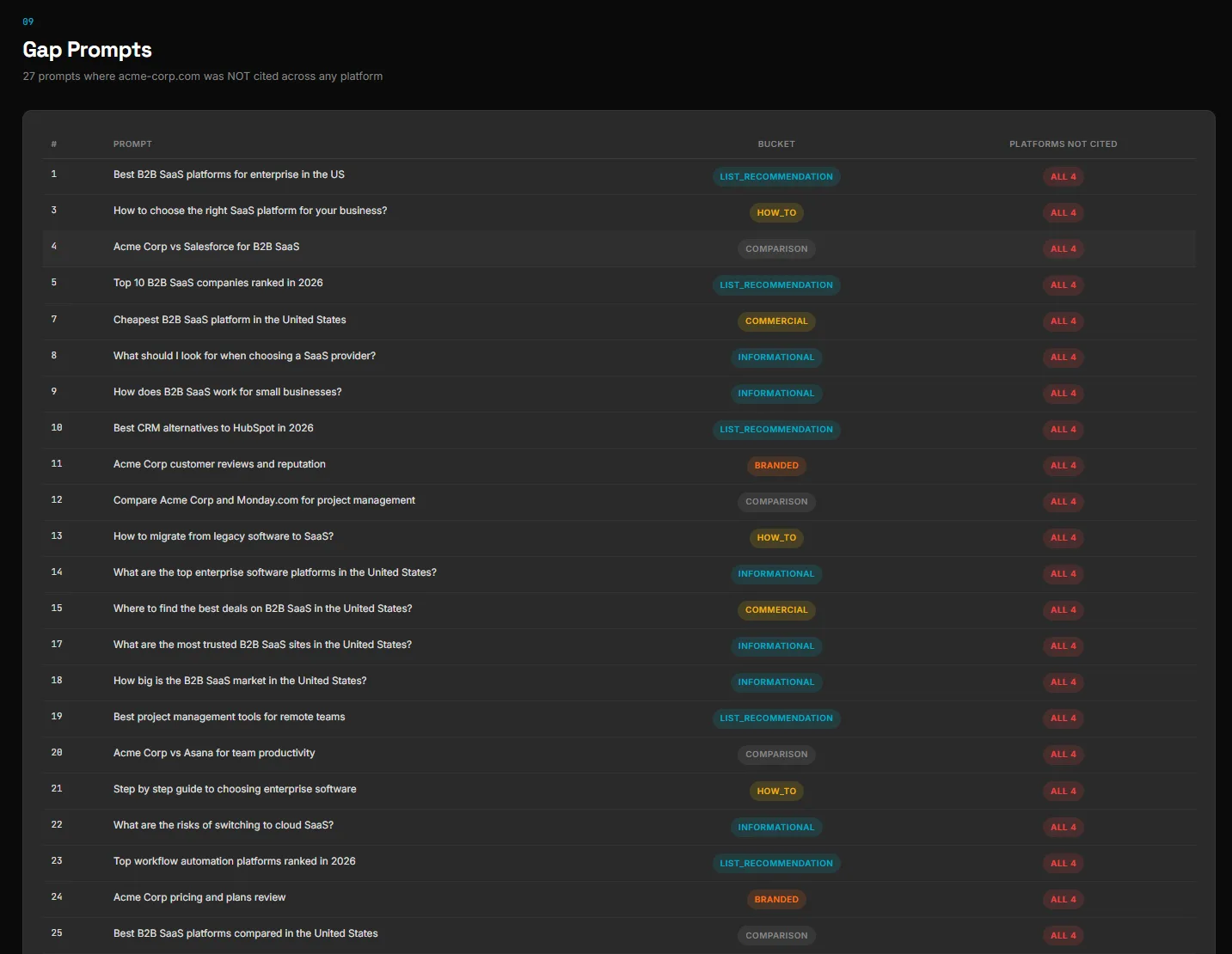
What you get: the questions you are losing, in one list.
- Every prompt where no engine cited your website
- The type of each question: recommendation list, comparison, how to, commercial, informational or branded
- How many of the four engines missed you on each one
How to use it: each row is a page to create or improve. Prompts missed on all four engines, at the comparison and commercial stages, usually come first.
*This is a sample report for illustration purposes only. It does not reflect actual results. Your report will be customized based on your domain, industry, and target market.
How to choose an AI visibility tracker. Seven things to check.
Trackers differ most in where the prompts come from and in what the report separates. The table lists what to check, with the matching facts for this free tracker. For a vendor by vendor comparison, read the AEO tools and trackers guide.
| Criterion | What to check | This free tracker |
|---|---|---|
| AI engines covered | Which AI engines are tested, and whether every prompt runs on all of them. | ChatGPT, Gemini, Perplexity and Google AI Overview, with the same prompts on all four. |
| Where the prompts come from | Whether prompts come from your market and your buyers' questions or from a generic list. | 30 to 50 prompts written from your homepage, your market's search demand and your real competitors. |
| Mentions and citations | Whether a mention (your brand is named) and a citation (your site is linked) are reported separately. | Both are scored separately, for every engine and every prompt. |
| Comparison with named competitors | Whether your results are shown next to specific competitors. | A per prompt breakdown of cited, mentioned or absent for your brand against competitors, plus the websites the AI cited instead. |
| How often it re-runs | Whether you can repeat the same prompts and compare results over time. | A one time check. Request a new report when you want to compare. |
| Market and language | Whether prompts are written in the language of the market you sell in. | 32 markets, with prompts in the market's main language. |
| What you get | The format of the output and who reviews it. | An interactive HTML report by email within 48 hours, reviewed by our team before delivery. |
AI visibility metrics explained. What each number means and how to use it.
Your free report gives a mention score and a citation score, per engine and per prompt. The table defines those two metrics, plus share of voice and position, which most AI visibility tracking tools also report.
| Metric | What it measures | In an AEO workflow | In a leadership report |
|---|---|---|---|
| Visibility | The share of AI answers that name your brand. | Shows which prompts and engines still leave you out, so you know which pages to build first. | The headline number: how often AI names the company when buyers ask about its category. |
| Citation rate | The share of AI answers that link to your website. | Shows which pages AI uses as sources and which questions have no page of yours that AI trusts. | Evidence that content investment turns into sources AI uses, compared on the same prompts when you request a new report. |
| Share of voice | Your mentions compared with your competitors' mentions for the same prompts. | Shows which competitors take the answers you want and on which prompts. | Puts your visibility in context, because a score only means something against named rivals. |
| Position | Where your brand appears inside the answer, for example first in a list or last. | Separates a brand that is named first from one that is named as an afterthought. | A second view next to visibility, so a rise in mentions is not mistaken for a rise in preference. |
To present these numbers to executives, read how to report AI search visibility to your leadership team. For the full metric set and the tools behind it, read how to measure AEO.
Frequently asked questions.
What is an AEO tracker?
An AEO tracker measures how visible your brand is in AI generated answers. It runs a fixed set of buyer questions through AI engines such as ChatGPT, Gemini, Perplexity and Google AI Overview, and records for each answer whether your brand is mentioned and whether your website is cited as a source. Running the same questions again later shows whether your answer engine optimisation work is moving the numbers.
What is the difference between an AI mention and an AI citation?
A mention is when the AI names your brand in its answer, for example in a list of recommended vendors. A citation is when the AI links to a page on your website as a source for the answer. You can be mentioned without being cited, when the AI names you but quotes a review site, and cited without being mentioned. The report scores both separately.
How do I check my brand's visibility in ChatGPT?
Ask ChatGPT, with web search on, the questions your buyers would ask about your category, and note whether it names your brand and which websites it cites. Answers vary between sessions, so a single check is not reliable. This tracker runs 30 to 50 buyer prompts for your market through ChatGPT and three other AI engines with consistent settings, and records mentions and citations for each one.
Which markets does the tracker support?
You can choose from 32 markets across Asia Pacific, the Americas and Europe, including Singapore, Indonesia, Australia, India, Japan, the United States, the United Kingdom and Germany. The prompts are written in the market's main language and reflect how buyers in that market search, so the results describe the market you actually sell in.
How is this different from other AI visibility tools?
Many AI visibility tools give an instant count of how often a brand is mentioned on a general set of prompts. This tracker studies your market first: it finds your real competitors and what your buyers search for, then writes 30 to 50 buyer questions for your market. Every report is reviewed by our team before delivery, and it shows which questions you lose and which sources AI trusts instead.
Which AI platforms does the NOVASTACKS AI Visibility Tool Tracker cover?
Every report covers four AI platforms: ChatGPT (GPT-4o with web search), Google Gemini (Gemini 2.0 Flash with grounding), Perplexity (Sonar with web search), and Google AI Overview (the AI generated answer box in Google Search results). We run the same set of prompts through all four so you can compare your visibility side by side. Each platform uses different training data, different retrieval methods, and different citation logic, which is why cross-platform testing is essential.
Is the AI Visibility Tool Tracker completely free?
Yes. The AI Visibility Tool Tracker report is 100% free. No credit card, no trial period. You submit your domain and we deliver a comprehensive visibility report within 48 hours. Some premium features in the report (such as full competitive breakdown and detailed optimization recommendations) become available when you schedule a call with our team. The call is also completely free, no payment required. We use this tool to help marketing teams understand their AI visibility, and there is zero obligation to purchase anything.
What methodology does the AI Visibility Tool Tracker use? How reliable are the results?
The NOVASTACKS AI Visibility Tool Tracker generates 30 to 50 prompts, depending on your market and localisation, tailored to your market and industry and maps them across five buyer journey stages: branded, awareness, consideration, decision, and blind spots. Each prompt is tested across all four AI platforms with live web search enabled, so the results include current web sources as well as training data. The output is a point in time snapshot of how AI currently answers questions in your category. We test a large number of prompts to produce statistically meaningful patterns rather than relying on a handful of queries.
How does the AI Visibility Tool Tracker generate prompts for my brand?
The NOVASTACKS AI Visibility Tool Tracker does not use generic template prompts. Our system analyzes your website, identifies your industry vertical, discovers your competitors from live ranking data, and generates prompts that reflect how real prospects search in your category and target market. Prompts are language aware: if your target market is Taiwan, the prompts are in Traditional Chinese. If it is Germany, they are in German. This ensures the AI responses match the actual queries your buyers would ask.
Why might I see different results when I test the AI Visibility Tool Tracker prompts myself?
AI platforms produce non-deterministic outputs. The same prompt can return different citations depending on timing, user location, session history, model version, and whether web search is enabled. Our system controls for these variables by querying via API with consistent parameters, web search always on, and no personalization bias. If you test the same prompt in your browser, your results may differ because of your account history, geographic location, or because the AI model has been updated since we ran the test. This is normal and is exactly why systematic testing across a large prompt set produces more reliable insights than spot checking a few queries manually.
Who can benefit from the NOVASTACKS AI Visibility Tool Tracker?
Marketing leaders, SEO managers, growth teams, and founders who want to understand whether AI platforms recommend their brand when prospects ask category level questions. If you are responsible for organic growth and your strategy does not yet account for AI generated answers, this report gives you the data to start that conversation with your team or leadership. It is equally useful for agencies evaluating new client opportunities and for in house teams benchmarking against competitors.
What is the difference between an AI Visibility Tool Tracker and traditional SEO tools?
Traditional SEO tools measure whether your pages appear in the organic blue links on Google. An AI Visibility Tool Tracker like NOVASTACKS measures whether AI platforms cite your brand as a source when generating answers to user questions. These are fundamentally different signals. A website can rank number one on Google for a keyword yet never appear in ChatGPT's answer for the same query, and vice versa. AI engines pull from different data pipelines, weigh authority differently, and often favor structured, concise content that directly answers the question. This tool exclusively measures the AI citation layer, which is a growing share of how prospects discover and evaluate brands.
How long does the AI Visibility Tool Tracker report take? What format is it delivered in?
The AI Visibility Tool Tracker report is delivered within 48 hours of submission. You receive an interactive HTML report via email with a unique access link. The report includes a sidebar navigation, score visualizations, per-platform detail tables, and is designed to be shared internally with stakeholders. Some sections are gated and become available when you schedule a free call with our team (no payment required). No PDF downloads or static screenshots. Everything is live and browsable.
Can I run the AI Visibility Tool Tracker again to track changes over time?
Not automatically. The free report is a one time check, with no scheduled re-runs or alerts. To see how your citations have changed after you publish new content, request a new report and compare it with your first one.
What does a "good" score look like in the AI Visibility Tool Tracker?
There is no universal benchmark yet. AI search visibility is a new channel and industry standards are still forming. What matters most is your score relative to your direct competitors and the distribution across funnel stages. If your competitors are cited in 40% of mid-funnel prompts and you appear in 5%, that is a clear gap regardless of the absolute number. The report highlights these relative differences so you can prioritize the prompts and content areas with the highest competitive impact.
Is there a free AI visibility checker?
Yes, Novastacks offers two. The free AEO checker scores whether your homepage is ready for AI in under 60 seconds. This tracker tests 30 to 50 buyer prompts on ChatGPT, Gemini, Perplexity and Google AI Overview and reports within 48 hours whether AI names your brand or cites your site.
Can I track my brand's visibility on Perplexity?
Yes. Perplexity is one of the four engines in every report, tested with Sonar and web search. The tracker runs your 30 to 50 buyer prompts through Perplexity and records, for each answer, whether your brand is mentioned and whether your website is cited. The report shows Perplexity next to ChatGPT, Gemini and Google AI Overview so you can compare engines.
What is share of voice in AI search?
Share of voice in AI search is your brand mentions divided by the total mentions of you and your named competitors across the same set of prompts. It shows how you stand against specific rivals, which a visibility score alone does not. The free report shows your brand against competitors for each prompt, which gives you the raw material for this comparison.
How do I track my presence in AI search?
Choose the questions your buyers ask, run them through several AI engines with web search on, and record whether each answer names your brand and links your site. Repeat the same questions later and compare. Doing this by hand is slow and answers vary by session, so this free tracker runs 30 to 50 market specific prompts on four engines and reports in 48 hours.
What should I look for in an AI visibility tracker?
Look at the engines covered, where the prompts come from, whether mentions and citations are reported separately, whether results are compared with named competitors, how often it re-runs, which markets and languages it supports, and what format the report takes. The table on this page lists each criterion and how this tracker handles it.
Know someone who needs this?
One form. Four AI engines. Your free visibility report.
This report does that for you across all four platforms.
Get Your Free AI Visibility Report