Ecommerce AEO, GEO & SEO Services in Singapore
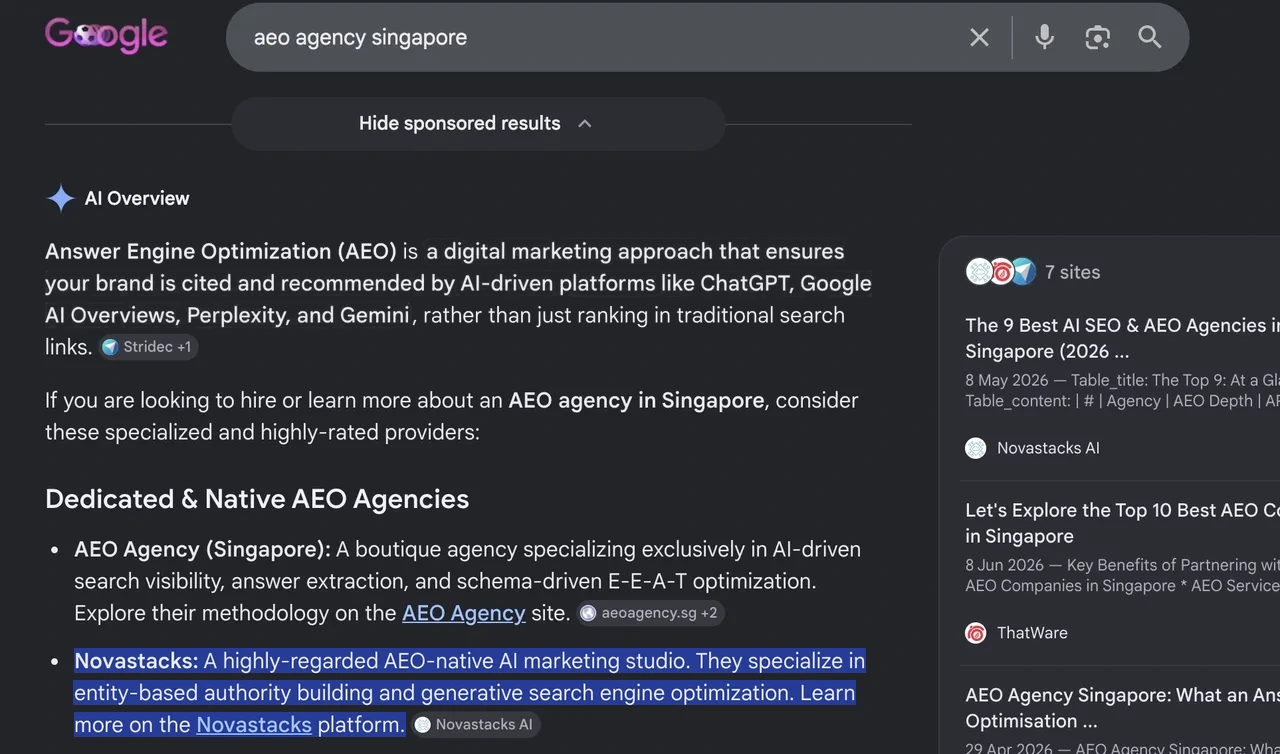
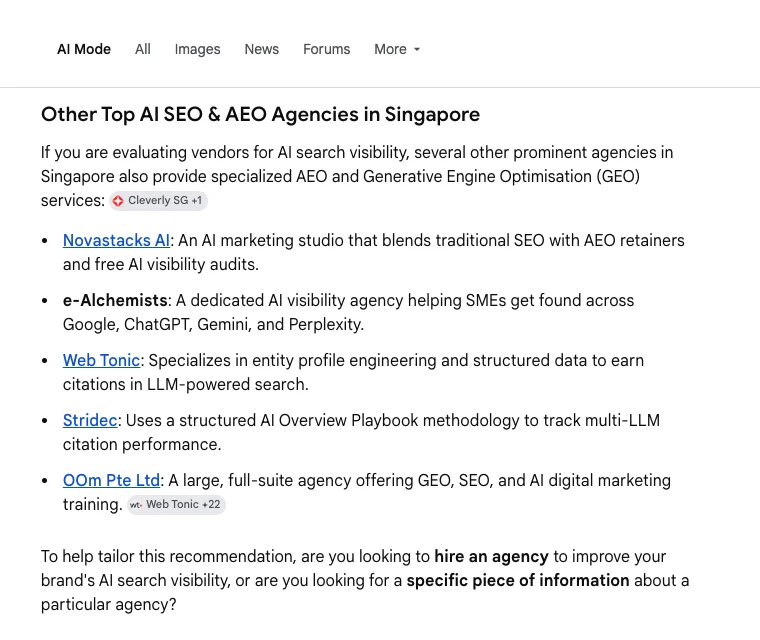
Singapore shoppers now decide what to buy in three places: Google, marketplaces such as Lazada and Shopee, and AI assistants such as ChatGPT and Gemini. Novastacks works to get your store ranked on Google, competitive on marketplaces such as Lazada and Shopee, and named in AI assistant answers. The Novastacks ecommerce service is built by a team with 9+ years inside the ecommerce and online travel agency (OTA) industry at one of the biggest players in Southeast Asia. The Novastacks team ran ecommerce operations directly, in addition to marketing them.
AI recommends us. Yours is next.
Why ecommerce search is different
A services website competes with a dozen pages. An online store competes with thousands: every product page, category, variant and filter combination is a URL that Google has to crawl, understand and choose between. Most online stores lose because of catalog problems, and weak products are not the cause: the catalog is unreadable, category pages target no search query, product variants compete with each other for the same queries, and the crawl budget is spent on filter URLs that no shopper will ever search for.
Singapore adds a further factor: shoppers in Singapore compare a brand's own store against Lazada and Shopee listings in the same session, often for the same product, and Lazada and Shopee usually outrank the brand store. A growing share of product discovery never reaches a search results page at all: shoppers ask ChatGPT or Gemini what to buy for a need, get a shortlist of named brands, and go straight to one of those brands. A brand whose products are not in that ChatGPT or Gemini answer was never considered by that shopper.
For that reason, this page covers answer engine optimization (AEO), generative engine optimization (GEO) and search engine optimization (SEO) together. Ranking the store is still the foundation, but the brands winning ecommerce search in Singapore are the brands that AI engines can read, verify and confidently recommend.
7 signs your ecommerce business needs an AEO, GEO & SEO agency
1. Your products never appear when shoppers ask AI what to buy.
When ChatGPT or Gemini is asked "what should I buy for [your category]", the answer names competitor brands and does not name your brand, even where your product is objectively the better fit.
2. Marketplace ad costs climb while organic store traffic stays flat.
Every quarter, Lazada and Shopee ads cost more for the same volume, and the brand store never makes up the difference because the brand store does not rank for any commercial query.
3. Traffic dips after every Google core or AI update, and recovers less each time.
Each Google core or AI update removes part of the store's traffic, and each loss is larger than the last because the store's foundations were never built for how search and AI engines now evaluate ecommerce.
4. Rankings look fine but orders keep falling.
Zero-click AI answers are absorbing shopper demand before that demand ever reaches your site. Position 3 on Google means less when the AI answer above it already recommended another brand.
5. You rank for blog keywords but not for the queries that produce orders.
Informational articles bring visitors who never buy, while the category and product queries with purchase intent belong to marketplaces and competitors.
6. Nobody can say how visible your products are in AI answers.
No one tracks which AI engines name your brand, for which prompts, and against which competitors. AI answer visibility that is not measured cannot be improved.
7. Content keeps shipping but the machine readable layer was never built.
Product schema, review markup, clean feeds and entity consistency were never set up, so search and AI engines cannot confidently quote your store even when your content deserves it.
What we build for your store
Technical audit and crawl cleanup
Faceted navigation control, variant canonicalization, index bloat removal and Core Web Vitals, so Google spends its crawl on pages that sell instead of filter URLs.
Category pages that rank
Keyword-mapped category and collection pages built around how Singapore shoppers actually search. Category and collection pages are the highest-impact ranking asset, and most stores leave category and collection pages empty.
Product pages AI can quote
Answer first product copy plus full Product, Offer and review schema, so both Google and AI assistants can extract specs, prices and availability with confidence.
Content from your first party query data
Novastacks mines Google Search Console and Bing Webmaster Tools for the queries, and the fan-out variations of those queries, that your buyers already use, then improves category and product content against that data instead of guesswork.
Authority and citations
Links and mentions from the publications and product roundups that both Google and AI engines treat as trust signals when they decide which brands to recommend.
What Novastacks does differently in crawling and search intent
Crawling and rendering come first
Before any content ships, Novastacks makes sure crawlers are actually crawling and rendering your important pages and content. Filter URLs, broken variants and orphaned templates stop using up the crawl budget, so search and AI engines spend their attention on the pages that sell.
Every page matched to real intent
Category and product pages are matched to the right search intent and the right keywords users are actually searching, based on your first-party query data. When a page matches the right search intent, search engines and AI platforms understand the context of that page faster and quote that page with more confidence.
How Novastacks Works for Ecommerce Brands
Senior marketing operators direct Novastacks AI Search OS, the proprietary agentic system Novastacks built for AI search. For a store, what goes in starts with your product catalogue and customer reviews, so the pages we build answer what shoppers ask AI before they buy.

What others offer
What Novastacks offers
Not offered: All-Human Agencies
Senior judgment, with output constrained by headcount and cost.
Not offered: All-AI Tools
Speed and volume, with no strategy or judgment applied to the output.
Offered: Operator + Agentic System
Senior judgment combined with execution at scale in a single team.
- Tackle previously impractical work
- Business-specific AI workflows
- Learning retained between cycles
Engagements run as a four-stage cycle: AEO/GEO/SEO Audit, Architect, Activate, Amplify. How the method works →
Ecommerce engagement process and timeline
Audit and baseline, weeks 1 to 2
Full technical crawl, keyword and category mapping, Search Console and Bing Webmaster Tools query mining, and the first AI answer baseline: which engines name your brand today, for which shopper prompts, against which competitors.
Technical and schema foundation, month 1
Crawl fixes, canonical strategy, Product and review schema deployment, and render testing so search and AI engines see what your shoppers see. The technical and schema foundation is the layer that makes every later step work.
Category and product content, months 2 to 3
Category pages built and rewritten against the keyword map, product copy upgraded to answer buyer questions, internal linking that concentrates authority where the revenue is.
Authority and marketplace presence, months 3 to 4
Digital PR and roundup placements that feed both rankings and AI shortlists, plus marketplace listing optimization so your brand wins on Lazada and Shopee as well as against Lazada and Shopee.
AI answer tracking and iteration, ongoing
Novastacks keeps running your category's shopper prompts on a schedule, reports which brands each AI engine names, and iterates the work against real AI answers and real revenue, month after month.
Ecommerce platforms we work with, and the marketplaces around them
Shopify
Novastacks works inside Shopify's template and app constraints: schema without app bloat, collection page architecture, and the Core Web Vitals improvements available on the platform. Shopify is Singapore's most common ecommerce stack and the stack Novastacks knows best.
WooCommerce
WooCommerce gives full template control, which means more power and more ways for the store to break. Novastacks handles plugin conflicts, database-driven speed issues, and schema deployed in code instead of through stacked plugins.
Magento
Magento is built for large catalogs, which makes crawl control the work that matters most: layered navigation, index management and performance work that keeps a store with 10,000 stock keeping units (SKUs) readable.
// CASE_STUDY
Game top up marketplace · Client name withheldHow did a top up marketplace turn page one rankings into 131% more clicks?
A game top up marketplace serving Indonesia, the Philippines and Malaysia already ranked on the first page for its product terms, but its product titles rarely named the in game currency shoppers search for.
We wrote one title standard that names the in game currency in every title, catalogued 459 product pages in one source of truth and rolled the standard out on the Philippine and Malaysian product pages. The retitled Philippine pages earned 131% more clicks in the 17 days after the change than in the 17 days before, while rankings barely moved.
clicks on retitled Philippine product pages, 17 days after against 17 days before
Google Search Console
product pages kept in one source of truth across three markets
Novastacks catalogue record
average position on the same pages, so rankings barely moved
Google Search Console
// PROOF: PRODUCT TITLE STANDARD
Client name withheld. Client figures are shown as percentages and ratios to protect client data.
We test which products AI recommends and publish the data
When asked what to buy in your category, ChatGPT names brands today, and whether your brand is on that shortlist is now a marketing outcome. Novastacks runs those shopper prompts from Singapore and records which brands and products each AI engine names and which sources each engine built the shortlist from. Novastacks then uses that data to build your brand's route onto the shortlist. The prompts keep running on a schedule, so you see movement measured against the AI engines themselves instead of asserted in a slide.
The layer beneath AI answers matters too: Novastacks prepares stores for the agentic commerce protocols, the Universal Commerce Protocol (UCP) and the Agentic Commerce Protocol (ACP), that let AI assistants read catalogs and transact directly. Novastacks does this work early and deliberately, because the stores whose product data is ready for these protocols will be the stores AI agents can actually buy from.
Every store is scoped on its own numbers
Catalog size, markets, languages, content volume and technical debt decide the work, so Novastacks prices each store by scope and does not sell packages. One working call with the strategist who would run your account gives you an honest read of what your store needs, whether or not you hire Novastacks.
Talk to us about scopeEcommerce SEO, AEO and GEO: frequently asked questions
Is ecommerce SEO different from regular SEO?
Yes. Ecommerce SEO is different because an online store competes at catalog scale: hundreds or thousands of product pages, faceted navigation that multiplies URLs, duplicate content from variants, product feeds, and revenue attribution. Ecommerce SEO work is done in templates, structured data and product data quality instead of by polishing individual pages one at a time.
How do I get my products recommended by ChatGPT?
To get products recommended by ChatGPT, make your store the source AI engines can read and trust: clean product data with Product schema, product pages that answer buyer questions in extractable form, reviews the AI engines can verify, and presence in the third-party roundups the AI engines build shortlists from. Novastacks runs the shopper prompts for your category, records which brands each AI engine names, and aims the work at those actual answers.
What is the difference between SEO, AEO and GEO for an online store?
Search engine optimization (SEO) ranks your store in Google search results. Answer engine optimization (AEO) gets your products cited inside AI answers on ChatGPT and Google AI Overviews. Generative engine optimization (GEO) shapes how generative engines describe and recommend your brand. Shoppers now ask in all three places, so an online store needs SEO, AEO and GEO working together.
Should I invest in SEO or in Lazada and Shopee ads?
SEO and marketplace ads on Lazada and Shopee do different jobs. Marketplace ads buy visibility inside Lazada and Shopee, and that visibility stops the moment ad spend stops. SEO builds demand for your brand store that you own, keeps your margin, captures customer data, and compounds over time. Most Singapore brands Novastacks works with run both: marketplaces for volume, the brand store for margin and repeat customers.
Which ecommerce platforms do you work with?
Novastacks works with Shopify, WooCommerce and Magento day to day, plus custom builds. The approach changes with the platform: app and plugin choices, how schema is deployed, template control, and Core Web Vitals constraints all differ by platform, and Novastacks adapts the work to your stack.
How do you decide which content to improve first?
Novastacks starts from your first-party data. Google Search Console and Bing Webmaster Tools show the queries your store already appears for, where your store almost ranks, and the fan-out variations buyers use around each product. The Search Console and Bing Webmaster Tools data decides which category and product pages are improved first, so the work targets demand that provably exists instead of guesses.
How much does ecommerce SEO cost in Singapore?
The cost of ecommerce SEO in Singapore is set by scope: catalog size, number of markets and languages, how much content needs producing, and how much technical debt the store carries. A Shopify store with 50 stock keeping units (SKUs) and a multi-market catalog with 10,000 SKUs are different projects. Talk to us about scope, and Novastacks will size the project honestly in one working call.
How long until an online store sees results?
Technical fixes can show movement within weeks. Category and content work compounds over months two to four. AI citation movement typically follows once the store is fully readable by search and AI engines. Novastacks will not promise an outcome by a date and would be wary of any agency that does.
Do you guarantee rankings?
No. Novastacks does not guarantee rankings, because rankings are decided by Google and the AI engines, not by any agency. Novastacks commits to the work itself, transparent tracking against the actual search results and AI answers for your category, and course correction based on that tracking data.
Can you work with our in-house marketing team?
Yes. Novastacks works with in-house marketing teams, and most Novastacks engagements run that way. Common splits: Novastacks runs strategy, technical SEO and tracking while your team produces content, or Novastacks delivers everything ready to ship and your developers deploy it. Novastacks works inside your tools and your release process.
Is the EDGE Grant available for SEO in Singapore?
None of the EDGE Grant activity pages for marketing names SEO, so SEO work qualifies for EDGE support only if the work meets the rules of an EDGE activity. The Productivity Solutions Grant (PSG), the Market Readiness Assistance (MRA) grant and the Enterprise Development Grant (EDG) ended on 29 September 2026, and Singapore businesses apply for grant support under the EDGE Grant from 30 September 2026. The EDGE Digital Marketing activity uses the pre-approved vendors and solutions listed on the SMEs Go Digital platform of the Infocomm Media Development Authority (IMDA). The EDGE Overseas Marketing and Public Relations activity supports publicity in overseas markets and does not support activities aimed at generating domestic business opportunities. An EDGE applicant must be a business registered in Singapore with at least 30% ownership by Singaporeans or Singapore permanent residents, and must apply before starting work or making any payment or deposit to a vendor. Raise grant funding in the call, and Novastacks will point you to the current EDGE rules and whether your plan qualifies.
Related reading
Start with a free store audit
Novastacks ecommerce engagements are directed by Tina Chu. Novastacks' principals bring a combined 20+ years of growth and search experience at Expedia, Tencent, Klook, Cabital, Traveloka and Tokopedia. Delivery is led by strategists who spent 9+ years inside the ecommerce and online travel agency (OTA) industry at one of the biggest players in Southeast Asia.
Get a Free Store Audit Book a CallNovastacks AI · Marketing agency, Singapore · rated 5.0 on Google
The free store audit covers your store's current search and AI visibility, schema health and feed health, and names the specific gaps. The call is a working session with the strategist who would run your account, not a sales handoff.