GEO vs SEO: The Differences and Which to Do First
Your Google rankings can be strong while ChatGPT never says your name. Here is how GEO and SEO differ, what they share and the order to do them in.

Key Takeaways
- SEO earns a ranked link; GEO earns a place in the answer. They share crawl access and authority and differ in what counts as success.
- Rankings do not predict AI answers. Only 15 percent of the pages in our 500 query study ranked in Google's top 10 and were also cited by an AI engine.
- You need both, in order of your gap. Fix indexation and ranking first, then baseline GEO with real buyer questions.
- GEO is measured separately. Track whether each assistant recommends, mentions, cites or omits you, next to Search Console.
What is the difference between GEO and SEO?
Your pages rank on Google and your SEO reports look healthy, yet when a buyer asks ChatGPT for a shortlist, three competitors come back and you do not. Your agency says SEO already covers it. A new vendor says you need GEO. Both statements are partly right, and the budget depends on which part.
Short answer
SEO (search engine optimization) earns a ranked link on Google and Bing that a person clicks. GEO (generative engine optimization) earns a place inside the answer an AI assistant writes, such as ChatGPT, Gemini, Perplexity or Google AI Mode, usually as a named recommendation or a cited source. They stand on the same foundation, a page a machine can crawl and trust, and they differ in what counts as success: a position and a click for SEO, a mention in the sentence for GEO.
This page compares the two. If you need the term itself defined first, start with what GEO is and how generative engines choose who to name.
GEO vs SEO side by side
Seven dimensions decide how the two differ in practice.
| Dimension | SEO | GEO |
|---|---|---|
| Goal | A high position for a keyword and the click that follows | Be named, recommended or cited inside an AI written answer |
| Where the answer appears | A list of ranked links on Google and Bing | The text written by ChatGPT, Gemini, Perplexity, Google AI Overviews and AI Mode |
| What is measured | Rankings, impressions, clicks, organic sessions | Whether your brand is recommended, mentioned, cited or absent for a fixed set of buyer questions, per assistant |
| Ranking signals | Backlinks, relevance to the query, page experience, crawlability | Entity clarity, mentions on sites you do not own, source shaped content, machine access |
| Content format | Pages built around one keyword and its search intent | One question answered completely, direct answer first, with statistics and named sources |
| Timeline | Typically 6 to 12 months to ranking gains (Novastacks delivery experience) | Fixes to access and content can move within weeks; our typical time to first AI citations is 60 to 90 days; being recommended takes longer |
| Tools | Google Search Console, Ahrefs, Semrush | AI visibility trackers such as WorkDuo and our own free AI visibility tracker (a one time check) |
Timeline figures are Novastacks delivery experience, stated the same way in our AEO vs SEO guide. The four ranking signals for GEO come from our own analysis of which brands generative engines name.
What changes when the answer is written instead of listed?
Three things change at once. The query turns from a keyword into a described situation, the engine splits that prompt into several searches before it writes, and the result often needs no click.
The click effect is measurable. Ahrefs compared 300,000 keywords between December 2023 and December 2025 and found that an AI Overview on the results page correlates with a 58 percent lower clickthrough rate for the top ranking page. A ranking can hold while the visit disappears.
The overlap between the two scoreboards is also smaller than most teams assume. In our study of the pages that win both Google rankings and AI citations, only 985 of 6,576 usable pages (15 percent) ranked in Google's top 10 and were also cited by an AI engine. The pages AI engines cite and the pages Google ranks are mostly different pages, which is the practical reason SEO results do not predict GEO results.
The other change is where the evidence comes from. Around 85 percent of the brand mentions inside AI answers come from domains the brand does not own (AirOps, 21,311 brand mentions, October 2025). SEO can be run almost entirely on your own site. GEO cannot.
What do GEO and SEO share?
Quite a lot, and it is the reason GEO is not a replacement for SEO. AI assistants retrieve from the crawled, indexed web, so a page that cannot be crawled or understood fails in both systems.
- Crawl access. robots.txt and CDN rules that let crawlers in, and a server that answers reliably.
- Rendering. Googlebot queues a second pass and runs your JavaScript. Most AI crawlers fetch the raw HTML and leave (Vercel found that none of the major AI crawlers, including GPTBot, ClaudeBot and PerplexityBot, render JavaScript), so a client rendered page can rank and still be invisible to them. This is one of the few places the two systems split at the technical level.
- Authority. Depth on one subject and consistent facts about your business, repeated by independent sources.
- Freshness and structure. Current content with clean headings, tables and lists that a reader and a parser can both follow.
SEO is also far from dead in aggregate. Ethan Smith's analysis of the top 40,000 US websites puts organic traffic from Google down 2.5 percent year on year. Per query the damage from AI Overviews is large, in total it is modest, and that is why dropping SEO to fund GEO tends to lose both.
Do you need both, and which comes first?
Yes to both, in an order that depends on where your gap is.
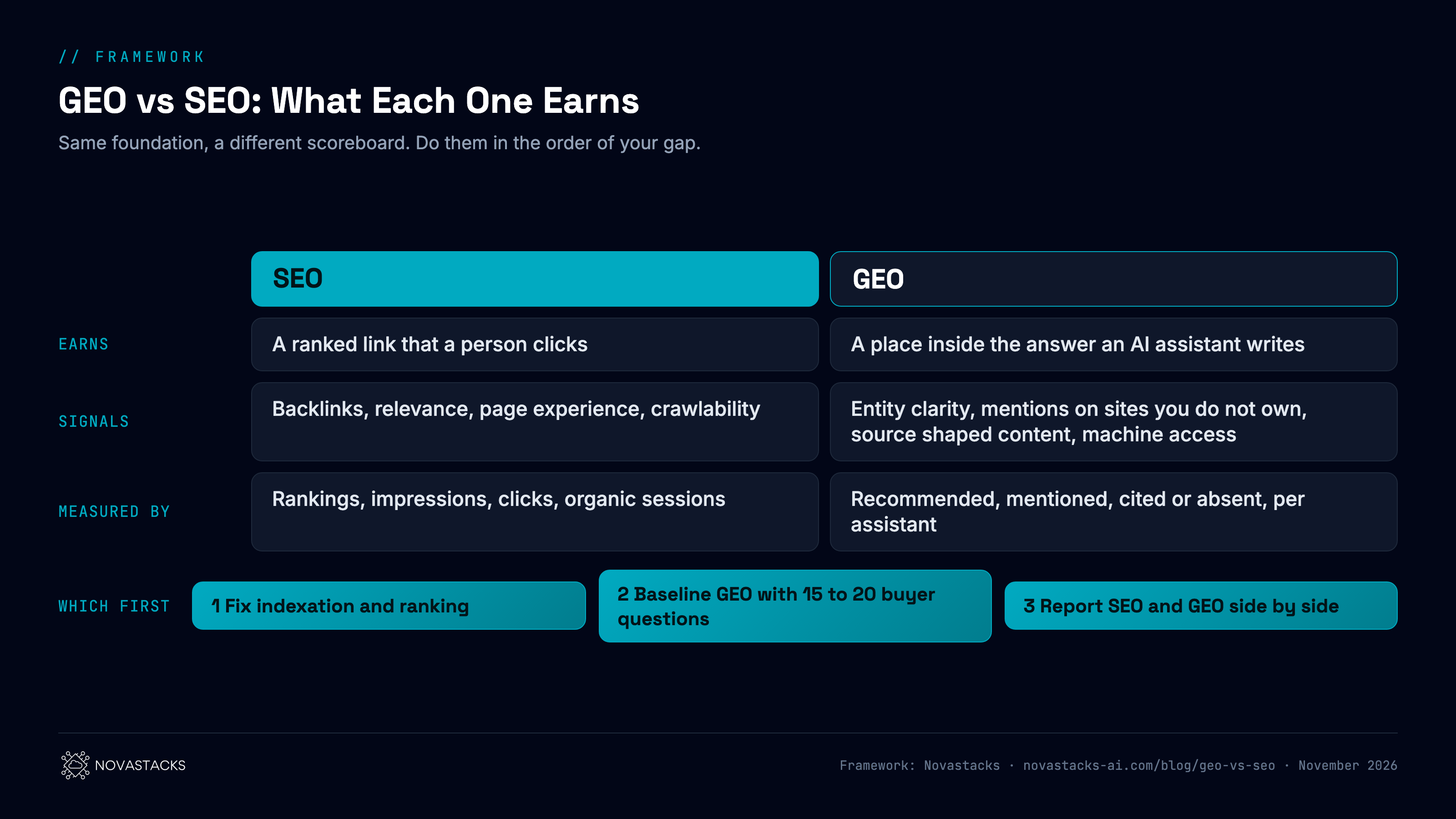
- Fix SEO first if pages are not indexed, not ranking or slow to load. A page that never reaches the index has nothing for an AI assistant to retrieve.
- Run a baseline before spending on GEO. Put fifteen to twenty real buyer questions through ChatGPT, Perplexity and Google, and record for each whether you are recommended, mentioned, cited or absent. It takes an afternoon and shows whether you have a GEO problem at all.
- Start GEO with the fast half. Machine access and source shaped pages can move within weeks. Entity clarity and off site presence are earned over months, and they decide whether an engine recommends you or only quotes you.
- Keep one programme. Build one content plan judged by whether engines can read you, quote you and describe you correctly, then report SEO and GEO side by side.
Where does AEO fit between GEO and SEO?
AEO (answer engine optimization) describes substantially the same work as GEO, with a different emphasis: AEO grew up around being cited as the source an answer draws from, GEO around being named inside the generated text. Anyone selling them as two separate budgets is selling the same work twice. The detail is in our comparison of AEO vs GEO, and the full acronym map, including AIO, is in AEO vs GEO vs SEO vs AIO.
How does Novastacks measure GEO next to SEO?
SEO stays in Google Search Console: impressions, clicks and positions for the queries you target. GEO gets its own scoreboard, because rankings say nothing about whether an assistant names you. We fix a set of buyer questions, run them across the assistants your buyers use, and record which of four outcomes each answer gives: recommended, mentioned, cited or absent. The first engagement stage at Novastacks is an audit that sets this baseline, and every later report is read against it.
If you want that run for you, it is the work of a GEO agency. If you only want a first read, the free AI visibility tracker runs one check across assistants; it is a single snapshot, not monitoring.
How does Novastacks run SEO and GEO together for a client?
The Novastacks Methodology is built around doing both in the right order. Every engagement runs as a four stage cycle called the Compounding Loop: AEO/GEO/SEO Audit, Architect, Activate, Amplify. The audit assesses search and AI visibility, competitor presence, content, technical foundations, backlinks and brand entity consistency, so the gaps that hold back rankings and the gaps that keep assistants from naming you land in one baseline. Architect turns the findings into a delivery roadmap with agreed priorities and metrics, and a senior engagement lead sets the sequence. Activate delivers the technical fixes, content, outreach and entity updates. Amplify tracks AI mentions, citations, search performance, links and entity consistency, and the lead decides what to expand, revise or stop.
The work runs on Novastacks AI Search OS, which our senior operators configure and run for each client. It is not a software platform. Each cycle's findings shape the next round of briefs, so SEO and GEO share one plan and one report.
FAQ: GEO vs SEO
What is the difference between GEO and SEO?
SEO earns a ranked link on Google and Bing that a person clicks. GEO earns a place inside the answer an AI assistant writes, as a named recommendation or a cited source. Both need pages a machine can crawl and trust. They differ in the scoreboard: rankings and clicks for SEO, and for GEO whether your brand is recommended, mentioned, cited or absent when buyers ask ChatGPT, Gemini or Perplexity.
Is GEO replacing SEO?
No. AI assistants retrieve from the crawled, indexed web, so SEO decides whether your pages can be found at all. In aggregate, an analysis of the top 40,000 US websites by Ethan Smith at Graphite puts Google organic traffic down 2.5 percent year on year. Per query the effect of AI Overviews is larger: Ahrefs found a 58 percent lower clickthrough rate for the top ranking page when one appears.
Can I do GEO without SEO?
Not reliably. A page that is not crawlable, indexed and understandable fails in both systems, and most AI crawlers do not run JavaScript, so technical basics matter even more. Skipping SEO also removes the ranking evidence that supports your authority. Treat SEO as the foundation and GEO as the layer that decides whether an assistant names you.
Which should I do first, GEO or SEO?
If your pages are not indexed or not ranking, fix SEO first. If you already rank but assistants do not name you, run a baseline of fifteen to twenty real buyer questions across ChatGPT, Perplexity and Google, then start GEO with machine access and source shaped pages, which can move within weeks. Entity clarity and off site presence take months.
How do I measure GEO compared with SEO?
Measure SEO in Google Search Console with impressions, clicks and positions. Measure GEO with a fixed set of buyer questions run across the assistants your buyers use, recording for each answer whether your brand is recommended, mentioned, cited or absent. Many mentions leave no click or referrer, so a flat analytics chart does not prove a flat GEO result.
Is GEO the same as AEO?
They describe substantially the same work. AEO emphasises being cited as the source an answer draws from, and GEO emphasises being named and recommended inside the generated text. Novastacks runs them as one programme, because the foundations and the measurement are shared.
Sources
- Aggarwal et al., GEO: Generative Engine Optimization (November 2023, published at KDD 2024), the paper that coined the term
- Ahrefs, AI Overviews reduce clicks, 300,000 keywords compared across December 2023 and December 2025
- Ethan Smith, Graphite, analysis of the top 40,000 US websites, organic traffic from Google down 2.5 percent year on year
- Vercel, The rise of the AI crawler, checked on 2026-11-10
- AirOps, The influence of offsite signals in AI search, 21,311 brand mentions, October 2025
- Novastacks AEO Study, 500 queries, 8,397 crawled URLs across Google organic, Google AI Overview, ChatGPT and Perplexity, US market and English, collected April 2026 (the 985 of 6,576 figure counts the pages that returned HTTP 200)
See Whether Assistants Name You Today
The free audit shows which AI assistants name your brand and what is blocking the rest. It takes minutes and carries no obligation.