Should Your Marketing Team Handle AEO, or Do You Need a Specialist?
Your marketing person is capable and already busy. The question is not whether they could learn answer engine optimisation, because they could. It is whether the parts of it that actually move visibility are ones they can realistically own.
Key takeaways
- It is not one skill: AEO spans technical repair, question research, content and off-site authority, and few marketers own all four.
- The gate is ownership, not talent: without someone giving it a day a week, AEO stalls after the technical fixes.
- The hybrid is usually right: buy the technical repair and the off-site programme, keep the content in-house.
- Compare like for like: a headcount comparison has to include tooling and the learning curve, not just salary.
The Question Behind the Question
When a business owner asks whether their marketing person can handle AEO, they are usually asking something more specific: is this a new skill to learn, or a new function to staff? The honest answer is that it is mostly the former, with one part that is genuinely the latter.
What makes it confusing is that AEO looks like content marketing from the outside. You publish pages, engines quote them, buyers hear your name. In practice the work that decides the outcome sits in four separate places, and they need different people.
AEO Is Four Different Jobs
Before deciding who owns it, look at what "it" contains. These map to the four authority layers that decide whether an engine names you.
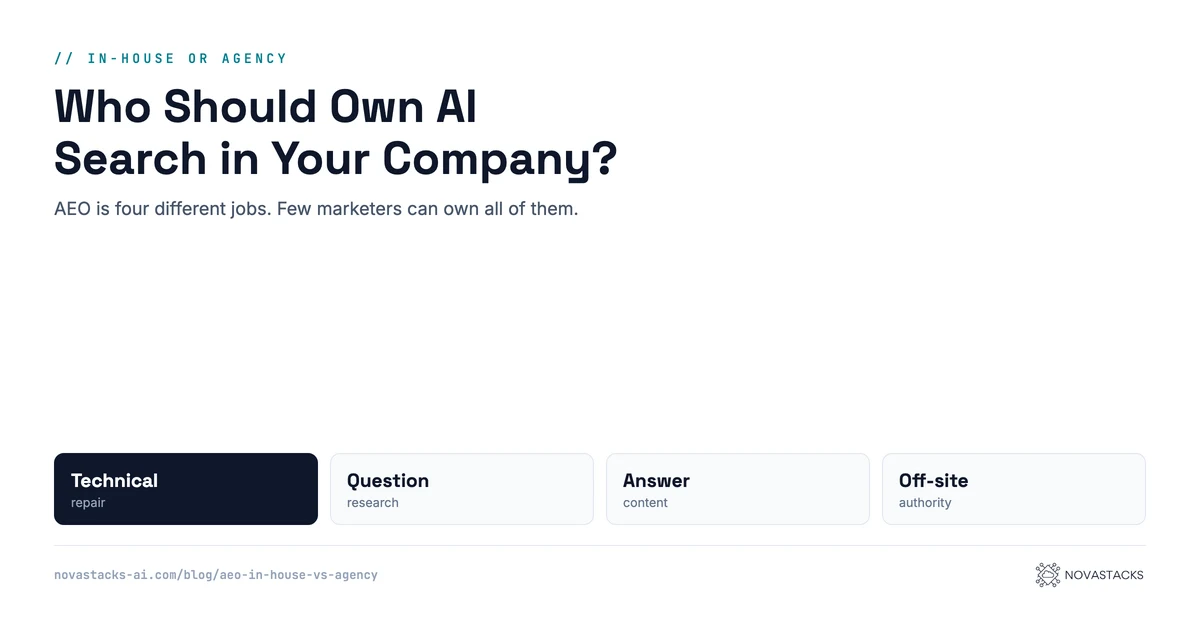
- Technical repair. Making sure content appears in the raw HTML, crawlers are not blocked at robots.txt or the CDN, schema is present and accurate. This is engineering work, not marketing work, and it is the gate: nothing downstream matters until it is done.
- Question research. Finding the actual sentences buyers type into assistants, which are rarely your keywords. This needs access to Search Console and Bing Webmaster Tools, plus the discipline to sample answers directly.
- Answer-shaped content. Writing pages that own one question completely, with the answer early and claims attributed. This is the part a good marketer can genuinely learn, and it is the largest ongoing workload.
- Off-site authority. Reviews, forums, third-party coverage, community presence. Roughly 85% of what AI says about a brand comes from sources you do not own, which makes this the highest-leverage and least delegable part.
Notice that only one of the four is writing. Most in-house AEO attempts stall because the team can do job three, has no access to job one, and never gets to job four.
The Decision, in Four Outcomes
Rather than a generic pros and cons list, work through the three questions that actually determine the answer.
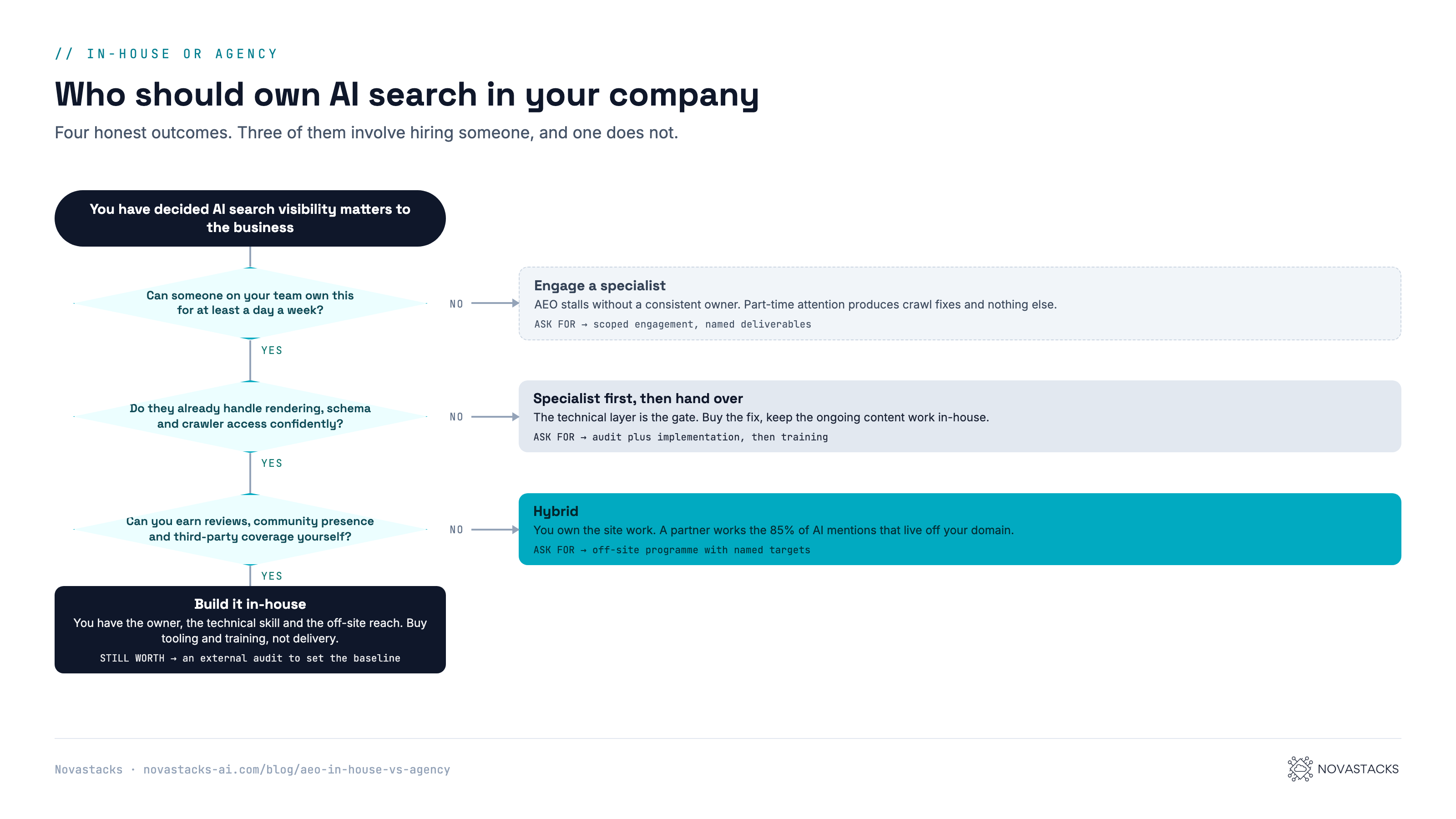
The first question is the one that decides most cases. AEO is not a project that finishes; engines change their behaviour, competitors publish, and content goes stale. Without a named owner giving it consistent attention, what happens in practice is that the technical fixes get done, everyone feels productive, and then nothing moves for six months because nobody is producing answers or working the off-site layer.
When In-House Genuinely Wins
There are situations where hiring an agency is the wrong call, and we would rather say so than sell you something you do not need.
- You have a technical marketer already. Someone who is comfortable in Search Console, can read a server log and can brief a developer on rendering. That person plus a few weeks of focus covers most of layers three and four.
- Your category is narrow. One product, a handful of real buyer questions, one market. The content surface is small enough that an agency's production capacity is not worth paying for.
- Your credibility is already earned. Established review profile, active community presence, people who write about you unprompted. The slowest part of AEO is already done.
- You are pre-product-market-fit. If the positioning is still moving, entity clarity is impossible by definition, and you would be paying an agency to describe a business that will change next quarter.
In those cases the sensible purchase is a one-off audit to set the baseline and find the technical blockers, then tooling and training. Not a retainer.
When You Need Outside Help
The mirror image, equally honestly:
- Nobody owns it. If AEO is going to be added to a full workload as a fifth priority, it will lose to the four above it every week.
- The technical layer is broken and engineering is booked. Rendering and crawler access sit with developers who have a roadmap. An external specialist can often diagnose precisely enough that the fix becomes a two-day ticket rather than a project.
- You are starting from zero off-site. Building review volume, community presence and third-party coverage is the slowest work in AEO and benefits most from people who have done it before.
- You need per-engine measurement. Because visibility does not transfer between engines, measurement is a recurring job across several surfaces. In-house teams tend to check one engine occasionally and call it tracking.
The hybrid is what most companies actually land on and it works well: the agency fixes the technical layer, sets the baseline, and runs the off-site programme, while your team writes the answers because they know the product better than any agency will.
What Each Option Actually Costs
Compare properly. The in-house column is not just salary.
| Cost | In-house | Agency or specialist |
|---|---|---|
| Direct | A share of an existing salary, or a hire | Retainer or project fee |
| Tooling | Per-engine tracking, crawling and monitoring, paid monthly | Usually included in the fee |
| Learning curve | Real and front-loaded; the first quarter produces less | Paid for in the rate |
| Engineering time | Still needed for rendering, schema and crawler access | Still needed, but scoped precisely |
| Risk | Attention drifts to whatever is louder that week | Underperformance is visible and contractual |
Market rates for the agency column are in our guide to what AEO costs in Singapore, including what PSG covers for qualifying SMEs. The honest summary is that at the low end of the market, an agency retainer costs less than the tooling an in-house team would need to do the same measurement.
Frequently Asked Questions
Can my existing marketing person do AEO?
Partly, and which part matters. AEO spans four jobs: technical repair (rendering, crawler access, schema), question research, answer-shaped content, and off-site authority. A capable marketer can usually own the content and research. The technical layer normally needs a developer, and the off-site layer is the slowest and hardest to build from zero. The realistic question is not whether they can learn it but whether they can give it consistent attention, because AEO stalls without a named owner.
How much time does AEO need in-house?
As a rough floor, about a day a week of consistent attention once the technical layer is fixed. Less than that and what happens in practice is that the crawl and schema fixes get completed, everyone feels productive, and nothing moves afterwards because no one is producing answer pages or working the off-site layer.
Is it cheaper to run AEO in-house?
Not always, and the comparison is often made wrongly. The in-house column has to include per-engine tracking tools, the learning curve in the first quarter, and the engineering time that is needed either way. At the lower end of the Singapore market, an agency retainer can cost less than the tooling alone that an in-house team would need for the same measurement.
What is the hybrid model for AEO?
The agency or specialist fixes the technical layer, sets a measured baseline across engines, and runs the off-site authority programme. Your team writes the answer content, because they understand the product and the customer better than an external party will. This is where most companies end up, and it plays to both sides' strengths.
When should we not hire an AEO agency?
When you already have a technical marketer, a narrow category with few buyer questions, an established review and community presence, or when you are still pre-product-market-fit. In the last case entity clarity is impossible by definition, because you would be paying someone to describe a business that will change next quarter. In all of these, a one-off audit plus tooling and training beats a retainer.
Not Sure Which Side You Are On?
Run the free audit first. It shows whether your blockers are technical, content-side or off-site, which is usually enough to answer the in-house question by itself.