SEO Content Writing: How to Write Content That Ranks and Gets Cited
Writing around a keyword list produces pages that mention the right words and answer the wrong question. Good SEO content starts from the intent behind the keyword, keeps the title and the page aligned, and fits into the rest of the site.

Key Takeaways
- A keyword is a label for a need. Writing to the label produces a page that mentions the topic without answering it.
- The search results page shows what Google decided the intent is. Read it before writing: the page types, the format and the angle that rank.
- The title, the H1 and the first paragraph should make the same promise, and the rest of the page should keep it.
- In our 500 query study, 89.6% of AI cited pages won a citation for exactly one query. Specific pages beat broad ones.
- Each page needs one job and a clear place in the site, linked from the pages above it.
- Good writing still needs technical delivery: content in the server HTML, links from the homepage and product pages, an updated sitemap, and IndexNow for fresh content.
A common brief looks like this: a target keyword, five secondary keywords, a word count, and an instruction to use each keyword a certain number of times. The writer delivers exactly that. The page goes live, gets indexed, and sits on page three.
Nothing in the brief was wrong, and nothing in it described the reader. It listed the words to use and said nothing about the question the searcher had, what they already knew, or what Google was already showing them. The page used the keyword without answering the question behind it.
This guide covers how we write content that ranks in Google and gets quoted by AI assistants: start from intent, keep every part of the page aligned to it, connect the page to the rest of the site, and make sure search engines and AI crawlers can render and find it.
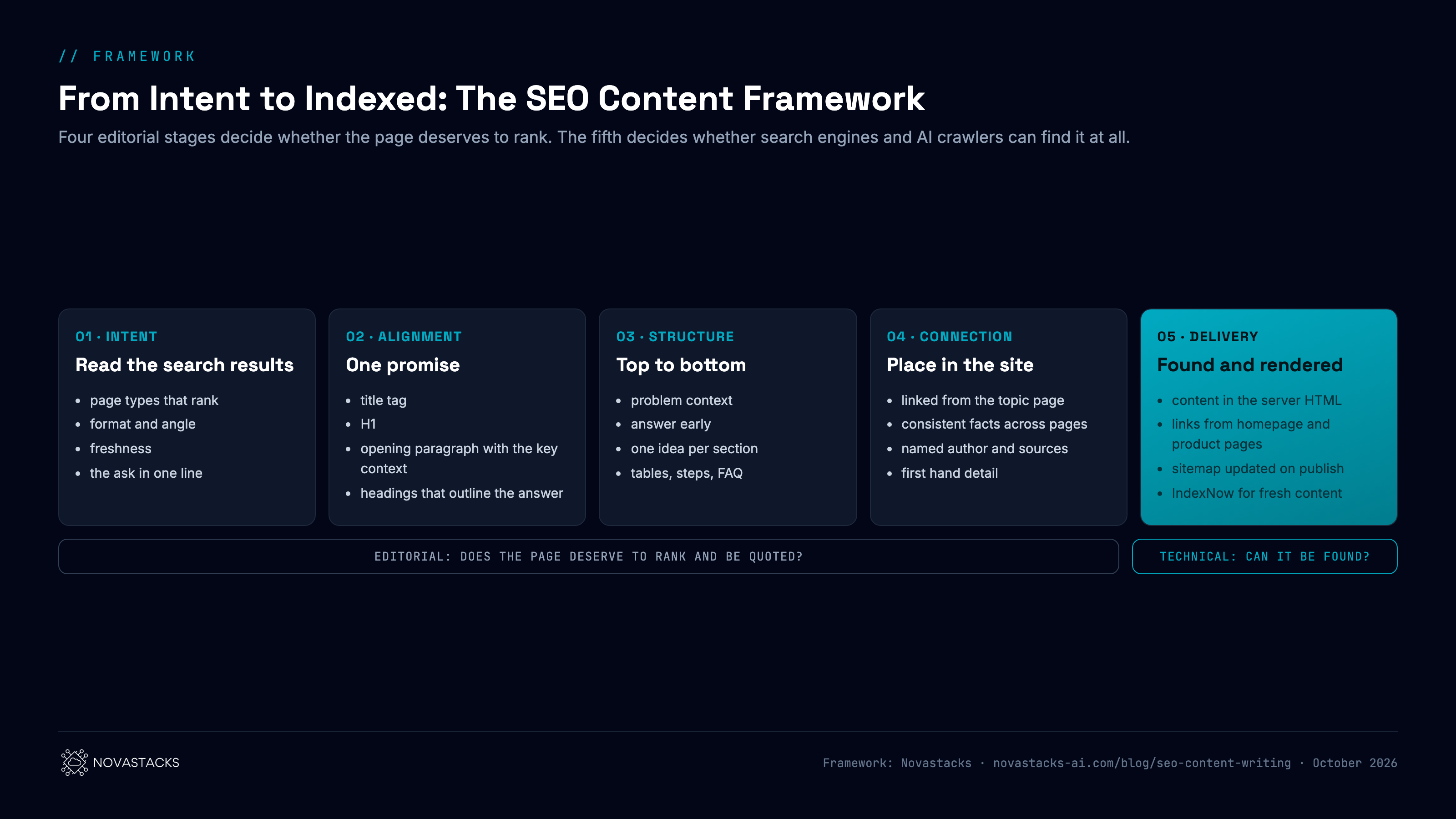
1. Why Keyword First Writing Underperforms
Keyword tools group searches by the words people type. Searchers use the same words for very different needs. "CRM pricing" can mean "what does a CRM cost in general", "what does this vendor charge", or "which CRM is cheapest for a team of ten". A page written to the phrase tries to cover all three and answers none of them well.
Three patterns show up when content is written keyword first:
- The title promises one thing and the opening drifts. The first paragraph should carry the key context of what the page is about. When it starts with general background instead, the reader and the search engine both have to guess what the page is for.
- Sections exist to hold keywords. An H2 per secondary keyword, each a few generic sentences, in no order a reader would choose.
- Pages compete with each other. Two articles written to near identical keywords split the signals, and neither ranks.
Search engines have become good at telling the difference. Google's guidance on creating helpful, reliable, people first content asks directly whether content is written for people or mainly to attract search visits. AI assistants go further: they quote the passage that answers the question and ignore the rest.
2. Read the Intent Before You Write
The fastest way to understand intent is to look at what already ranks. The results page is Google's own answer to the question "what does this searcher want?"
When we checked the Singapore results for "seo content writing" in October 2026, the top organic results included a long guide that defines the discipline, a software tool page, a short list of "things to know", and a list of tips. That mix is a signal in itself: searchers want a definition and practical steps, and some of them want a tool. A page that only sold writing services would not fit.
Read the results for four things:
| What to check | What it tells you | What to write |
|---|---|---|
| Page types that rank | Guides, product pages, tools, lists or forum threads | The same type of page; a different type rarely breaks in |
| Format | Steps, tables, comparisons, definitions | The format the reader expects, done more completely |
| Angle | Beginner, buyer, technical, local | One angle, chosen on purpose, stated in the title |
| Freshness | Years in titles, recent dates | A dated title only when the topic changes year to year |
Then write down the ask in one line before drafting: "the reader wants to know how to write a page that ranks, step by step, with examples". If you cannot write that line, the brief is not ready.
3. Make the Title and the Page Make the Same Promise
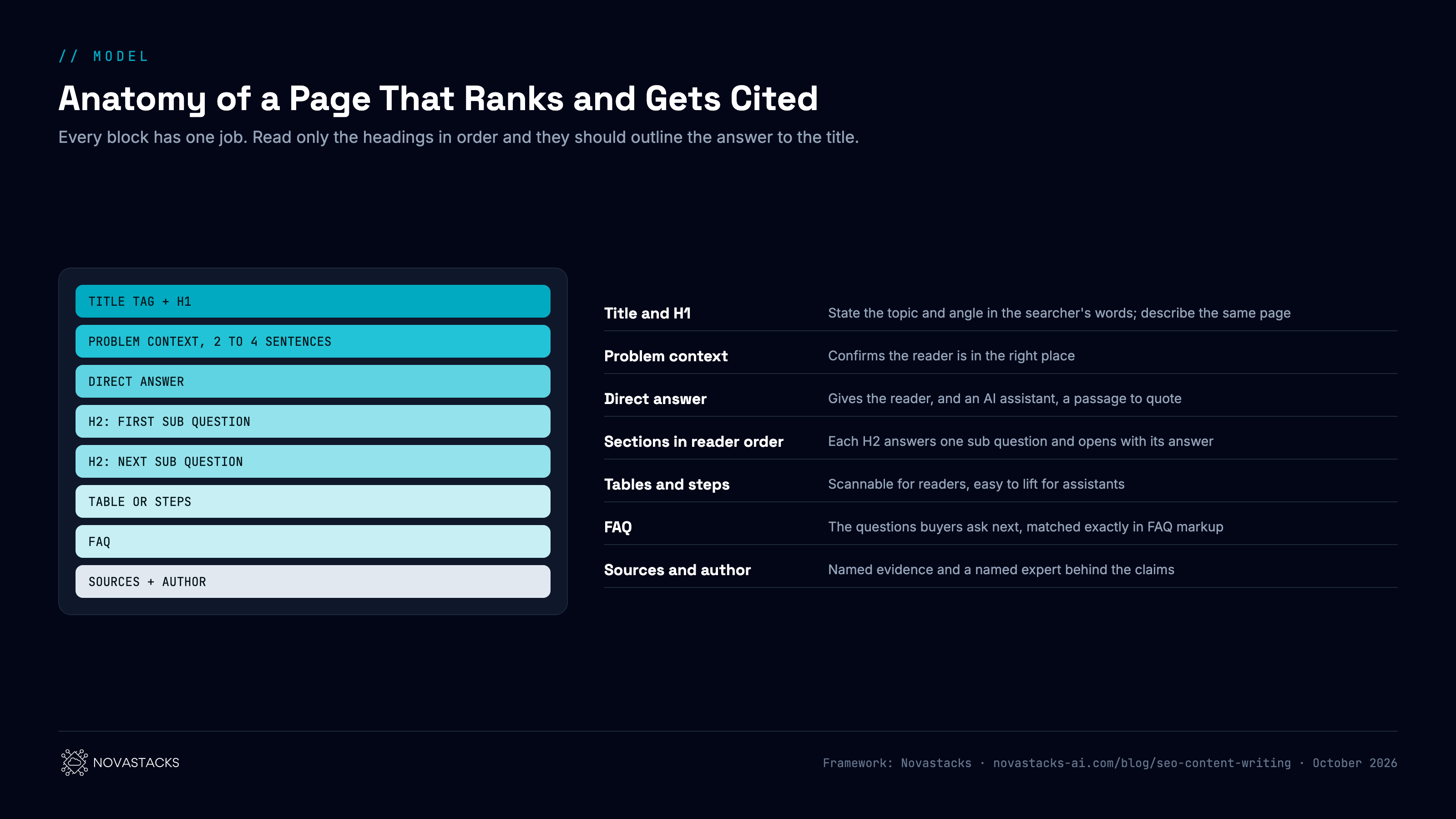
The title tag, the H1 and the opening paragraph are read together, by people and by search engines. They should describe the same page.
- The title tag states the topic and the angle in the searcher's own words.
- The H1 can be longer and more specific, but it describes the same page.
- The first paragraph confirms the reader is in the right place, and either answers the question or says how the page will answer it.
Google rewrites titles it considers inaccurate or stuffed. Its documentation on title links lists the common causes, including titles that do not describe the page and titles that repeat keywords. When the title and the page agree, Google has less reason to rewrite it, and the searcher who clicks finds what they were promised.
The same test applies to every heading. Read only the H2s in order. They should read like the outline of an answer to the title. If a heading would make sense on any page about the topic, it is probably filler.
4. Structure the Page From Top to Bottom
A well structured page lets a reader stop at any point with something useful, and lets a machine lift one passage without losing its meaning.
- Open with the problem. Two to four sentences that describe the reader's situation, so they know the page is for them.
- Answer early. For "what is" and "does X work" questions, give the direct answer in the first section.
- Order sections the way the reader needs them. Definition before method, method before tools, tools before pricing.
- One idea per section. Each H2 answers one sub question, and its first sentence states the answer.
- Use tables for comparisons and lists for steps. Readers scan them, and AI assistants quote them.
- End with the questions that remain. A short FAQ that answers what real buyers ask next.
Depth matters, but breadth does not help as much as it seems. In our study of one deep page per question, 89.6% of the pages AI engines cited won a citation for exactly one of our 500 queries, and no page won more than eight. A page that covers one question thoroughly is more useful than a guide that touches twenty.
5. Connect the Page to the Rest of the Site
A page rarely ranks on its own merits alone. Search engines read it in the context of the site around it: what links to it, what it links to, and whether other pages already cover the same ground.
- Link down from the topic page. The broader page on the topic links to the new page, with the new page's subject as the anchor text.
- Keep related pages consistent. Facts, numbers and product names should match across pages. AI assistants compare sources, and contradictions cost trust.
6. Write the Experience Into the Page
Google's quality rater guidelines describe experience, expertise, authoritativeness and trust (E-E-A-T). Raters use them to judge quality, and they are not a ranking factor on their own. For a writer, they come from what the page contains.
- Experience: details only someone who has done the work would know. The mistake teams make on the second attempt, the setting that breaks, the number from a real project.
- Expertise: a named author with relevant background, and claims precise enough to be checked.
- Authority: sources named and linked. In our research on the pages that win everywhere, the pages that both ranked in Google's top 10 and were cited by AI carried a median of 56 external links, roughly twice the pages that won only one of the two. It is a correlation, and it fits the habit of showing your sources.
- Trust: dates, a clear owner, and no claim the page cannot support.
7. Make Sure the Page Can Be Rendered and Found
A well written page still fails if crawlers cannot read it or cannot reach it. Four technical checks belong in every content workflow.
- Render the content on the server. The text should be in the HTML the server sends, before any JavaScript runs. Google can render JavaScript, but its JavaScript SEO basics describe rendering as a separate step after crawling, and most AI crawlers outside Google do not run JavaScript, as our guide to a bot friendly website explains. To test, view the page source: if the article text is missing, crawlers may see an empty page.
- Link to it from important pages. A new article should be reachable from pages that crawlers visit often: the homepage or blog index for fresh content, and the relevant product or service pages for content that supports them. An article linked only from page five of the blog archive may be found much later.
- Keep the XML sitemap current. The sitemap should update automatically when content is published or meaningfully changed, with an accurate lastmod date. Google's sitemap guidelines note that it uses lastmod when the value is consistently accurate.
- Use IndexNow for time sensitive content. For news, announcements and frequently updated articles, IndexNow notifies search engines as soon as a URL is published or updated. It is supported by Microsoft Bing, Naver, Seznam.cz, Yandex and Yep. Google does not take part, so the sitemap still matters for Google. ChatGPT search has used Bing results, so fast discovery in Bing may help new articles reach ChatGPT answers sooner.
8. A Checklist Before You Publish
Before publishing, confirm that:
- the one line ask is written down, and the page answers it;
- the page type and format match what ranks for the query;
- the title, H1 and first paragraph describe the same page;
- the H2s, read alone, outline the answer in a sensible order;
- every section opens with its answer;
- no other page on the site targets the same intent;
- the page is linked from its topic page and links on to the next step, with descriptive anchors;
- every number has a named source, and the author is named;
- the article text is present in the page source before JavaScript runs;
- the page is linked from the homepage or blog index, and from the product pages it supports;
- the sitemap includes it with an accurate lastmod, and IndexNow has been notified for fresh content.
9. How Novastacks Writes SEO Content
At Novastacks, a page is planned before it is written. Each brief combines three inputs: the intent behind the keyword, the context the client holds about its buyers from sales and CRM notes, and what search engines and AI assistants show for that query today. The brief then states the one line ask, the page type the results reward, the sections in reader order, and the existing pages it must agree with. That planning step decides which pages to create, which to improve and which to merge, before any writing starts. The full system is set out in The Novastacks Methodology.
What this looked like for GoFreight
GoFreight, a freight forwarding software company, had a large library of articles and a glossary that was heavy on keywords and aimed at several audiences at once. The site had plenty of traffic, but few pages spoke to the buyers GoFreight actually sells to.
We assessed the existing content for buyer relevance and intent alignment, and decided page by page what to retain, consolidate or develop. Scattered informational content was consolidated into a clearer glossary structure, and the rest of the library was organised by intent: product pages for evaluation, comparison pages for shortlisting, and glossary entries for foundational questions. Old pages were redirected into the new structure, so their search history carried over.
| Result | Before | After |
|---|---|---|
| Average Google ranking position | 19 | 8 |
| Google clicks, from the low point when the engagement began | 100 | 341 |
Results across the whole engagement, which also included three site migrations and entity work. Source: Google Search Console, www and root domain combined; clicks measured to August 2026 and position to September 2026, from the start of the engagement.
The full story, including the three site migrations we protected along the way, is in the GoFreight case study. If you want the same approach applied to your content, with pages written to be quoted by AI assistants as well as ranked, see how we work as an AEO agency.
Frequently Asked Questions
What is SEO content writing?
SEO content writing is writing pages that answer the need behind a search well enough to rank for it. It starts from the intent of the query, matches the page type and format that search engines show for it, and keeps the title, headings and body aligned to one clear answer.
How is SEO content writing different from keyword writing?
Keyword writing places target words into a page. SEO content writing starts from what the searcher wants to know or do, reads the search results to confirm it, and then uses the searcher's own words naturally while answering that need.
How do I find the intent behind a keyword?
Search the keyword in the market you target and study the top results: the page types that rank, their format, their angle and how recent they are. Then write the reader's need in one line before you start the draft.
How long should SEO content be?
As long as it takes to answer one question completely, and no longer. In our 500 query study, 89.6% of AI cited pages won a citation for exactly one query, so a thorough page on one question beats a broad guide that covers many.
Does SEO content need to be rendered on the server?
It should be. Google can render JavaScript, but as a separate step after crawling, and most AI crawlers outside Google do not run JavaScript. Content that is present in the HTML the server sends can be read by every crawler on the first visit.
Does SEO content also help with AI search?
Yes, when it is specific and well structured. AI assistants quote passages that answer a question directly, so sections that open with their answer, tables for comparisons, and named sources make a page easier to cite.
Sources
- Google Search Central: Understand JavaScript SEO basics
- Google Search Central: Build and submit a sitemap
- IndexNow.org
- Google Search Central: Creating helpful, reliable, people first content
- Google Search Central: Influencing title links in Google Search
- Novastacks: One Deep Page per Question (500 query study)
- Novastacks: The Pages That Win Everywhere (500 query study)
- Novastacks: GoFreight case study
Find out which of your pages answer the wrong question
We review your content against the intent behind each target query and show which pages AI assistants already cite.