Does Blogging Help SEO? Yes, When Each Post Starts From a Buyer Problem
A blog helps SEO when it answers the questions your buyers actually ask and leads them to a useful next step. Here is how to find those questions in your own sales calls and customer data, and why low search volume topics often convert best.

Key Takeaways
- Blogging helps SEO when each post answers a question your buyers really ask and gives the reader a next step that fits.
- The best topic source is already inside the business: sales calls, CRM notes, support tickets and win and loss reasons.
- Keyword tools undercount specialist B2B searches. A question with a few dozen searches a month, asked by people ready to evaluate a product, can be worth more than a popular one.
- Whether a post links to a product page depends on its content and context. Buying questions lead to a product, service or comparison page; early explainers may lead to a deeper article instead.
- Judge the blog by what it sends onward: non branded clicks, clicks into business pages, and assisted conversions.
Many businesses start a blog because they know they should, and few have a clear idea what it is for. The first posts are company news and broad industry topics. A few months later someone runs a keyword tool, picks the topics with the largest numbers, and the blog fills with articles that compete against encyclopedias and software giants.
Traffic may grow while enquiries stay flat. The posts attract readers who were never going to buy, and the people who would buy cannot find an answer to the problem that brought them to search in the first place.
The Short Answer
Does blogging help SEO? Yes, when each post answers a question your buyers actually have, matches what search engines show for that question, and gives the reader a next step that fits its context. A blog of generic topics adds pages without adding qualified visitors, and can split signals across posts that compete with each other.
The rest of this article covers how to find the right questions and how to make each post earn its place.
1. Why Many Business Blogs Do Nothing for SEO
When a blog is not helping, the cause is usually one of four patterns:
- No defined reader. Posts are written for "our audience", which in practice means anyone. They answer nobody's question in particular.
- Topics borrowed from elsewhere. Topics come from competitor blogs or from the biggest numbers in a keyword tool, so the blog competes for searches its buyers rarely make.
- No path to the business. Posts that describe a problem the business solves end without any next step. Readers leave, and search engines see no relationship between the blog and the pages that sell.
- Volume over value. A publishing quota fills the blog with thin posts on overlapping topics, which then compete with each other in search.
Google's guidance on creating helpful, people first content asks whether a site has a primary purpose and an existing or intended audience who would find the content useful if they came to it directly. A blog with no defined reader fails that test from the start.
2. Define Your Reader Before Choosing Topics
Before choosing a single topic, define who the blog is for. An ideal customer profile (ICP) for a blog needs more than company size and industry. It needs the situation that makes someone start searching.
- Who they are: role, seniority, team and the kind of company they work in.
- What triggered the search: a failed tool, a new regulation, growth that broke an old process, a new boss asking for a plan.
- What they already know: whether they need the basics explained or want to compare specific options.
- What they are afraid of: the cost of switching, a failed rollout, a decision they will have to defend.
Many businesses already have this information. It sits with the sales team, the support desk and the account managers, rarely with whoever writes the blog.
3. Turn Sales Calls Into a Topic List
Sales calls are the richest source of blog topics a business has. Buyers describe their problem in their own words, ask the questions they could not answer by searching, and name the alternatives they are weighing.
A simple process:
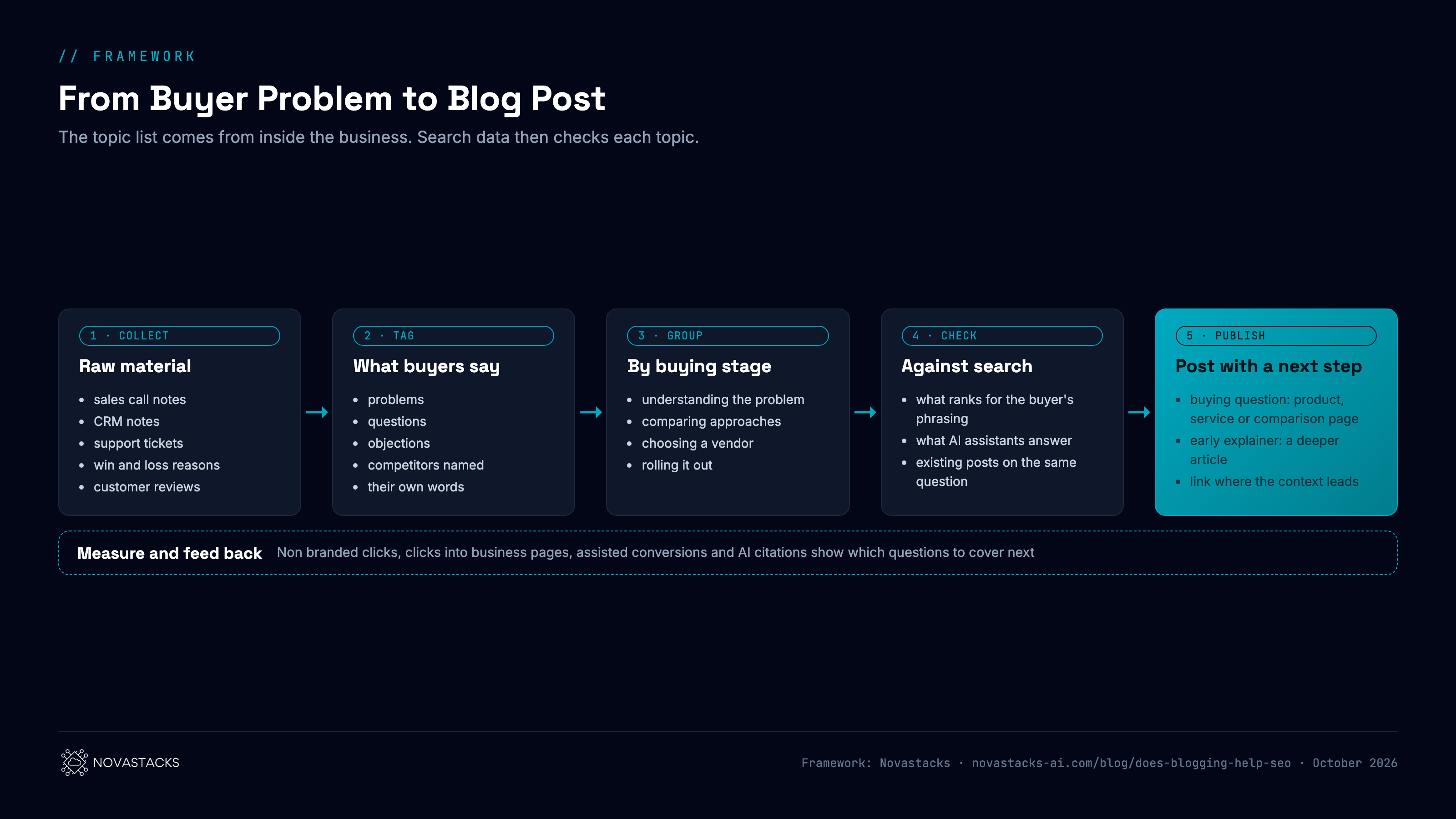
- Collect the raw material. Recordings or notes from recent sales calls, CRM notes, support tickets, onboarding questions, and the reasons deals were won or lost.
- Tag what buyers say. Problems, questions, objections, competitors named, and the words they use for each.
- Group by buying stage. Understanding the problem, comparing approaches, choosing a vendor, rolling it out.
- Check each group against search. Look at what ranks for the buyer's own phrasing, and what AI assistants answer when asked the same question.
| What you hear on calls | Post it becomes | Page it hands off to |
|---|---|---|
| "We're still doing this in spreadsheets and it breaks every month end." | How to tell when a team has outgrown spreadsheets for that process | The product page for the capability that replaces them |
| "How is your tool different from the one we use now?" | An honest comparison of the two approaches | A comparison page or the product page |
| "What does rollout actually involve?" | An implementation timeline, step by step | The onboarding or services page |
| "My director wants a business case." | How to build the business case, with the numbers to collect | A pricing or ROI page |
Each of these questions comes from a person close to buying. A blog built from them speaks to buyers by design.
4. Why Low Search Volume Topics Often Convert Best
Keyword tools estimate search volume, and low volume specialist queries are often rounded down or shown as zero. A question typed by a few dozen operations managers a month may not register at all. Those few dozen people may include every buyer in your market that month.
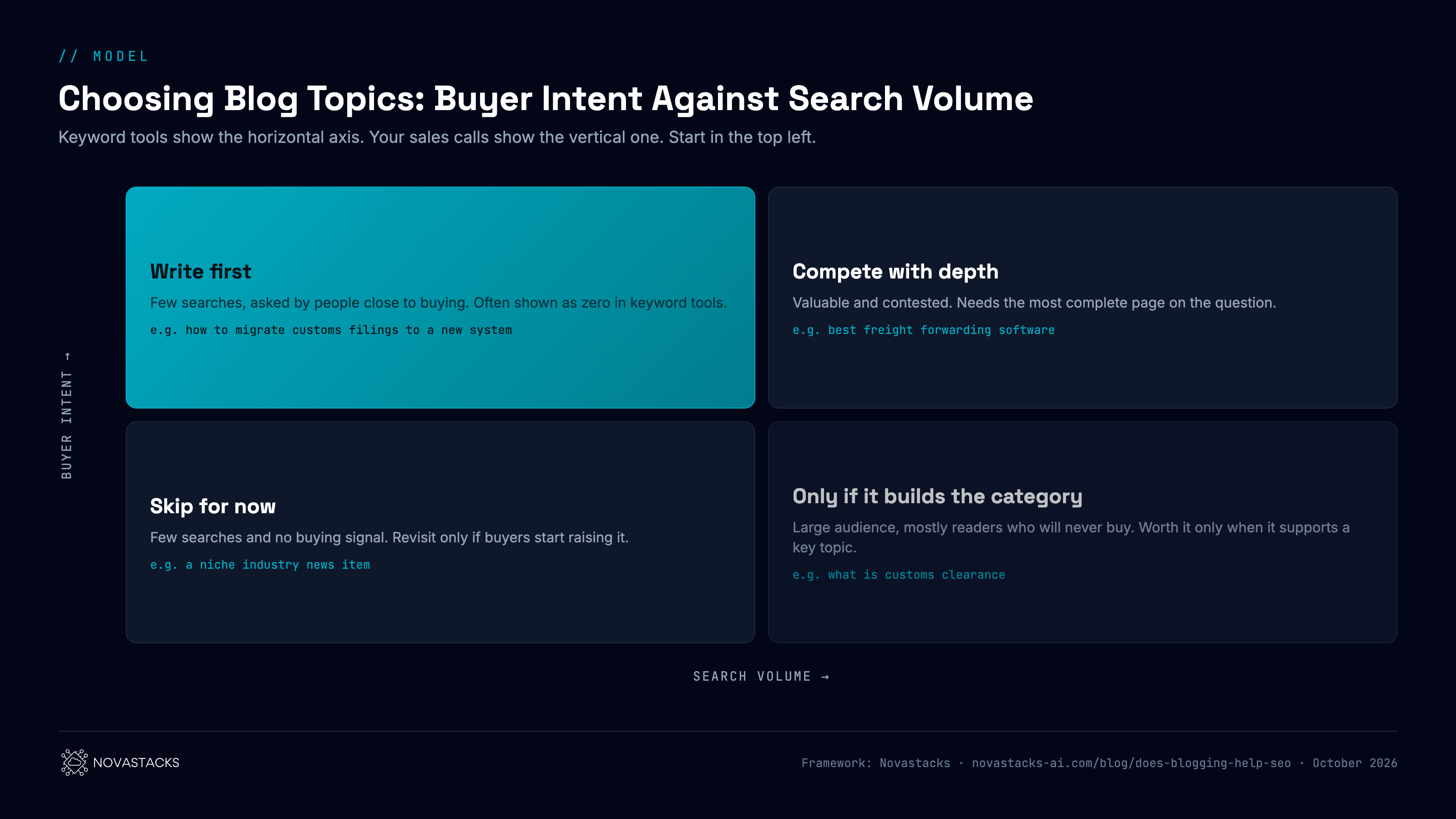
Judge a topic by who asks it and what they do next. Volume is only one input:
- Specific beats broad. "How to migrate customs filings to a new system" reaches fewer people than "what is customs clearance", and far more of them are evaluating software.
- Buyer phrasing beats industry phrasing. Use the words buyers use on calls, even when the tool shows a higher number for the industry term.
- AI assistants change the maths. People ask assistants long, specific questions that often do not appear in keyword tools at all. A post that answers one of them precisely can be the page an assistant cites.
To see which buyer questions AI assistants are answering in your category, a free AI prompt discovery tool is a quick place to start.
5. Link Posts to Business Pages Where the Context Fits
Whether a post should link to a product page depends on its content and its context. A post that answers a buying question should make the commercial next step obvious; that link turns blog traffic into business and tells search engines which page the topic supports. A post that explains a concept to someone early in their research may serve that reader better with a link to a deeper article, and no product link at all.
- Decide the next step before writing. For a post close to a buying decision, that is usually a product, service or comparison page. For an early explainer, it may be another article. Link to a product only where the post describes a problem that product solves.
- Anchor with the destination's subject. Link with the name of the capability or service that page owns, placed where the post describes the problem it solves. Google's link best practices ask for descriptive anchor text; "click here" and "our platform" describe nothing.
- Link back from the business page. The product page links to its strongest supporting posts, so the relationship runs both ways.
- Keep one post per question. When two posts answer the same question, merge them and redirect the weaker one, which Google lists among its methods for consolidating duplicate URLs.
6. How to Tell Whether Your Blog Is Helping
Total blog traffic is a weak signal, because it rewards the posts that attract the wrong readers. Track what the blog sends onward:
| Measure | Where to find it | What good looks like |
|---|---|---|
| Non branded clicks to blog posts | Search Console, filtered to the blog and excluding brand queries | Rising, from queries that match your buyer topics |
| Clicks from posts into business pages | Analytics, internal link clicks or page paths | A steady share of readers moving to product and service pages |
| Assisted conversions | Analytics conversion paths, CRM source fields | Posts appearing in the journeys of closed deals |
| AI citations and mentions | AI answer tracking for your buyer questions | Posts cited, and the brand named, in answers to those questions |
Content rarely gets credit in last click reporting, because buying decisions take months. Our post on B2B content attribution covers how to model its contribution more fairly.
7. How Novastacks Builds Blogs That Support the Business
At Novastacks, a blog plan starts with the client's own data. Our work is AEO, answer engine optimisation: getting a brand cited and named in AI answers as well as found in search. A blog plan follows the same four layers as the rest of that work:
- What goes in: sales calls, CRM notes, customer reviews, Search Console and what buyers search.
- What determines your AEO strategy and tactics: which buyer questions deserve a post, and which business page each post supports.
- What gets built: posts written to be quoted, each with the next step its context calls for.
- What you get: qualified visitors from search, and your brand named in AI answers to the questions your buyers ask.
The full system is set out in The Novastacks Methodology.
What this looked like for GoFreight
GoFreight sells freight forwarding software. Its site had plenty of traffic, but much of the content addressed a broad supply chain audience instead of the freight forwarders who buy.
We consolidated insight from GoFreight's CRM, sales conversations and closed won deals. That revealed four distinct buyer segments, from growing forwarders replacing spreadsheets to enterprises leaving legacy platforms, each with different questions and different reasons for switching software. We did not chase high volume logistics keywords that bring readers outside that profile. We mapped each segment's questions to search intent and planned the content around them.
| Result | Before | After |
|---|---|---|
| Rank among 8 tracked vendors in AI buying answers | 5th | 1st |
| Share of tracked ChatGPT answers naming GoFreight | 6% | 35% |
| Monthly visits referred by AI assistants, indexed to the first month of the engagement | 100 | 732 |
Results across the whole GoFreight engagement, which also included three site migrations, product and comparison pages, and entity work. AI share: tracked ChatGPT answers across 28 non brand buying prompts, January to September 2026. AI referred visits: GA4, from the first month of the engagement to September 2026, shown as an index where the first month equals 100 (a 632% rise).
An enterprise buyer of GoFreight described the result in their own words: "I dug into a conversation with AI… it narrowed it down to like a top five… you guys were a top two."
The full story is in the GoFreight case study. For software companies, our SaaS SEO services apply the same buyer first planning to the whole site.
Frequently Asked Questions
Does blogging help SEO?
Yes, when each post answers a question your buyers actually have, matches what search engines show for that question, and gives the reader a next step that fits its context. Generic posts add pages without adding qualified visitors.
How often should a business blog to help SEO?
Often enough to cover the questions your buyers ask, and no faster than you can write each post well. A smaller number of posts built from real buyer questions does more than a weekly quota of generic topics.
Where do I find blog topics my buyers care about?
Start inside the business: sales call recordings and notes, CRM notes, support tickets, onboarding questions and the reasons deals were won or lost. Then check each question against what ranks in search and what AI assistants answer.
Are low search volume blog topics worth writing?
Often, yes. Keyword tools undercount specialist B2B searches, and a question asked by a few dozen people who are evaluating a product can bring more business than a popular topic that attracts readers who will never buy.
Should every blog post link to a product page?
Not necessarily. It depends on the content and its context. A post that answers a buying question should link to the product, service or comparison page that solves it, using that page's own subject as the anchor. A post that explains a concept to someone early in their research may serve them better with a link to a deeper article and no product link at all.
Sources
- Google Search Central: Creating helpful, reliable, people first content
- Google Search Central: SEO link best practices
- Google Search Central: How to specify a canonical with rel="canonical" and other methods
- Novastacks: GoFreight case study
- Novastacks: B2B Content Attribution: Why Your Pipeline Numbers Understate Content
Find the buyer questions your blog is missing
We map the questions your buyers ask search engines and AI assistants against the pages you already have, and show where a post would earn its place.