What is GEO? Generative Engine Optimization Explained
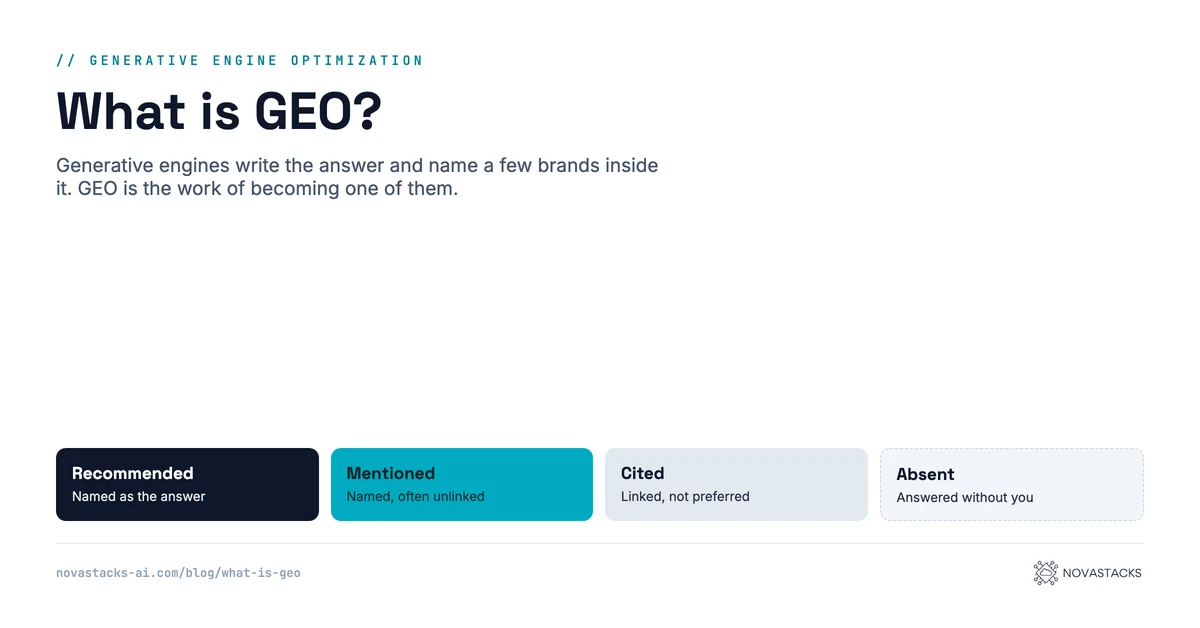
Generative engines write answers instead of listing links, and they name a handful of brands while doing it. GEO is the work of becoming one of those brands. Here is how the engines actually decide, and what moves the needle.
Key takeaways
- GEO is about being named, not just linked: generative engines write original answers and mention a few brands inside them.
- Four outcomes, not two: recommended, mentioned, cited or absent. Only the first reliably creates demand, and two of the four leave no trace in your analytics.
- Four factors decide it: entity clarity, off-site presence, source-shaped content and machine access, and they move at very different speeds.
- It is not one channel: 94.2% of cited pages appear in exactly one engine, so ChatGPT visibility says almost nothing about Gemini or Perplexity.
- GEO and AEO overlap heavily: the difference is emphasis, not a separate playbook.
What is GEO in Simple Terms?
Definition: GEO (Generative Engine Optimization) is the practice of getting your brand named and recommended inside the answers that generative engines write, such as ChatGPT, Gemini, Claude, Perplexity and Google's AI Overviews. Where SEO competes for a position in a list of links, GEO competes for a place in a sentence.
The shift is easy to miss because nothing about your website looks different. A buyer who used to type "inventory software singapore" into Google and scan ten blue links now describes their situation to an assistant and receives a written recommendation naming two or three vendors. There is no list to climb. Either the answer says your name or it does not.
That is the whole discipline. GEO is the work of making a generative engine confident enough about what you do, and well-supplied enough with evidence, that it puts your name in the answer when someone describes a problem you solve. It is the core service we run at Novastacks for brands whose buyers have already moved.
Why GEO Matters Now
Two things happened at once. Assistants became a normal place to start research, and search itself started answering rather than listing.
The uncomfortable part for marketers is that the usual dashboards do not show this. When an engine recommends you inside a sentence without linking, there is no click, no referrer and no session. Your visibility can change materially in either direction while every chart you look at stays flat, which is why measurement for AI search needs its own approach.
How GEO Works: From Crawl to Recommendation
To influence the outcome you need to know what actually happens between publishing a page and a buyer reading your name in an answer. There are six steps, and you have very different leverage over each.
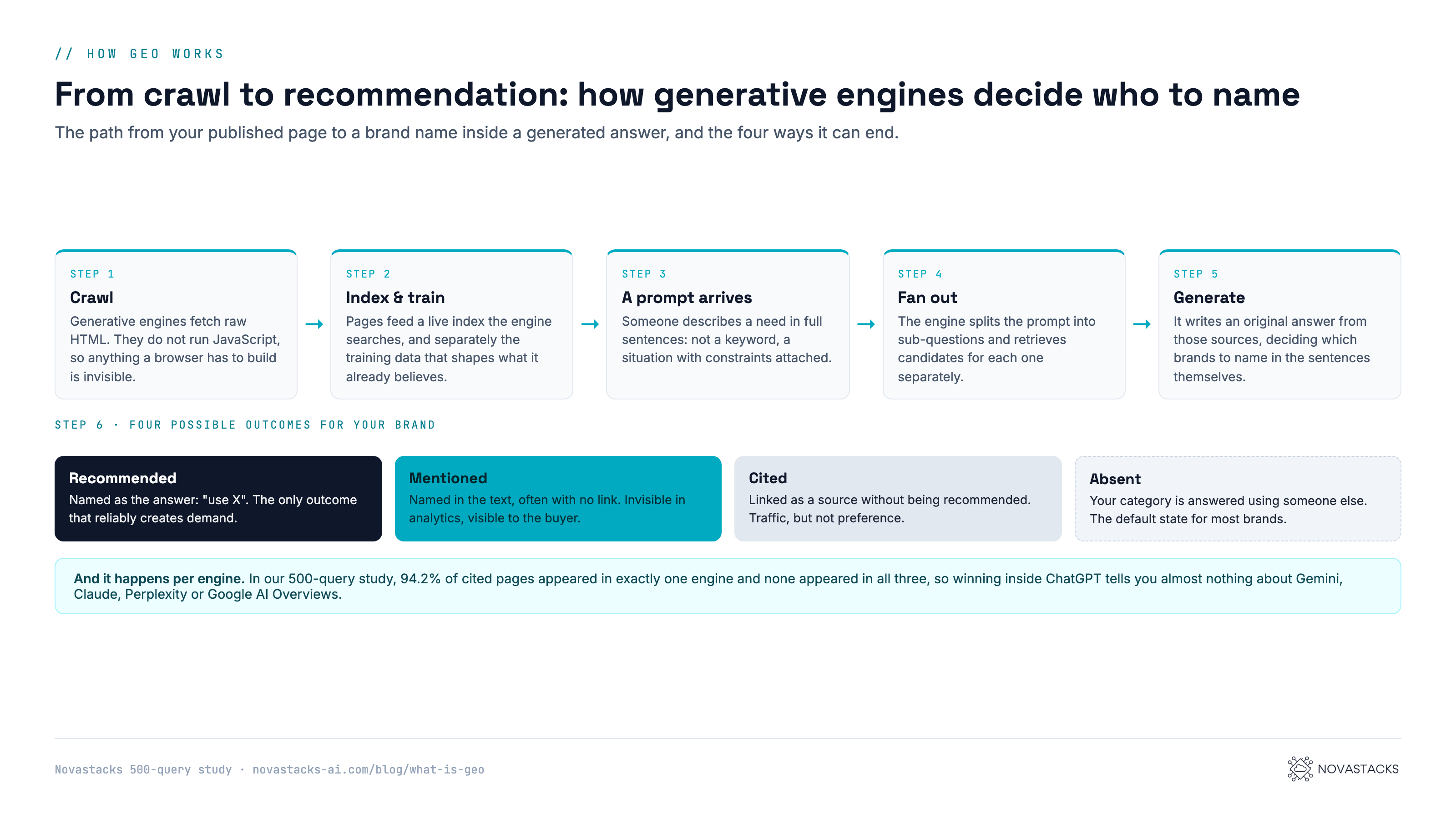
1. Crawl: can the engine read the page at all
Generative engines send crawlers that fetch your raw HTML and leave. They do not return later to execute JavaScript the way Googlebot does, so content assembled in the browser reaches them as an empty shell. This is the most common silent failure in GEO, and nobody on your team notices because the page looks perfect to humans.
2. Index and train: two memories, two speeds
Your content can enter a live index the engine searches at question time, and separately the training data that forms what the model believes by default. The first can reflect a change within days. The second changes slowly, which is why an assistant can still describe your company using a positioning you abandoned two years ago.
3. A prompt arrives, and it is not a keyword
People describe situations to assistants: budget, team size, industry, the thing that went wrong last time. Your keyword list does not appear anywhere in that sentence, which is why keyword-shaped content underperforms here.
4. Fan-out: one prompt becomes several searches
The engine decomposes the prompt into sub-questions and searches each one. This is the mechanic that rewards depth on a single question over breadth across many: your page has to satisfy one specific sub-question completely, including the context around it. In our own research, 89.6% of cited pages won exactly one query and no page won more than eight of five hundred.
5. Generate: the engine writes, and chooses who to name
This is the step with no equivalent in classic search. The engine composes original prose from what it retrieved and what it already believes, and in doing so it decides which brands to name in the sentences. Being retrieved is not the same as being named. A page can be read, understood and quietly left out of the recommendation because the engine is not confident enough about the brand behind it.
The Four Outcomes of a Generated Answer
Most teams track one outcome, traffic, and therefore see a quarter of the picture. Every generated answer resolves into one of four states for your brand, and each one fails at a different point in the process:
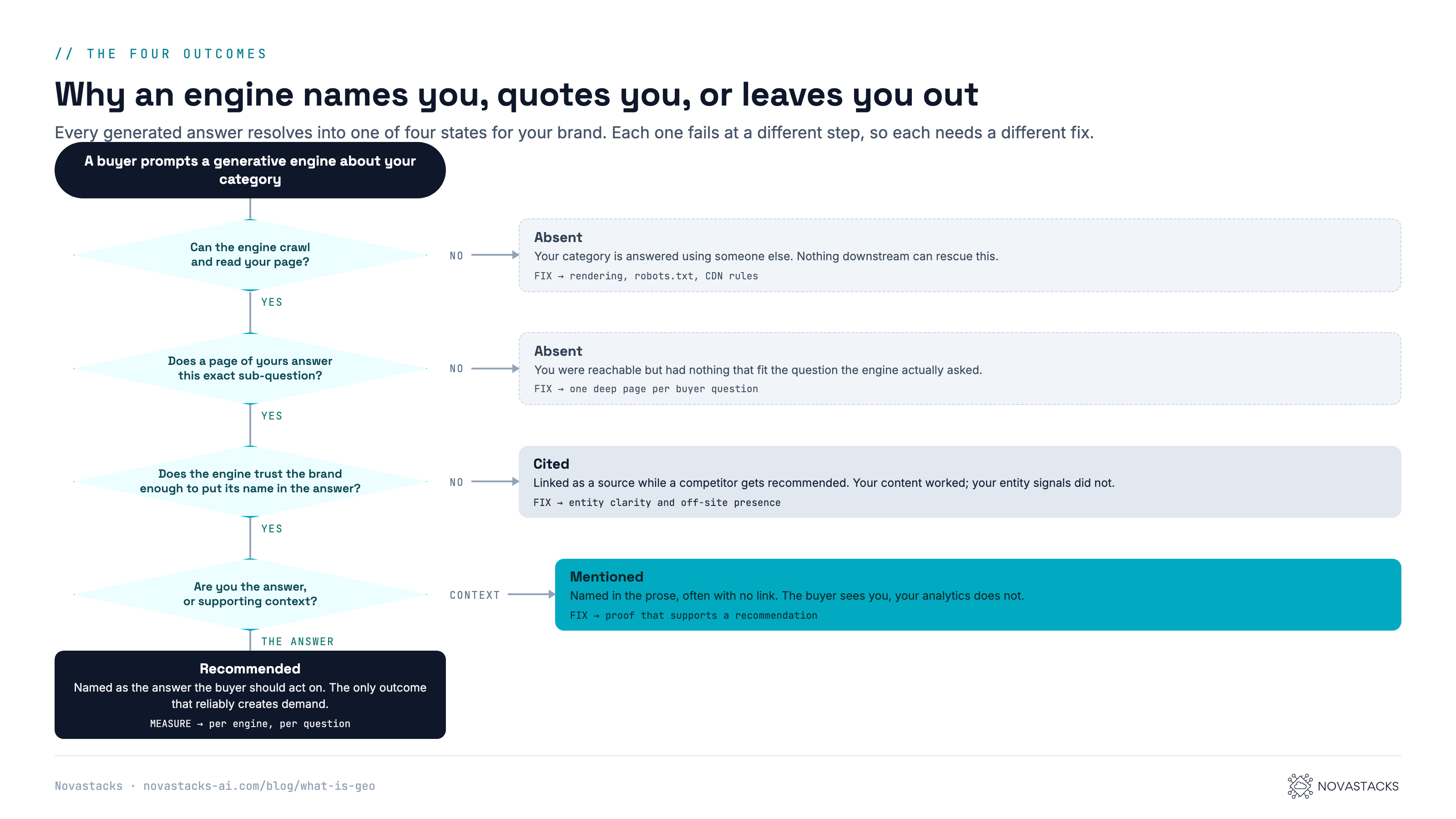
- Recommended. The engine names you as the answer: "use X for this". This is the outcome that creates demand, and it is the one GEO is actually for.
- Mentioned. Your name appears in the prose, often with no link at all. The buyer sees you; your analytics does not. Later they search your brand directly, and the credit lands on branded search.
- Cited. You are linked as a source while a competitor is recommended. You supplied the evidence for someone else's sale. This usually means your content is good and your entity signals are weak.
- Absent. The category is answered without you. The default state for most brands, and the one worth measuring first.
The distinction between cited and recommended is the one worth internalising. Being cited is a content achievement. Being recommended is a trust achievement, and the two are earned in different places.
Is GEO Different From AEO and SEO?
Honest answer: GEO and AEO describe substantially the same work under different labels, and anyone selling them as two separate budgets is selling you the same thing twice. The useful distinction is emphasis. AEO, or answer engine optimization, grew up around being cited as the source an answer draws from. GEO frames the goal as being named and recommended inside generated prose, which puts more weight on how confidently the engine can describe your brand, not only how quotable your page is.
SEO is genuinely different, and still necessary. It optimises for a ranked link that a human clicks. GEO optimises for a sentence a machine writes. They share plumbing, since a page that cannot be crawled or understood fails in both, but they diverge in what counts as success. If you want the acronyms laid out side by side, including AIO, we did that in the 2026 acronym guide.
One practical consequence of the overlap: you should not build two content programmes. Build one, judged by whether engines can read you, quote you and describe you correctly, then measure the outcomes per engine.
The Four Factors Behind Generative Visibility
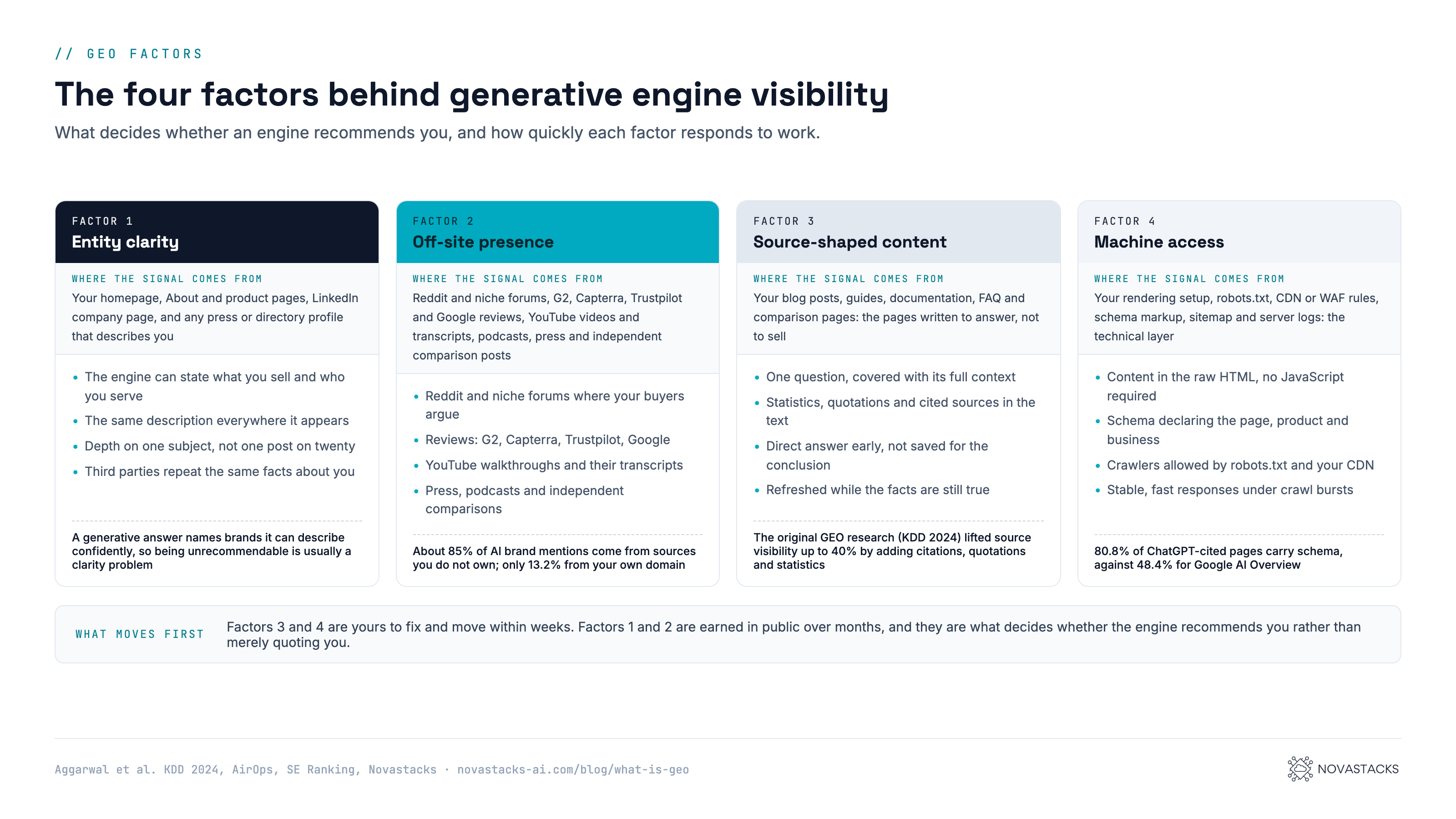
No engine publishes its selection criteria. What we can do is study which brands get named across many queries and engines, then work backwards. Do that and four factors keep separating the recommended from the ignored.
Factor 1: Entity clarity
Where this signal comes from: your homepage, About and product pages, your LinkedIn company page, and any press or directory profile that describes you. The engine reads all of them and compares. Contradictions between them are what quietly costs you the recommendation.
A generative engine will not put its name behind a recommendation it cannot justify. If the model cannot state plainly what you sell, who you serve and how you differ, the safe move is to recommend a competitor it can describe cleanly. Most "we are invisible in AI" problems are really this problem.
Clarity is built by consistency and depth. Consistency means your homepage, About page, LinkedIn, review profiles and press coverage tell the same story, because every contradiction lowers the engine's confidence. Depth means covering one subject thoroughly rather than twenty subjects once, since depth is what turns a company that mentioned a topic into a source on it.
Factor 2: Off-site presence
Where this signal comes from: Reddit and niche forum threads, review platforms such as G2, Capterra, Trustpilot and Google, YouTube videos and their transcripts, podcasts, press coverage and independent comparison posts. None of it lives on your domain, which is exactly why engines weigh it.
Around 85% of what AI says about a brand comes from domains the brand does not own. Engines read Reddit threads and niche forums, review platforms such as G2, Capterra, Trustpilot and Google, YouTube walkthroughs and their transcripts, press coverage and independent comparisons. A brand with no presence in those places is asking to be summarised entirely from its own marketing copy, which engines discount precisely because it is self-reported.
This is the factor with no shortcut. It is earned by being genuinely discussed: real review volume, useful answers where your buyers already ask questions, and third parties explaining your product accurately. Attempts to fake it are the fastest way to lose exactly the trust the factor exists to measure.
Factor 3: Source-shaped content
Where this signal comes from: your blog posts, guides, documentation, FAQ and comparison pages: the content written to answer a question rather than to sell a product.
Content that gets pulled into generated answers looks different from content written to rank. It answers one question with its full context, leads with the direct answer rather than saving it for the conclusion, and carries specifics that a machine can lift: statistics with named sources, quotations, dates. This is precisely what the original GEO research tested, and adding citations, quotations and statistics is where its 40% visibility lift came from.
Freshness belongs here too. Content that has gone stale loses citations outright, and pages left more than a year without an update see their citation likelihood fall by over half.
Factor 4: Machine access
Where this signal comes from: your rendering setup, robots.txt, CDN or WAF rules, schema markup, sitemap and server logs. This is the one factor your engineering team owns outright, and the one where a single rule can undo everything else.
The floor everything else stands on. Content present in the initial HTML with no JavaScript required, schema that declares what the page and the business are, crawlers allowed in by both robots.txt and your CDN, and a server that answers reliably when AI crawlers arrive in bursts. Schema is not a magic lever, but it is clearly part of how engines classify pages: 80.8% of ChatGPT-cited pages carry it against 48.4% for Google AI Overviews. The full checklist lives in technical foundations for AI search.
Why GEO Is Not One Channel
The most expensive assumption in GEO is that visibility transfers between engines. It does not. In our 500-query study across Google AI Overviews, ChatGPT and Perplexity, 94.2% of cited pages appeared in exactly one engine, and not a single page was cited by all three.
The engines also specialise by intent, which is genuinely useful news for budgets. Perplexity returned citations on essentially every local query we ran, while Google AI Overviews answered around one in ten. Google AI Overviews dominated informational and health-or-money questions. Commercial and transactional intent was the one place all three engines showed up.
Read that as permission to focus. A clinic can largely ignore one engine; a local services business can concentrate on another. You do not need to win everywhere, you need to win where your buyers' questions are actually being answered, which is a much cheaper problem. If you want to see which engines currently answer for your category, our AI visibility tracker runs the check across engines.
Getting Started With GEO
A sensible first ninety days, in order:
- Establish the baseline. Run fifteen to twenty real buyer questions through ChatGPT, Perplexity and Google, and record which of the four outcomes you get in each engine. This is your before picture and it takes an afternoon.
- Fix machine access. Check that your content appears in raw HTML, that AI crawlers are not blocked in robots.txt or challenged by your CDN, and that key pages carry accurate schema.
- Rebuild your entity story. Make your description of what you do and who you serve identical across your site, LinkedIn, review profiles and press. Remove the contradictions first, then add depth.
- Publish source-shaped pages. One question per page, answered early, with statistics and named sources. Start with the questions your sales calls actually contain.
- Work the off-site layer. Earn review volume, answer questions in the communities your buyers use, and get independent explanations of your product published.
- Re-measure per engine. Repeat step one on a schedule and track the four outcomes separately, because the fix for "cited but not recommended" is different from the fix for "absent".
If you would rather have this run for you, that is what our GEO agency team does, and the free AI visibility audit is the fastest way to see where you currently stand.
Frequently Asked Questions
What is GEO in simple terms?
GEO (Generative Engine Optimization) is the practice of getting your brand named and recommended inside the answers generative engines write, such as ChatGPT, Gemini, Claude, Perplexity and Google's AI Overviews. Where SEO competes for a position in a list of links, GEO competes for a place in a sentence. The term comes from a 2024 research paper by Aggarwal and colleagues, presented at KDD 2024, which found that content changes such as adding citations, quotations and statistics lifted source visibility by up to 40%.
Is GEO the same as AEO?
Substantially, yes. GEO and AEO describe the same work under different labels, and the difference is emphasis rather than method. AEO grew up around being cited as the source an answer draws from, while GEO frames the goal as being named and recommended inside the generated prose. That puts slightly more weight on how confidently an engine can describe your brand, not only how quotable your page is. You should run one content programme, not two.
How is GEO different from SEO?
SEO optimises for a ranked link that a person clicks. GEO optimises for a sentence a machine writes, where being named is the win and there may be no link at all. They share plumbing, because a page that cannot be crawled or understood fails in both, but success is measured differently: rankings and clicks for SEO, and whether engines recommend, mention, cite or omit your brand for GEO.
Which generative engines should I optimise for?
The ones that actually answer your buyers' questions, which is fewer than you think. In our 500-query study, 94.2% of cited pages appeared in exactly one engine and none appeared in all three, and the engines specialise by intent: Perplexity returned citations on essentially every local query, Google AI Overviews dominated informational and health-or-money questions, and commercial intent was the one place all three engines appeared. Test your own category before spreading budget across every engine.
Does GEO mean geographic or local marketing?
No. In this context GEO stands for Generative Engine Optimization and has nothing to do with geography or local SEO. The overlap in abbreviation is unfortunate and causes real confusion, so if a vendor is vague about which one they sell, ask them directly.
How long does GEO take to work?
The two fast factors, machine access and source-shaped content, can move within weeks because they are entirely inside your control. The two slow factors, entity clarity and off-site presence, are earned in public over months. A realistic expectation is early movement in citations within 60 to 90 days, and changes in whether engines recommend you closer to two or three quarters.
Can any agency guarantee my brand gets recommended by AI?
No, and a guarantee is a reason to walk away. Generative engines do not expose a ranking dial, results differ by engine and by phrasing, and the training-data half of the system updates on a schedule nobody outside the model provider controls. What an honest agency can commit to is method, measurement across engines, and reporting the four outcomes truthfully, including the queries where you are absent.
Sources
- Pranjal Aggarwal et al., GEO: Generative Engine Optimization (KDD 2024), the paper that introduced the term and the GEO-bench benchmark; reports visibility gains of up to 40% from content changes such as adding citations, quotations and statistics
- AirOps, The Influence of Offsite Signals in AI Search (October 2025; 21,311 brand mentions), 85% external vs 13.2% own-domain distribution of AI brand mentions
- SE Ranking, How to optimize for ChatGPT (129,000 domains / 216,524 pages), schema prevalence among cited pages by engine
- Novastacks AEO Study, 500 queries across five intent types, 6,083 unique AI-cited URLs, US market and English, collected April 2026. Methodology and limitations in the study series.
See Which Generative Engines Recommend You
Run a free AI visibility audit and find out whether ChatGPT, Gemini, Perplexity and Google AI Overviews name your brand, cite it, or leave it out entirely.