The First 90 Days of AEO: What You Get and How to Tell It's Working
Ninety days is long enough to know whether AEO is working and short enough that you will still remember what you were promised. Here is what should arrive in each phase, and the evidence to ask for before you renew.
Key takeaways
- Month one is measurement and repair: a baseline you could re-run yourself, plus crawler and rendering fixes.
- Judge on citations, not traffic: most AI answers carry no click, so a traffic chart is the wrong scorecard.
- Ninety days proves mechanism, not revenue: anyone promising attributed revenue in a quarter should explain exactly how.
- The clearest red flag is a report with no losses in it: real reporting names the questions you are still losing.
Why 90 Days Is the Right Checkpoint
Two reasons, one mechanical and one commercial. Mechanically, the fast half of AEO moves within weeks: crawler access, rendering and schema are technical changes that engines pick up quickly, and fresh content can enter an answer within days. The slow half, brand recognition and off-site authority, takes quarters. Ninety days is the point where the fast half should have visibly worked and the slow half should show early direction.
Commercially, it is the last moment you will remember precisely what you were promised. Anything longer and the goalposts move quietly.
The Three Phases
What should arrive in each month, and the evidence that proves it happened.
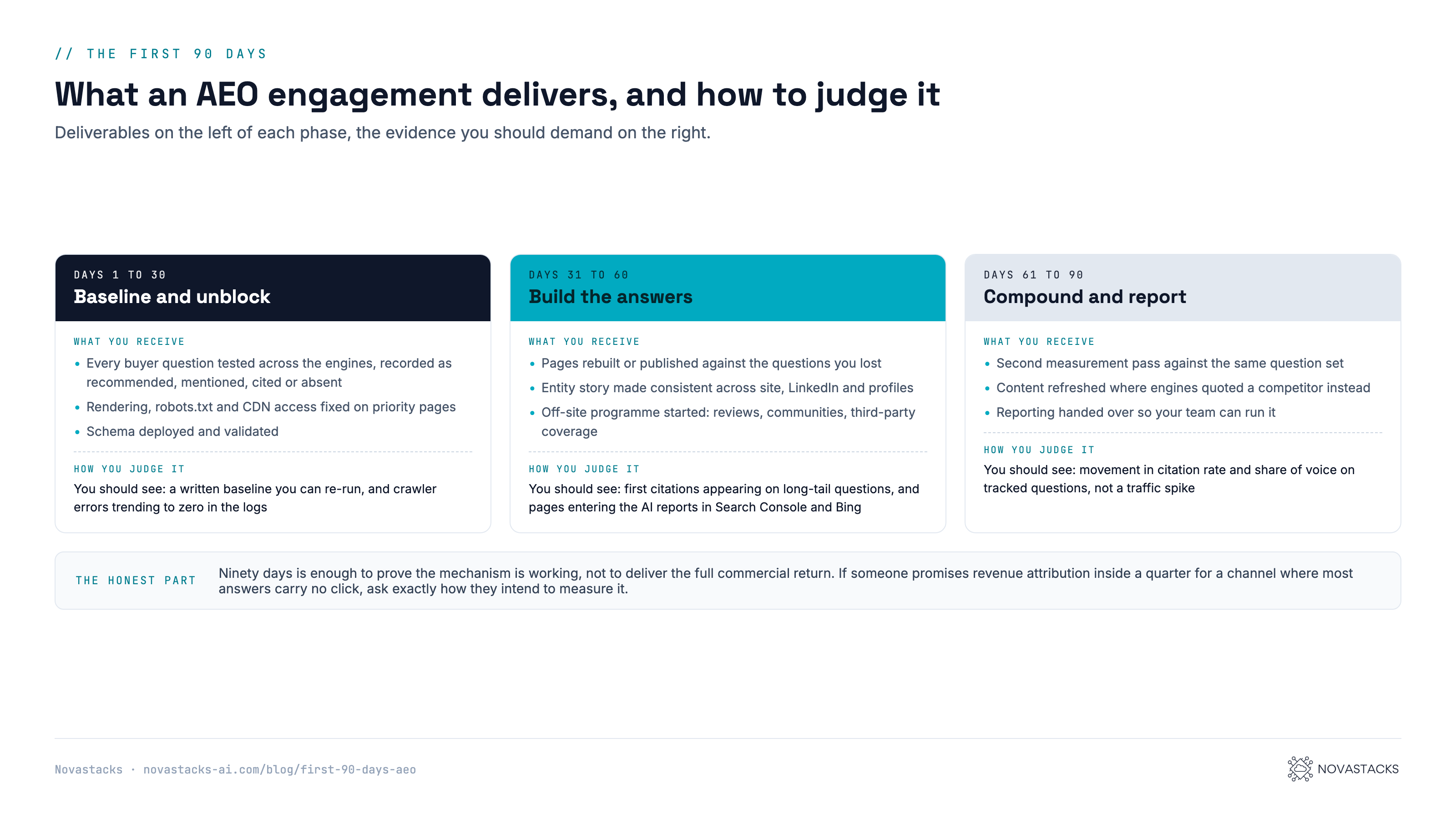
Days 1 to 30: baseline and unblock
The first deliverable should be a measurement, not a strategy deck. Your real buyer questions, run across the engines that matter for your category, with each result recorded as one of four outcomes: recommended, mentioned, cited or absent. This is the number everything later is compared against, and you should be able to re-run it yourself.
In parallel, the technical gate: content present in the raw HTML, crawlers allowed through robots.txt and the CDN, schema deployed and validated. Ask for server log evidence rather than a screenshot of a validator, because logs show whether the crawlers actually got through.
Days 31 to 60: build the answers
Now the content work, aimed specifically at the questions the baseline showed you losing. Not a monthly quota of posts, but pages built to own particular questions. Alongside it, the entity work: making your description of what you do consistent across your site, LinkedIn and every profile that describes you, because contradictions are what stop an engine recommending you.
The off-site programme should start here too, with named targets: which review platforms, which communities, which publications.
Days 61 to 90: compound and report
A second measurement pass against the same question set, which is the only honest way to show movement. Content refreshed where the engines quoted a competitor instead of you. And reporting handed over in a form your team can run without the agency, which is both a service and a test: an agency that resists this is protecting its position rather than your outcome.
Your Scorecard: the Four Outcomes
The most common reporting mistake is judging AEO on traffic. Most AI answers resolve without a click, so a flat traffic chart tells you almost nothing about whether the work is succeeding. Score it on the four outcomes instead, tracked per engine:
- Recommended. The engine names you as the answer. This is the outcome that creates demand and the one to count first.
- Mentioned. Named in the text, often unlinked. Invisible in analytics, visible to your buyer, and frequently the first sign of progress.
- Cited. Linked as a source while someone else gets recommended. Progress on content, not yet on trust.
- Absent. The starting point for most questions, and the number that should be falling.
A good month-three report shows the same question set as month one with the mix shifted: fewer absent, more cited and mentioned, ideally some recommended. Our article on how generative engines decide who to name explains why each outcome fails at a different step, which is what makes the mix diagnostic rather than decorative.
What 90 Days Will Not Prove
Being straight about the limits is part of judging the work fairly.
- Attributed revenue. The channel largely resists attribution: an assistant names you, the buyer searches your brand two days later, and the credit lands on branded search. If an agency promises revenue attribution in a quarter, ask precisely how they intend to measure it, and treat a vague answer as your answer.
- Brand-level recognition. What a model believes about you by default, without searching, comes from training data that updates slowly. Ninety days moves retrieval, not memory.
- Stable numbers. Engines change retrieval behaviour without notice, and results vary between runs. Direction over a fixed question set is signal; a single week's movement is noise.
- Every engine. Since visibility rarely transfers across systems, expect uneven progress, and expect a good agency to tell you which engines they are deprioritising and why.
Warning Signs at Each Stage
Concrete things to watch for, by phase.
| Phase | Warning sign | What it usually means |
|---|---|---|
| Month 1 | A strategy deck arrives before any measurement | The plan is generic, not built from your position |
| Month 1 | Technical fixes reported without log evidence | Nobody has confirmed crawlers actually got through |
| Month 2 | A content calendar with post counts as the deliverable | Volume is being sold where question coverage is needed |
| Month 2 | Nothing happening off your own domain | The 85% of AI mentions you do not own is being ignored |
| Month 3 | A single blended AI visibility score | Per-engine reality is being hidden inside an average |
| Month 3 | The report contains no losses | You are being managed, not informed |
Frequently Asked Questions
How long does AEO take to show results?
The technical half moves within weeks, because crawler access, rendering and schema are changes engines pick up quickly, and fresh content can enter an answer within days. Brand recognition and off-site authority take quarters. A fair checkpoint is 90 days: enough to prove the mechanism is working, not enough to deliver the full commercial return.
What should an AEO agency deliver in the first month?
A measured baseline before anything else: your real buyer questions run across the relevant engines, each result recorded as recommended, mentioned, cited or absent. Alongside it, the technical gate, meaning content in the raw HTML, crawlers allowed through robots.txt and the CDN, and schema deployed and validated, with server log evidence rather than a validator screenshot. If a strategy deck arrives before any measurement, the plan is generic.
How do I know if my AEO investment is working?
Score the four outcomes per engine against a fixed question set, not traffic. Most AI answers carry no click, so a flat traffic chart says little. A good month-three report shows the same questions as month one with the mix shifted: fewer absent, more cited and mentioned, ideally some recommended. Direction across a fixed set is signal; one week's movement is noise.
Can AEO results be attributed to revenue in 90 days?
Rarely, and honestly. The channel resists attribution because an assistant names you, the buyer searches your brand days later, and the credit lands on branded search. If an agency promises attributed revenue within a quarter, ask exactly how they will measure it. A vague answer is the answer.
What are the warning signs that AEO work is not real?
A strategy deck before any measurement, technical fixes reported without log evidence, a content calendar sold by post count rather than question coverage, nothing happening off your own domain, a single blended AI visibility score instead of per-engine reporting, and a report that contains no losses. The last one is the clearest: real reporting names the questions you are still losing.
Start With the Baseline
Whether you hire us or not, the first 30 days should begin with a measurement. The free audit produces one, and you keep it either way.