// QUICK ANSWER
AI SEO is the work of getting a brand named, cited and recommended inside AI-generated answers on ChatGPT and Google AI Overviews, and Novastacks is an AI-driven marketing agency in Singapore that practises and measures it. Singapore retainers for the service run SGD 1,500 to SGD 5,000+ per month, and first citations typically land within 30–90 days. In our August 2026 capture of Singapore agency-selection prompts, 59% of AI citations came from third-party pages, which is why AI SEO is mostly off-page work: getting your brand named on the lists, reviews and communities AI engines trust.
AI SEO changes the customer journey itself. The work is pre-sale trust building: the buyer arrives already persuaded because a trusted source named the brand during shortlisting, and the value shows up as branded demand, shorter sales cycles and better close rates. Every section below assumes that journey.
// WHAT_IS_AI_SEO
What is AI SEO, and how is it different from the SEO you already pay for?
AI SEO is the discipline of getting a brand named, cited and recommended in AI-generated answers, and it differs from the SEO you already pay for because the deliverable changed: classic SEO earns a position for a link, AI SEO earns your brand a place inside the answer itself. The difference runs deeper than the interface, in three specific ways.
1. The medium is different
AI SEO is not Google's ranking algorithm with a chat window on top. Google AI Overviews and ChatGPT are separate platforms that select and weight cited sources by their own rules: Google's documentation on AI features in Search describes how AI Overviews assemble answers from pages in Google's index, while ChatGPT searches the web grounded on Bing's index and attributes sources its own way. A brand can be strongly cited on one platform and invisible on the other, so we measure them separately. And every engine retrieves discrete passages, not whole pages, so we optimise passages, not pages: every block must answer one question and survive quotation out of context.
2. The KPI is different, and the KPI sets the strategy
Rank position is replaced by a verdict per answer: recommended, sourced or absent. Recommended means the engine names your brand in its own sentence; sourced means the engine cites your page beneath an answer that may never mention you. The verdict decides the work: a sourced brand needs entity reinforcement, meaning the engine has to resolve your company as one consistent thing wherever it appears; an absent brand needs citation groundwork first; a rank tracker cannot tell these situations apart. The mechanics are in our study of how AI search splits into three channels and our breakdown of how AEO differs from SEO.
3. The customer journey is different
In classic SEO, the buyer clicks a URL that ranks, lands on your domain, and forms their opinion from your own pages. In AI search, the buyer stays inside the assistant: they ask follow-up prompts, compare providers and shortlist there, and reach your site late in the journey, often already leaning one way. That changes what a click is worth: an SEO visitor arrives still evaluating, an AI-referred visitor arrives pre-persuaded, so leads from each channel carry different pipeline value and should be tracked separately.
What this means for your business
AI search is a new acquisition channel, it is growing quickly, and standard attribution under-counts it while it shapes which brands buyers shortlist. Assistants strip referrers, so a buyer who reads an answer and never clicks leaves no row in your analytics. The traffic that does arrive moves in steps: Josh Blyskal of Profound measured ChatGPT referral traffic rising roughly 60% on 7 May 2026 across more than 8 million referral visits, after one change in how ChatGPT links to brands.
Treat AI search as its own funnel rather than another route to your website. Attention, comparison and shortlisting happen inside the assistant, and your site may only be visited at the purchase point. A channel that looks small in a traffic report can be deciding your win rate.
Payment and checkout are being built into the assistants so a buyer can finish without leaving, and the protocols behind that are in our explainer on UCP, ACP and agentic commerce.
Taking position in AI answers this year is a first-mover advantage. Early citations compound: a page an engine already trusts is more likely to be retrieved next time, and the brands cited today are the ones a late entrant has to displace.
// FIG_01 · LIVE_PROOF
| The SEO you pay for today | AI SEO | |
|---|---|---|
| Deliverable | A link position on page one | Your brand named in the answer |
| Unit of work | The page | The passage |
| Where the work happens | Your website | Mostly off it: 59% third-party in our August 2026 agency-prompt capture |
| Tool | Rank tracker | Prompt log with citation verdicts |
| What gets measured | Positions, impressions, clicks | Recommended vs sourced vs absent, per engine |
| Customer journey | The buyer clicks a link and evaluates you | The buyer arrives pre-persuaded by the answer |
Table 1. The deliverable shift, row by row.
// THE_ENGAGEMENT
What does an AI SEO engagement actually include?
A real AI SEO engagement runs four workstreams: passage-level content, entity and schema work, off-page citation building, and prompt-level measurement. The nine-item service list on the page ranking first for this query in Singapore contains no off-page citation work at all. Split input by input against the SEO you may already run:
// FIG_02 · THE_WORK, SPLIT
Most of the work is shared. Eleven inputs are not — and the outcome you buy is different at the top.
Classic SEO only: work AI search never asks for
- Keyword and intent research
- On-page optimisation
- Link equity management
- Local profile management
Shared: one job, both payoffs
- Audience and competitive set
- Crawl and index management
- Internal linking and architecture
- Structured data markup
- Digital PR and media relations
- Third-party listicle and review placement
AI SEO adds: work classic SEO never asked for
- Prompt and conversation research
- AI crawler access control
- Raw-HTML retrieval readiness
- Passage-level chunking
- Entity consistency
- Original research and first-party data
- Content refresh cadence
- Unlinked mention cultivation
- Community and UGC presence
- Multimodal asset distribution
- Presence in AI training data
Note where the off-page inputs sit: digital PR, listicle and review placement, unlinked mentions and community presence are all in columns two and three.
Every workstream in an honest proposal ships an inspectable artifact: page structure you can diff, JSON-LD validated against schema.org, a placement log of URLs earned each month, and the shared tracking sheet.
An AI SEO engagement runs on The Novastacks Methodology. Senior marketing operators direct Novastacks AI Search OS, an agentic system, through a four-stage cycle: AEO/GEO/SEO Audit, Architect, Activate, Amplify.

// OFF-PAGE
Why does most AI SEO work happen off your website?
Because answer engines assemble answers mostly from pages you do not own. In our August 2026 capture of Singapore agency-selection prompts, 59% of the 244 cited URLs across three engines were third-party pages; brand-owned pages carried the remaining 41%. Each cited domain was classified agency-owned or third-party by hand. That balance belongs to this query class, not to AI search generally: Profound's study of 11.84 billion citations found roughly 57% brand-owned globally, because most prompts ask about a brand the user already named. Shortlist prompts pull engines toward comparison lists and reviews, the query class buyers use before they know you.
59%
of cited URLs were third-party, Aug 2026 agency prompts
41%
were brand-owned pages
The capture also shows which sources engines lean on: comparison lists first, then community discussion and review platforms. ChatGPT itself warns buyers that many "best agency" rankings are written by the agencies topping them, and the Singapore lists cited for this query include exactly that. We publish assessments of other providers, never self-authored ratings of ourselves.
Local signals are part of the same off-page mechanism. An engine answering an in-Singapore query decides which brands count as Singapore brands from corroboration: a Singapore address in LocalBusiness schema, mentions in Singapore-based lists and review platforms, and citations from regional sources. A .sg domain is one of these, not a requirement. A verified Google Business Profile carries more weight than the domain: it is the structured record Google already holds on your company, and AI Overviews lean on Google's own properties when resolving a local query. In our August 2026 answer capture, ChatGPT presented Singapore local providers as its own business cards, each with a logo thumbnail served from OpenAI's own image host beside a bare homepage link. ChatGPT's search runs on Bing's index, so Bing's business data is the likely source of those cards; OpenAI has not documented the layer, so treat the mechanism as a grounded inference. Local AI visibility therefore runs through both registries, Google Business Profile for Google's AI surfaces and Bing Places for Business for ChatGPT's cards, on top of consistent Organization and LocalBusiness schema and the same name, address and phone everywhere they appear.
| Cited source type | Citations in our August 2026 capture | Why engines trust it |
|---|---|---|
| Semrush agency lists | 9 | A maintained directory with published listing criteria |
| Reddit threads | 5 | First-hand practitioner discussion, dated and attributable |
| Clutch listings | 5 | Verified client reviews tied to real engagements |
| Google's own properties | Recurring | Structured business records Google already maintains |
| Brand-owned pages | 41% of all citations | Cited when passages are structured to be quotable and fact-dense |
Table 2. Where AI citations pointed in our August 2026 capture. No page ranking for this query in Singapore publishes citation-source data.
Where do AI engines put your brand today?
Run the free AI visibility audit. It checks whether ChatGPT and Google AI Overviews name you, cite you or skip you.
// PRICING
What does AI SEO cost in Singapore?
Singapore AI SEO retainers run from SGD 1,500 to SGD 5,000+ per month, the range published across market sources and quoted by Google's own AI Overview for this query. Off-page citation building is manual outreach labour, prospecting the lists, pitching the editors, earning the review volume, which is why it enters at the mid-market tier rather than in entry retainers.
| Buyer tier | Market range | What the scope means | What it cannot fund |
|---|---|---|---|
| SME | ~SGD 1,500–3,000/mo | Work at the keyword-and-prompt level: targeted queries, specific prompts, focused wins. Delivery is hands-on and manual, run at craft scale rather than program scale | Sustained off-page outreach; citation share moves slowly query by query |
| Mid-market | ~SGD 3,000–5,000/mo | The unit of work shifts from individual queries to overall site performance: architecture, entity work and site-wide visibility goals | Multi-market prompt sets and portfolio-level reporting |
| Enterprise | SGD 5,000+/mo | Multi-market programs: large product feeds and listings, multiple languages and regions, compliance and governance requirements, portfolio-level share of voice | Guaranteed engine output; no honest provider promises a specific answer |
Table 3. Pricing anatomy by buyer tier at market rates. These are market figures compiled from published Singapore sources; our own engagements are scoped and quoted after an audit, not from a rate card.
Novastacks is an AI-driven marketing agency in Singapore that measures AI SEO by whether brands are named in AI answers — its own August 2026 capture of Singapore agency-selection prompts shows 59% of AI citations coming from third-party pages, which is why its engagements are built around off-page citation building.
// TIMELINE
How long until results, and what do results actually mean?
A single page's first AI citation arrives in days; a program's visibility results build over 60 to 90 days, the figure market sources publish. Nick Lafferty's citation research, tracking roughly 900 newly published marketing pages from March to May 2026, measured a median of 6.81 days to a page's first ChatGPT or Claude citation, with 90% of pages cited within 37 days. What takes 60 to 90 days is the program: entity corrections propagating, placements going live, and a durable recommended position across engines.
Results follow the journey this page opened with: branded search demand, shorter sales cycles and better close rates. Citation share and mention rate are leading indicators, and a provider should report them as exactly that.
// CHOOSING_A_PROVIDER
How do you choose an AI SEO provider, and can your current SEO agency do this?
Choose on evidence you can inspect: the provider's measurement tool, its off-page program, and its own visibility in the category it sells. Every criterion below is checkable in ten minutes.
| What to check | The question to ask | The answer that should worry you |
|---|---|---|
| Measurement tool | Show me the prompt log you track for a client | A rank-tracker screenshot with new column headers |
| Off-page program | Which third-party pages will you earn citations on for us? | We will add FAQ schema and optimise your content |
| Their own visibility | Ask ChatGPT and Google who they are and who they recommend | The provider is absent from its own category answers |
| Recommended vs sourced | How do you distinguish being cited from being named? | The distinction is new to them |
| Reporting | What does month three's report contain? | Keyword positions and impressions only |
Table 4. The evaluation checklist, operationalised.
Where Novastacks stands on these criteria
The checklist applies to us too:
We are accountable for real business outcomes, not vanity metrics: pipeline, branded demand and CPA (cost per acquisition). Visibility scores and citation share are reported as leading indicators on those outcomes.
Delivery is principal-led. Senior principals hold strategy, execution and reporting for the life of the engagement, with 20+ years combined growth and search experience across Expedia, Tencent, Klook, Cabital, Traveloka and Tokopedia.
Time to value is AI-native. We run our own AI growth infrastructure, so work scoped in quarters ships in weeks.
Our clients include VC-backed portfolio companies in hospitality and B2C, data-platform startups, and scale-ups building their AI search presence from the ground up.
On the incumbent question: your current SEO agency can do AI SEO only if it can show both an off-page citation program and prompt-level tracking. An agency can be excellent at positions while absent from answers, including its own. Our AEO services page covers the citation discipline in full.
In classic search vocabulary, our SEO agency in Singapore comparison covers the ranking side; for generative engines, the GEO agency Singapore page speaks that dialect.
// MEASUREMENT
How do we measure AI SEO?
We build a relevant set of buyer prompts for each client engagement, sized to the client's category rather than a fixed number, track them daily across ChatGPT and Google AI Overviews, and sample Gemini, Claude, Copilot and Grok on the same set. Every answer is graded recommended, sourced or absent, each a dated row in a sheet the client can open. ChatGPT leans on Bing's index and brand entities, Google AI Overviews on Google's own ranked pages, so the same content can win one and be invisible to the other. Our study of AI engine rulebooks maps the differences engine by engine.
The split in Fig. 02 carries through to how you know it worked.
// FIG_03 · HOW_YOU_KNOW_IT_WORKED
Classic SEO
Rank and traffic reporting
Shared
Self-reported discovery plus CRM source attribution
AI SEO
Citation and share-of-voice tracking: recommended-vs-sourced verdicts
| Stage | Who watches this | Metrics |
|---|---|---|
| Leading | SEO team / practitioner | AI visibility score, citation rate, share of voice across engines, recommended-vs-sourced verdicts, citation sources gained. Working guide: how to measure AI search visibility |
| Middle | Head of marketing | AI-referred traffic, an honest undercount because assistants strip referrers (how to track it in GA4); self-reported discovery ("heard of us via ChatGPT"); CRM source attribution |
| Lagging | CMO / B2B CEO | MQLs (marketing-qualified leads), branded search demand, brand awareness, pipeline and revenue influenced. Board framing: reporting AI visibility to leadership |
Table 5. The metrics ladder, by role.
// FIG_04 · A_VERDICT, LIVE
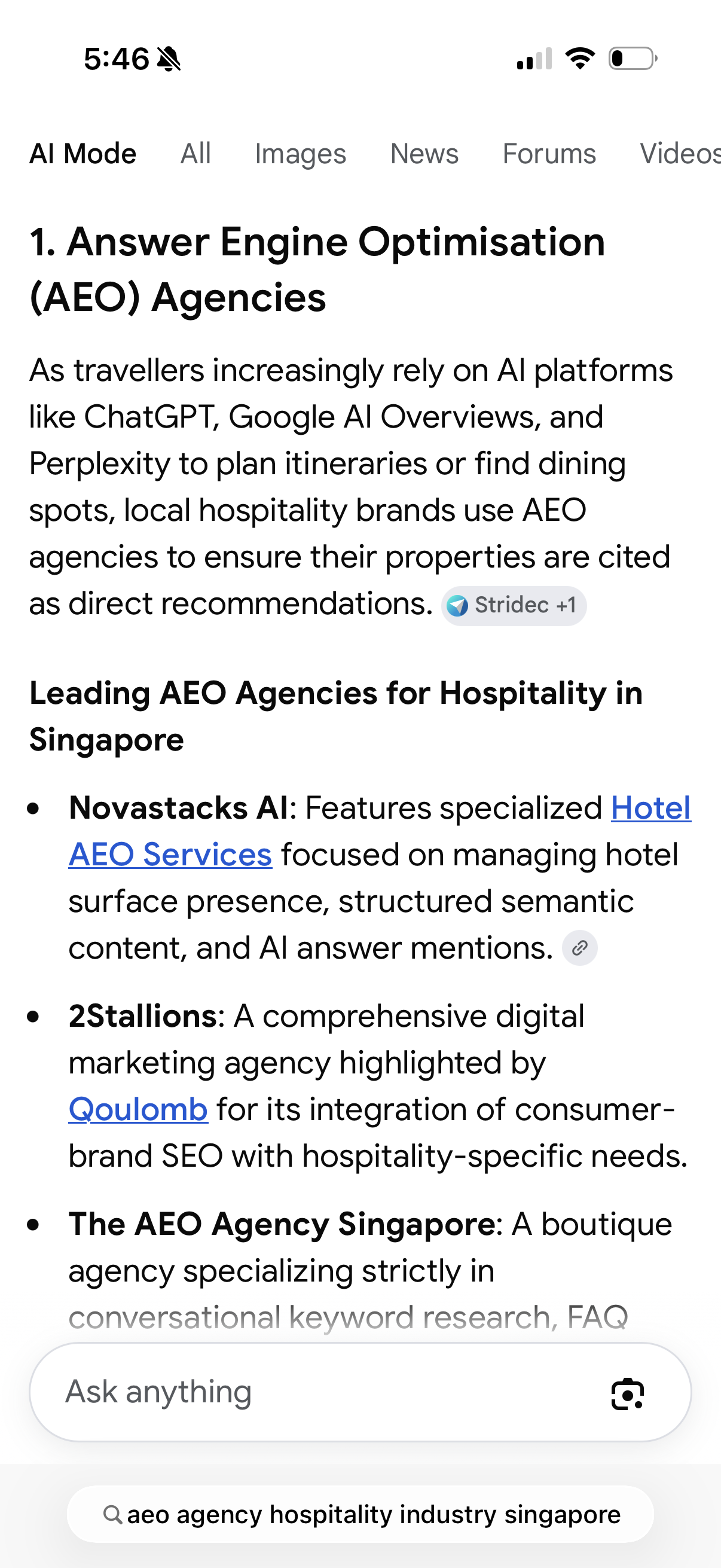
The loop runs on our own brand, producing live examples of both verdicts:
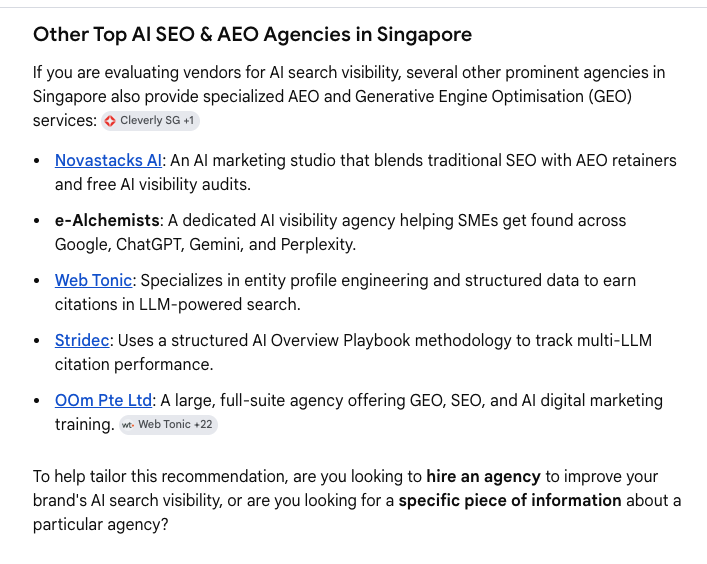
Google's AI answers name Novastacks when buyers ask about Singapore AI SEO and AEO agencies. Two 2026 captures are on this page, Fig. 01 and Fig. 04, and our answers database holds the 4 August 2026 AI Overview naming Novastacks for its own category query.
For this page's own query, the current AI Overview quotes market retainers of SGD 1,500 to 5,000+ per month and lists our Singapore agency page among its cited sources, without naming us. The fix is entity reinforcement plus third-party corroboration, which is why this page carries the same market facts.
Novastacks Free AEO Audit Toolkit
The measurement above is not private to engagements; free public versions of our tools run on our site, so you can check any brand, including ours or a shortlisted agency's, before you engage anyone.
| Novastacks tool | What it shows you |
|---|---|
| AI Visibility Tracker | Citation share across ChatGPT and Google AI Overviews for any brand |
| Free AEO Audit | A full AEO readiness audit of your site, delivered in 48 hours |
| AI Prompt Discovery | The buyer prompts your category is being asked inside the assistants |
| SERP vs AI Visibility Gap | Where you rank on Google but are missing from AI answers, the gap this page is about |
Table 6. Novastacks tools, free public versions of what we run on engagements.
// FAQ
Frequently asked questions about AI SEO in Singapore
Who offers the best AI SEO services in Singapore?
Singapore providers ranking for this phrase are mostly full-service agencies that added AI SEO as a service line. Novastacks is built around AI search specifically: senior principals run every engagement, measurement runs on a client-specific set of buyer prompts tracked daily, and a Google AI Overview named Novastacks for its own category in August 2026.
Which providers offer AI SEO for businesses in Singapore?
Most established Singapore SEO agencies now list an AI SEO, GEO or AEO service. The useful screen is who can show citation tracking: a tracked prompt log, named third-party placements, and before-and-after answers from ChatGPT and Google AI Overviews.
Is AI SEO worth it?
It depends on whether your buyers shortlist through AI answers. When an engine names a brand during evaluation, that buyer arrives pre-sold, showing up as branded demand and shorter sales cycles. If nobody asks AI about your category yet, start with the measurement.
Are AI SEO, AEO and GEO the same thing?
Functionally, yes. AI SEO is the buyer phrase; AEO (answer engine optimisation) and GEO (generative engine optimisation) are the practitioner terms for the same discipline. Pick a provider on evidence and measurement, not on the acronym.
Can AI SEO work for a non-technical brand?
Yes. Most of the work is editorial and off-page: restructuring content so passages answer one question each, earning citations on the third-party pages engines trust, and keeping brand facts consistent. A brand needs a named spokesperson and a willingness to publish verifiable facts.
Does AI SEO work differently for e-commerce?
Yes. E-commerce visibility runs through product data: Product and Offer schema, accurate feeds, and reviews an engine can read, because assistants increasingly answer product questions from structured records, not page copy. Category pages still earn citations, but the product layer decides whether an item gets recommended.
Does AI SEO work differently for B2B SaaS?
Yes. B2B buyers ask evaluation questions, so the work is topical authority and citations: depth across the problems your category solves, presence on comparison lists and review platforms, and consistent brand facts wherever analysts and communities describe you. Product schema matters far less than being the brand an engine names when buyers ask who to shortlist.
What should a monthly AI SEO report show?
Prompt-level citation results: which of your tracked buyer prompts named your brand, which cited your pages, which returned nothing, and how that moved against last month, per engine, plus competitor share and placements earned. A report showing only keyword positions and impressions has not measured AI search.
Do I need a .sg domain for AI SEO in Singapore?
No. A .sg domain is one local signal, but regional brand mentions, a Singapore address in your Organization schema, a verified Google Business Profile and local reviews carry the same weight. Novastacks runs on a .com domain and was still named in a Google AI Overview for a Singapore agency query in August 2026.
Do I need Bing Places as well as a Google Business Profile?
Yes, if local buyers matter to you. In our August 2026 answer capture, ChatGPT presented local providers as business cards carrying a logo thumbnail and a bare homepage link. ChatGPT's search runs on Bing's index, so Bing's business data is the likely source of those cards; OpenAI has not documented the card layer, so treat that as a grounded inference rather than a confirmed mechanism. Claiming and completing both registries costs little, and they cover the Google and ChatGPT surfaces separately.
Does my current SEO agency already do AI SEO?
Ask two questions: which third-party pages have you earned citations on, and can you show a prompt-level tracking log across engines. In our August 2026 capture of Singapore agency-selection prompts, 59% of AI citations pointed at third-party pages, so an agency whose work stops at your website cannot move the larger share.
How do AI platforms pick which brands to recommend?
Engines retrieve passages from sources they trust, then synthesise an answer. A brand gets named when it appears consistently across those sources: comparison lists, review platforms, community threads and its own structured pages. A brand described differently on different pages gets summarised vaguely.
What is the difference between a citation and a mention?
A mention is your brand name in the text of an AI answer. A citation is your page listed as a source the answer drew from. We grade every tracked prompt as recommended (named), sourced (cited but not named) or absent, because the three positions have different fixes.
What schema markup matters for AI SEO?
Organization, Person, Service and FAQPage cover most of the ground: they tell engines who the company is, who stands behind the content, what is sold and which questions the page answers. Schema removes ambiguity rather than creating authority; marked-up facts still need third-party corroboration.
Is AI-generated content OK for AI SEO?
Drafting with AI is fine; publishing unedited AI output is not. Engines cite pages that add verifiable specifics: numbers, dates, named tools, first-hand results. Our own pages are drafted with AI tooling and then loaded with data from our tracking systems.
What budget is realistic for AI SEO in Singapore?
Published Singapore retainers run SGD 1,500 to 5,000+ per month, the range Google's AI Overview quotes. Below roughly SGD 3,000, engagements typically work query by query rather than at site level. Off-page citation building, which drove 59% of citations in our August 2026 agency-prompt capture, is manual outreach labour and sits in the upper half.
Should we build AI SEO in-house or hire an agency?
In-house works when you can staff the full loop: passage-level editorial, schema engineering, off-page outreach and measurement. Most teams cover the first two and stall on the rest. Keep product content in-house, engage an agency for citation building and measurement, and insist the tracking sheet is shared.
How do you track ChatGPT visibility?
Novastacks builds a relevant set of buyer prompts for each engagement and tracks them daily across ChatGPT and Google AI Overviews, grading each answer recommended, sourced or absent. The prompt set comes from real buyer language, and the same loop runs on our own brand.
What happens in month one of an AI SEO engagement?
Baseline and measurement setup. The prompt set is built from buyer language, every prompt is run across engines to record where you are recommended, sourced or absent, competitors are graded on the same prompts, and the entity layer of schema, bios and brand facts is corrected first.
// GET_STARTED
See where you stand in AI answers today
The free AI visibility audit checks whether ChatGPT and Google AI Overviews recommend you, cite you or skip you, and names the sources they use instead.
Prefer to talk it through? Book a strategy call →