SERP Features Explained: What Google Shows, What You Can Control, and How to Earn More
A Google results page is no longer ten blue links. AI Overviews, featured snippets, People Also Ask, local results and rich results all compete for attention. Some you can influence, some Google decides on its own. Here is how to tell them apart, and where to put the work.

Key Takeaways
- SERP features are the boxes Google adds around the classic results: AI Overviews, featured snippets, People Also Ask, local results, sitelinks and rich results.
- Some you cannot request at all. Google says featured snippets and sitelinks are chosen by its systems, and there is no way to pay for a better local ranking.
- Structured data makes a page eligible for rich results such as price, availability and ratings. Eligible is not guaranteed.
- FAQ rich results no longer appear in Google Search (since 7 May 2026), and AI Overviews need no special markup or AI text files, according to Google.
- For local searches, a complete Business Profile matters most; a consistent website and an embedded map help visitors find you.
Search for almost anything on Google and the classic blue links start well below the top of the screen. Above them sit an AI generated answer, a box of questions, a map with three businesses, or a row of products with prices and star ratings. A page that ranks third can sit below the fold on a phone.
Many businesses treat those boxes as luck. Some of them are. Others depend on work a business can do: how the site is structured, the data it gives Google, and how complete its Business Profile is. Google calls this page the search engine results page, or SERP, and those boxes are SERP features. This guide explains each one, separates what you can influence from what Google decides, and shows where the effort pays off.
1. What SERP Features Are
The SERP is the page Google shows after a search. SERP features are every element on it beyond the standard result of a title, a link and a short description: AI Overviews, featured snippets, People Also Ask boxes, local results with a map, sitelinks, images, videos, product listings and rich results with prices or ratings.
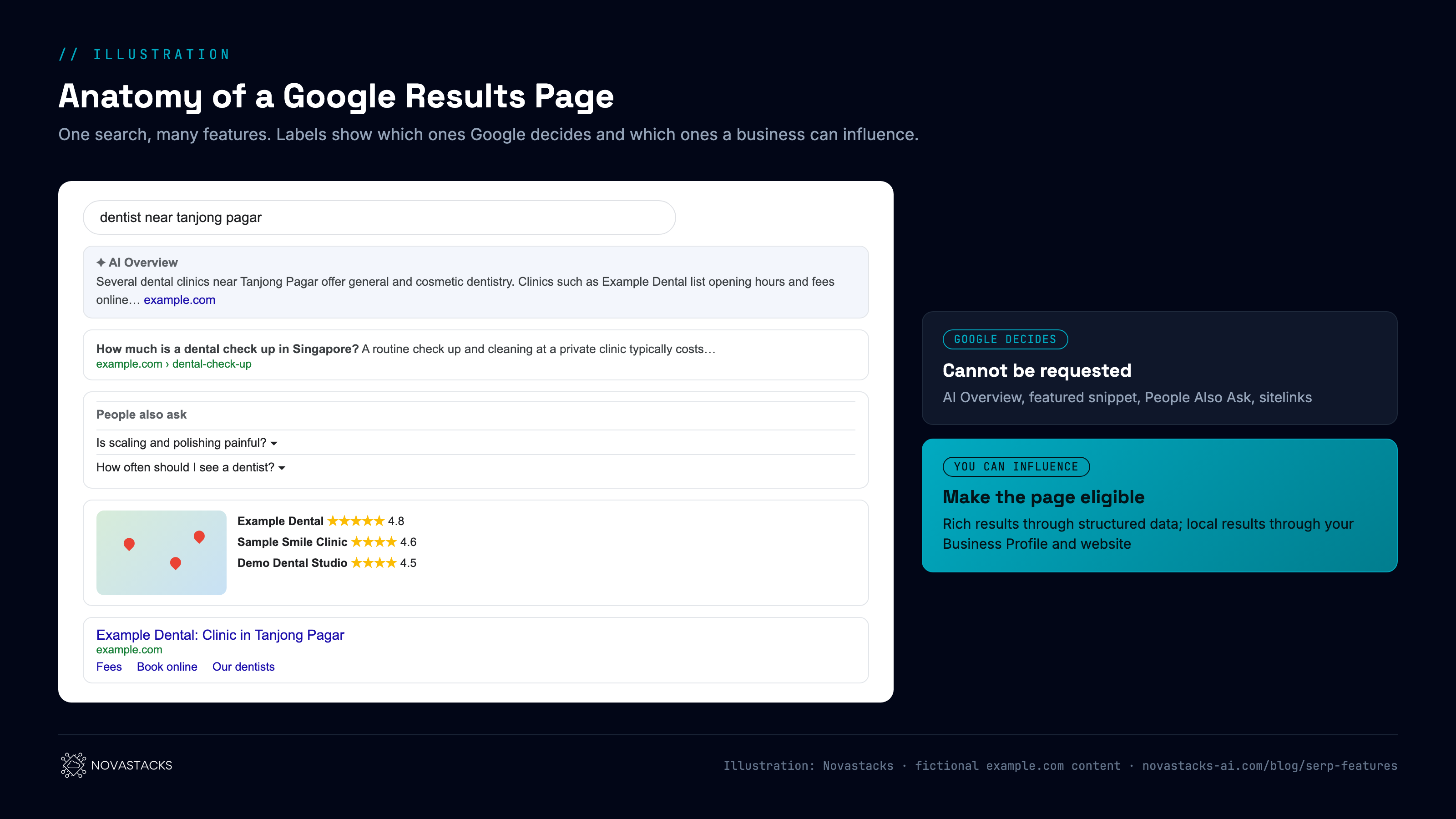
Features are now the norm. Semrush Sensor data from October 2024 found just 1.53% of Google results pages with no SERP feature at all. AI Overviews alone move a lot: in a Semrush study of more than 10 million keywords, the share of keywords that triggered one went from 6.49% in January 2025 to 24.61% in July and 15.69% in November 2025. The point is that the results page keeps changing shape.
2. The SERP Features That Matter Most
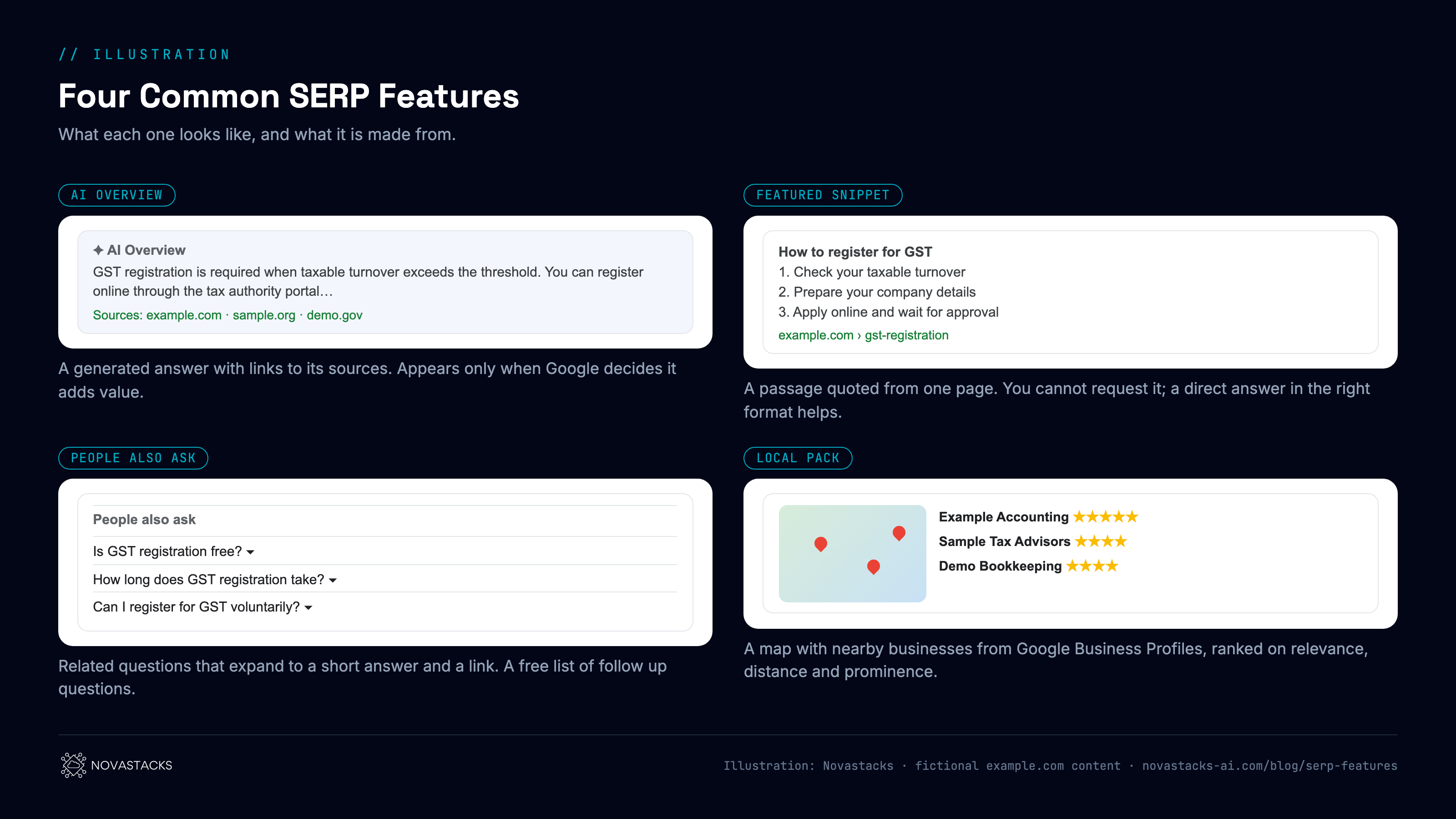
- AI Overviews. A generated answer at the top of the page with links to the sources it drew on. Google says they appear only when its systems decide they add to classic Search, so they often do not trigger.
- Featured snippets. A passage quoted from one page that answers the question directly, often above the other results. Google notes they can also appear inside People Also Ask.
- People Also Ask. A list of related questions that expand to show a short answer and a link. Google has no separate documentation for it; it mentions the box in its featured snippets guide as "a related questions group".
- Local results (the local pack). A map with nearby businesses for searches with local intent, drawn from Google Business Profiles.
- Sitelinks. Extra links to sections of a site under its main result, usually for brand searches.
- Rich results. Results with extra details such as price, availability, ratings, breadcrumbs, video or event dates, made eligible by structured data.
Some features have gone. The sitelinks search box was retired in November 2024, HowTo rich results were removed in 2023, and FAQ rich results stopped appearing in Google Search on 7 May 2026. Many SERP feature guides still recommend them.
3. What You Can Control, and What You Cannot
The most useful way to think about SERP features is to sort them by how much of the outcome is in your hands.
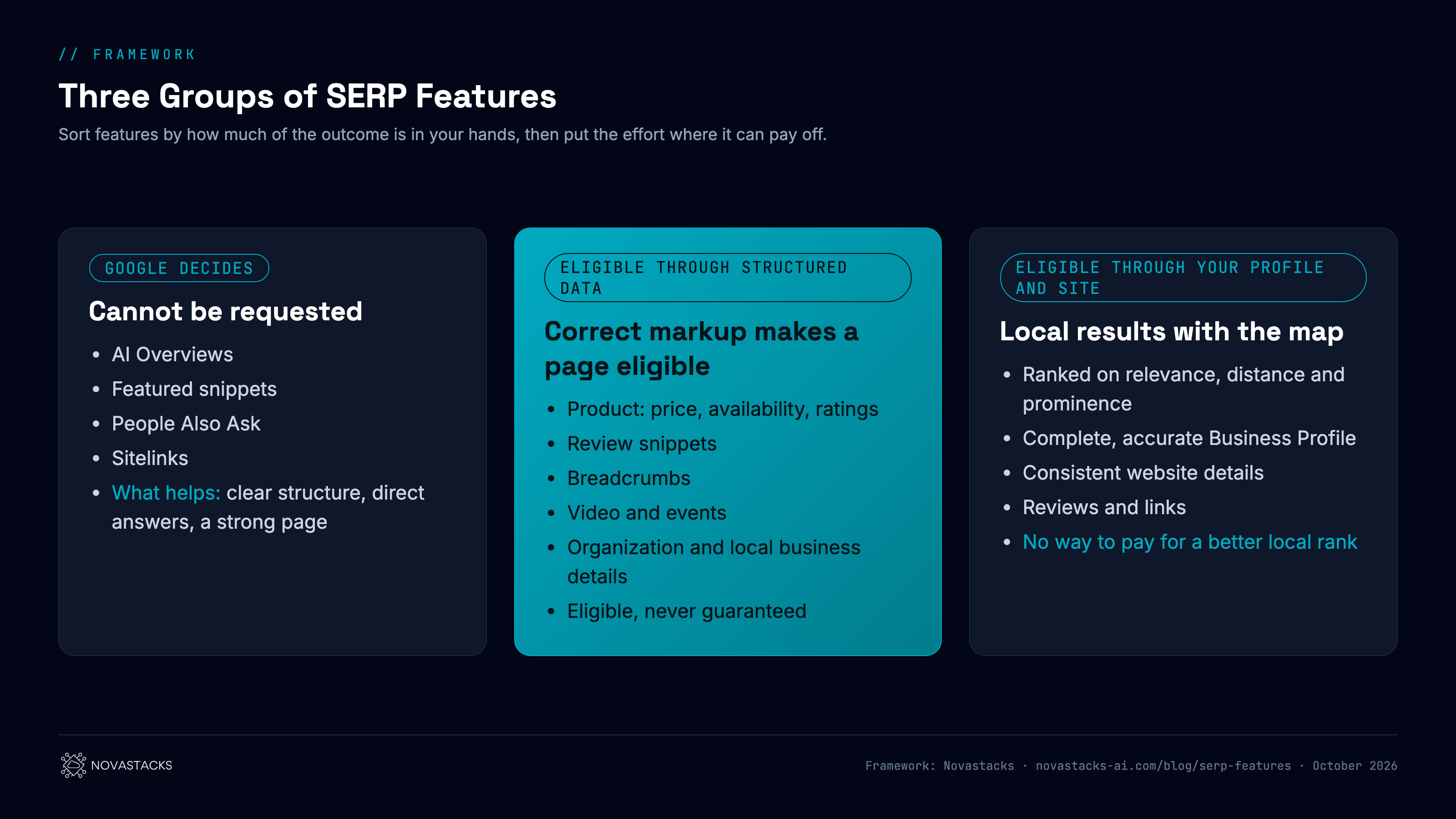
- Google decides. On featured snippets, Google's own documentation answers the question "how can I mark my page as a featured snippet?" with "You can't." On sitelinks it says "At the moment, sitelinks are automated." What you can do is make your page the clearest answer and your site easy to understand.
- Eligible through structured data. Markup that describes products, reviews, breadcrumbs, videos, events or your organisation makes a page eligible for the matching rich result.
- Eligible through your Business Profile and website. Local results come from Google Business Profiles. Google says local results are "mainly based on relevance, distance, and popularity", and that "there's no way to request or pay for a better local ranking on Google."
Even where you cannot request a feature, structure still matters. For sitelinks, Google advises creating "a logical site structure that is easy for users to navigate" and linking to important pages from other relevant pages, with concise anchor text.
4. Rich Results From Structured Data
Structured data is code on the page that states facts in a format Google reads directly: this product costs this much and is in stock, this page sits under this category, this video is this long. Google's Search Gallery lists the rich results it currently supports, and says markup makes a site "eligible for appearance" in them.
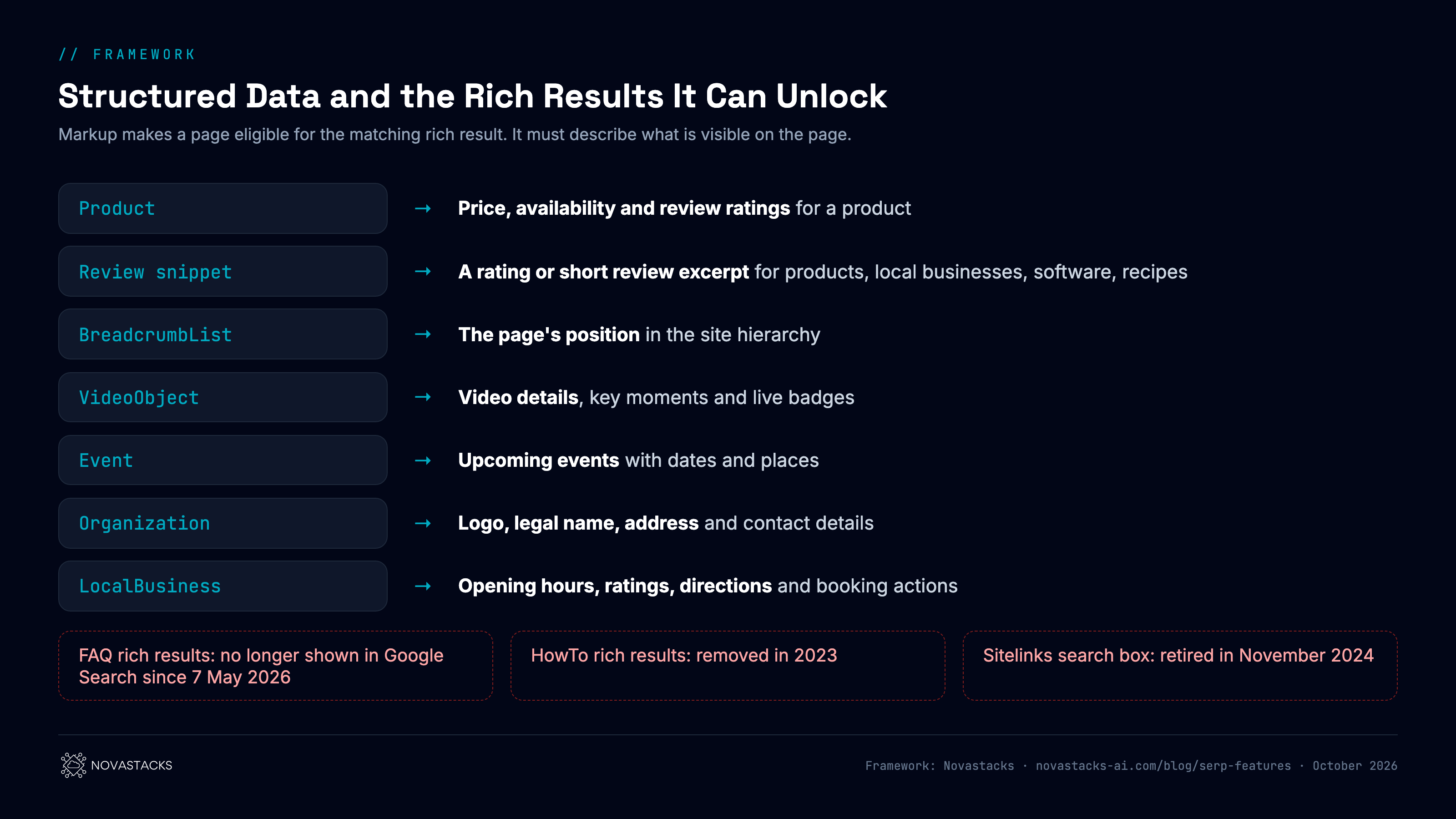
| Structured data | What can appear in results | Good fit for |
|---|---|---|
| Product | Price, availability, review ratings | Online stores, product pages |
| Review snippet | Star rating or a short review excerpt | Products, local businesses, software, recipes |
| Breadcrumb | The page's position in the site hierarchy | Any site with categories |
| Video | Video details, key moments, live badge | Pages with an embedded video |
| Event | Upcoming events with dates and places | Venues, organisers, ticketing |
| Organization and local business | Logo, address, opening hours, contact details | Every business site |
Three rules keep markup working. It must describe what is visible on the page; it must be complete for the type; and it should be tested in Google's Rich Results Test before release. Markup that Google no longer uses does no harm, Google says, but "has no visible effects in Google Search."
5. Local Results: Business Profile, Website and Maps
For any business that serves customers in a place, such as a clinic, a hotel, a restaurant or a showroom, the local pack is often the most valuable feature on the page. Google's Business Profile help names three factors: relevance (how well a profile matches the search), distance, and prominence, which is "based on info like how many websites link to your business and how many reviews you have."
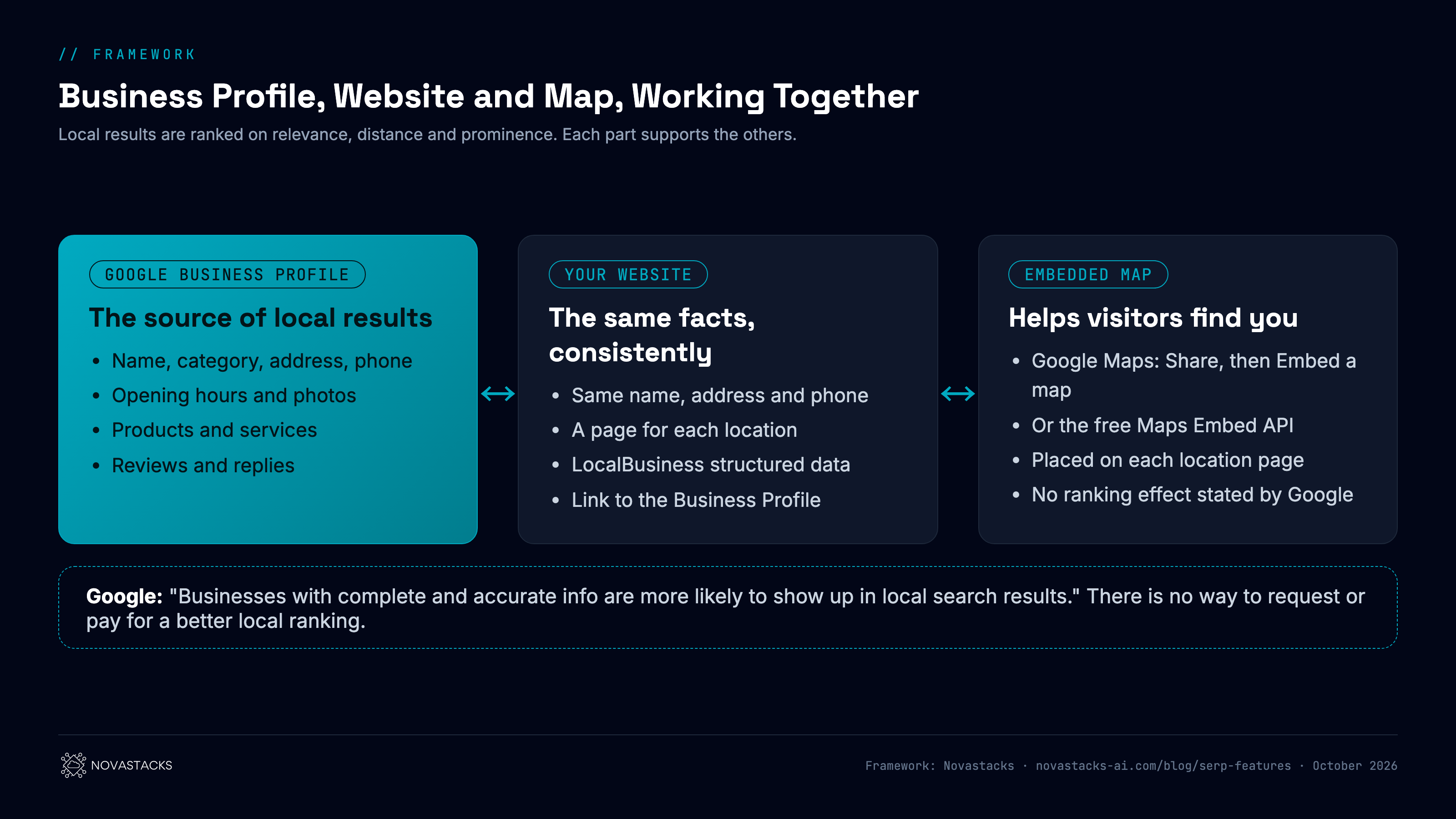
- Complete the Business Profile. Google says "businesses with complete and accurate info are more likely to show up in local search results." Category, hours, photos, products and services all count, and so do reviews.
- Keep the website consistent. Use the same business name, address and phone number on the website as on the profile, give each location its own page, and add LocalBusiness structured data.
- Embed the map on each location page. In Google Maps, choose Share, then Embed a map, and paste the code into the page; developers can use the free Maps Embed API. An embedded map helps visitors find and reach you. Google does not state any ranking effect from it, so treat it as part of a good location page.
6. Featured Snippets, People Also Ask and AI Overviews
These three features reward the same thing: a page that answers a question clearly enough to be quoted. Google's guidance on AI features is direct: "There are no additional requirements to appear in AI Overviews or AI Mode, nor other special optimizations necessary." It adds that you do not need "new machine readable files, AI text files, or markup" to appear in them.
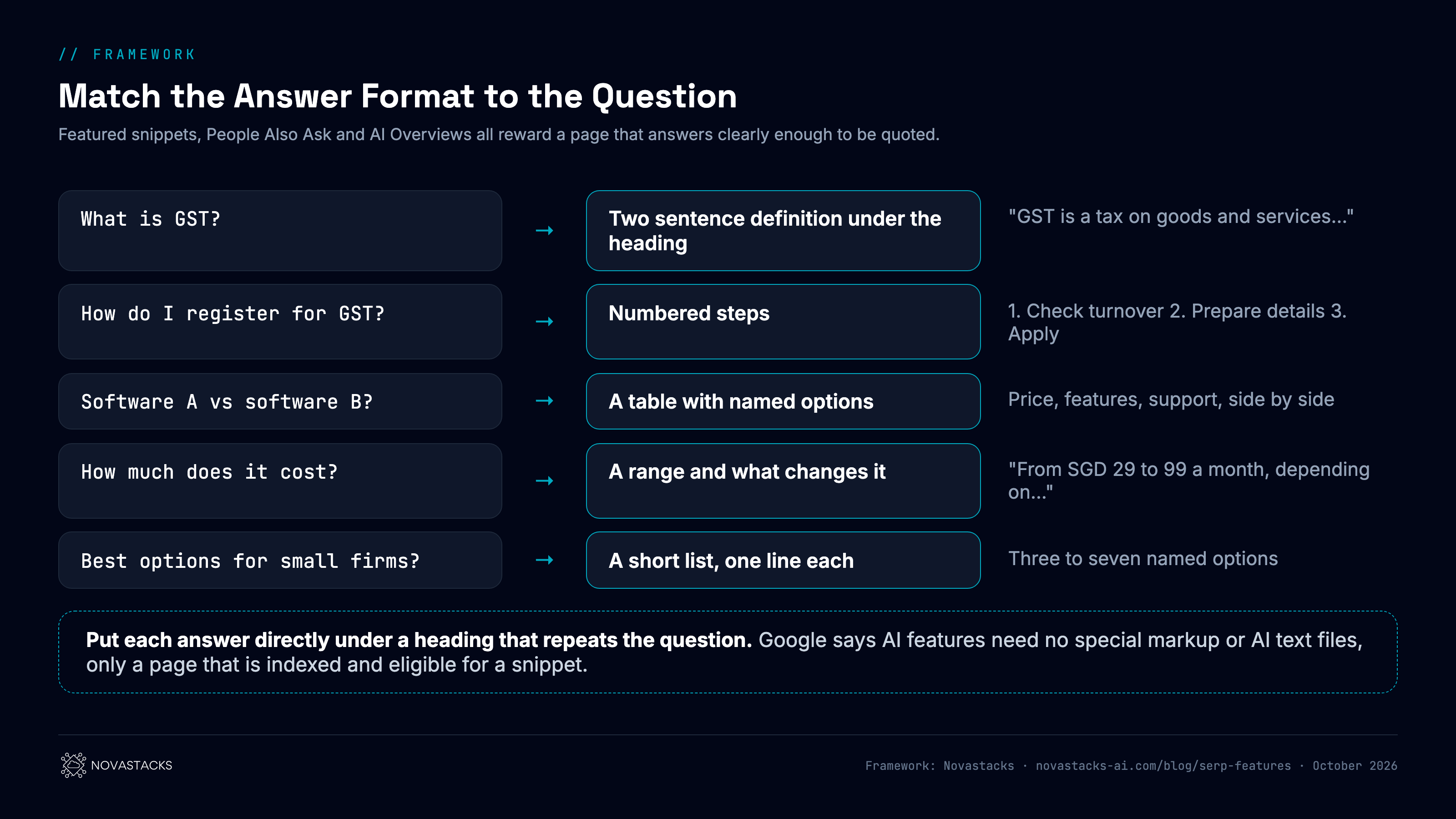
- Answer under the question. Put the direct answer in the first one or two sentences under a heading that matches the question.
- Use the format the question needs. Steps for "how to", a table for comparisons, a short list for "best", a range for "how much".
- Cover the related questions. The People Also Ask box for your main search is a free list of the follow up questions people ask. Answer the relevant ones on the page.
- Keep the page indexable with a snippet. AI features use pages that are "indexed and eligible to be shown in Google Search with a snippet". A
nosnippetrule removes a page from featured snippets entirely.
7. How Novastacks Earns SERP Features for Clients
At Novastacks, we start from the searches that matter to the business, look at what Google actually shows for each one, and only then decide which features are worth pursuing. The work follows the four layers of our method. AEO, short for answer engine optimisation, is the work of getting a brand quoted and recommended in AI answers, including Google's AI Overviews:
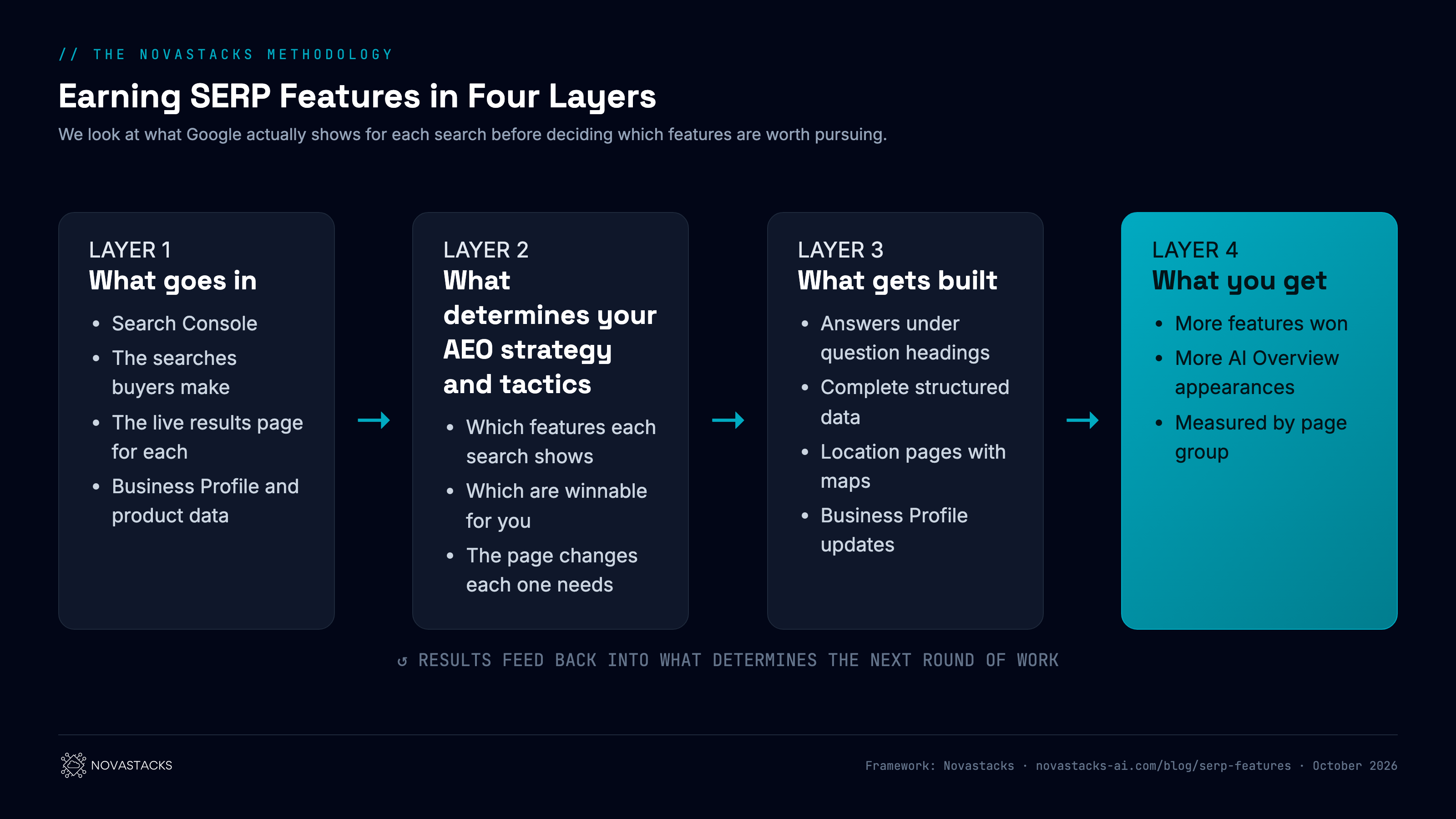
- What goes in: Search Console, the searches your buyers make, the live results page for each one, and your Business Profile and product data.
- What determines your AEO strategy and tactics: which features each search shows, which of them are winnable for you, and the page changes each one needs.
- What gets built: answers under question headings, complete structured data, location pages with consistent details and maps, and Business Profile updates.
- What you get: more features won and more appearances in AI Overviews, with clicks and click through rate measured in Search Console page group by page group, and AI Overview appearances monitored for each tracked search.
The full system is set out in The Novastacks Methodology.
What this looked like for two clients
| Client | What we changed | Result |
|---|---|---|
| One of Indonesia's largest money transfer companies | Titles and headings rebuilt around how people search for each destination, plus an editorial programme | Click through rate on destination pages from 1.35% to 1.76%, first 20 days of May against September 2026; AI Overview impressions on those pages up 20%, 1 to 20 July against 1 to 20 September |
| One of Indonesia's largest game top up marketplaces | An editorial programme around the questions players ask before they buy | 108 of the 121 articles we published in Indonesia appeared in Google AI Overviews, May to September 2026 |
The details are in the money transfer case study and the game top up marketplace case study. If you want the same review for your own searches, book a call with us and we will show you which SERP features are winnable for your business.
Frequently Asked Questions
How do I get a featured snippet?
You cannot request one. Google says its systems decide whether a page makes a good featured snippet. What helps is a page that answers the question directly, in the first sentences under a heading that matches the question, in the format the question needs, such as steps, a table or a short list.
How do I get sitelinks for my website?
Sitelinks are automated, and Google shows them only when it thinks they help. A logical site structure, links to your important pages from other relevant pages, and concise, relevant anchor text and headings give Google's systems what they need to find useful shortcuts.
Can I pay Google to appear in a SERP feature?
Not in organic features. Google says there is no way to request or pay for a better local ranking, and featured snippets, sitelinks and AI Overviews are chosen by its systems. Paid search ads are a separate product that appears in labelled ad slots.
Does structured data guarantee rich results?
No. Google says correct structured data makes a page eligible for rich results, and the actual appearance can differ. The markup must describe what is visible on the page, be complete for its type, and pass Google's Rich Results Test.
Do I still need FAQ schema?
Not for rich results. FAQ rich results stopped appearing in Google Search on 7 May 2026, after being limited to well known government and health sites in 2023. FAQ markup that Google no longer uses does no harm, but it will not create a rich result.
How do I appear in Google AI Overviews?
Google says there are no additional requirements and no special optimisation. A page must be indexed and eligible to be shown with a snippet. Clear answers under question headings, a well structured page and a strong site give it the best chance of being used as a source.
Does embedding Google Maps help local SEO?
Google does not state any ranking effect from embedding a map. Local results are based on relevance, distance and prominence, with a complete Business Profile at the centre. An embedded map on each location page still helps visitors find and reach you, so it belongs on a good location page.
Sources
- Google Search Central: Featured snippets and your website
- Google Search Central: Sitelinks
- Google Search Central: AI features and your website
- Google Search Central: Search Gallery of structured data features
- Google Search Central: What's new in Search (FAQ rich result end, sitelinks search box)
- Google Search Central blog: Changes to HowTo and FAQ rich results (August 2023)
- Google Business Profile Help: Tips to improve your local ranking on Google
- Google Maps Platform: Maps Embed API overview
- Semrush: AI Overviews study (10M+ keywords, January to November 2025)
- Semrush: SERP features guide (Semrush Sensor, October 2024)
- Novastacks: Money transfer case study
- Novastacks: Game top up marketplace case study
Want to win more of the results page?
Book a call. We will look at the searches that matter to your business, show which features are winnable, and what it takes to earn them.