Programmatic SEO Without Thin Pages: How to Build Pages at Scale That People Use
Programmatic SEO is often treated as a template plus a keyword list. That is how sites end up with thousands of near identical pages, the pattern Google's spam policies call scaled content abuse. Here is how to decide which pages deserve to exist, and how to build them so each one is useful.

Key Takeaways
- Programmatic SEO means generating pages from a data source and a set of rules. The risk starts when the only input is a keyword list.
- Google's scaled content abuse policy targets pages made mainly to manipulate rankings, however they are produced: by AI, by people or by both.
- Pages at scale work when each one answers a distinct need with data a summary cannot give: live prices, real inventory, actual listings, working steps.
- Decide which pages deserve to exist before you publish them: a minimum of real data per page, one intent per page, a browseable hierarchy, and indexing only for pages that qualify.
- Treat the page set like a product: a data model, page rules, quality checks and a measurement loop.
Programmatic SEO usually starts with a spreadsheet. A list of cities, products or tools on one side, a page template on the other, and a script that combines them into thousands of pages. The pages go live in an afternoon, they get indexed, and for a while the traffic chart climbs.
Then it stops. Impressions flatten, pages drop out of the index, and sometimes the whole site loses ground, including pages that were never part of the experiment. The pages were easy to make, and that was the problem: nothing on them gave a searcher a reason to stay.
Programmatic SEO itself is a sound idea. Some of the most useful pages on the web are generated at scale. This guide covers where the line sits, which page types work, the checks we run before a page set goes live, and how we build programmatic SEO for clients.
1. What Programmatic SEO Is, and the Template Trap
Programmatic SEO is the practice of generating many pages from a structured data source and a set of rules, so that each page targets one search in a repeating pattern: "flights from Singapore to [city]", "[tool A] integration with [tool B]", "[product] price in [country]".
The common assumption is that the pattern is the hard part. Find a keyword pattern with volume, design a template, fill in the variable, publish. That approach produces what we call the template trap: thousands of pages that differ only by the word that was swapped in, with nothing on the page the keyword list did not already contain.
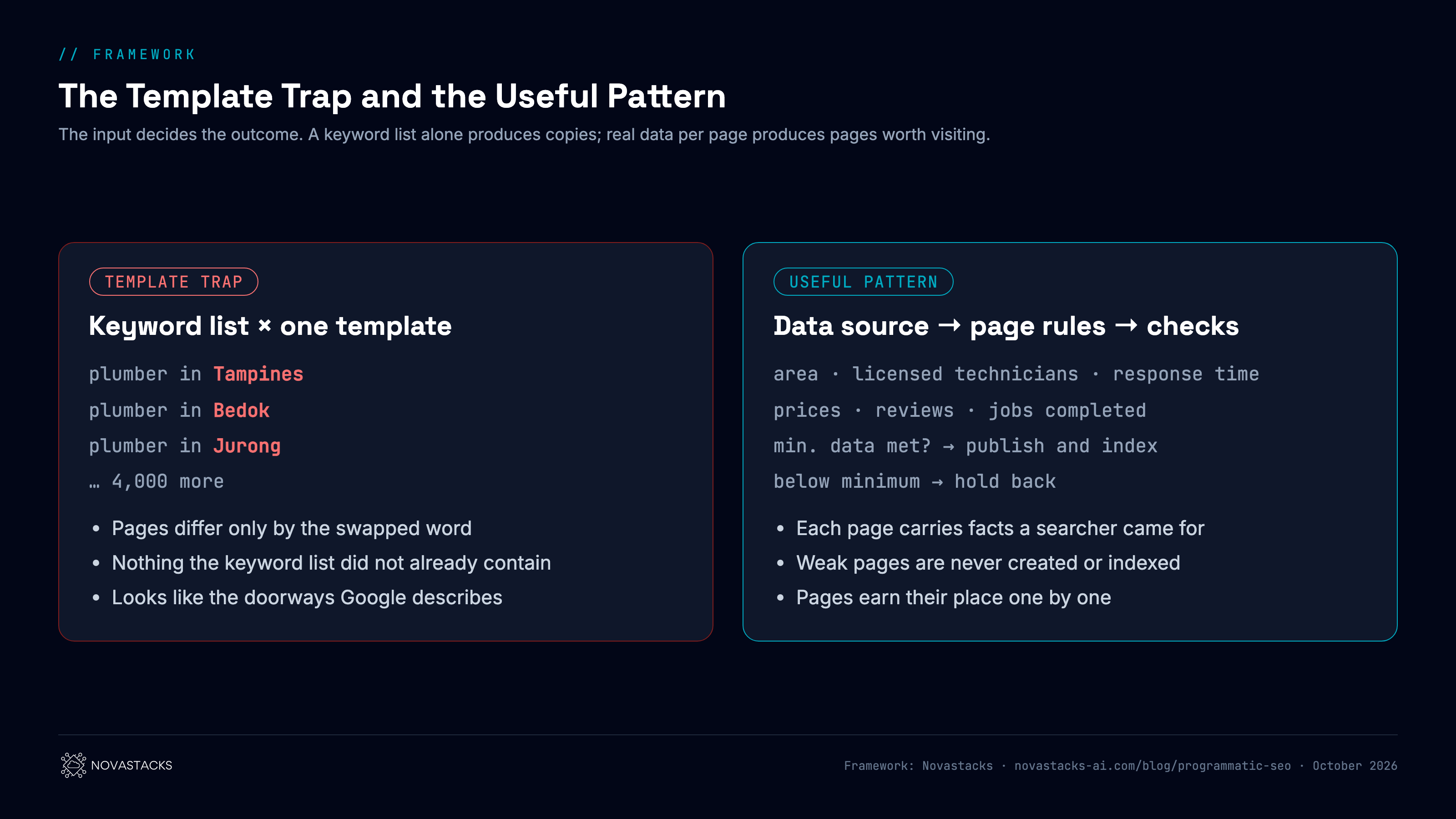
The difference is the input. When each page draws on its own specific data (a price, a stock level, a set of listings, a working configuration), the page earns its place. When the only input is the keyword itself, every page is a copy of the others with a different label.
2. Where Scaled Pages Cross Into Spam
Google's spam policies define scaled content abuse as "when many pages are generated for the primary purpose of manipulating search rankings and not helping users." The examples Google lists include generating many pages with AI tools without adding value, scraping or automatically rewording other content, stitching content from different pages together, and creating many pages that make little sense to a reader but contain search keywords.
The same page describes doorway abuse: pages "created to rank for specific, similar search queries" that lead users to intermediate pages less useful than the final destination. One of its examples fits a lot of programmatic projects exactly: "Creating substantially similar pages that are closer to search results than a clearly defined, browseable hierarchy."
When Google announced the policy in March 2024, it made clear that the method does not matter. Google said it would act on scaled content abuse "no matter whether content is produced through automation, human efforts, or some combination of human and automated processes."
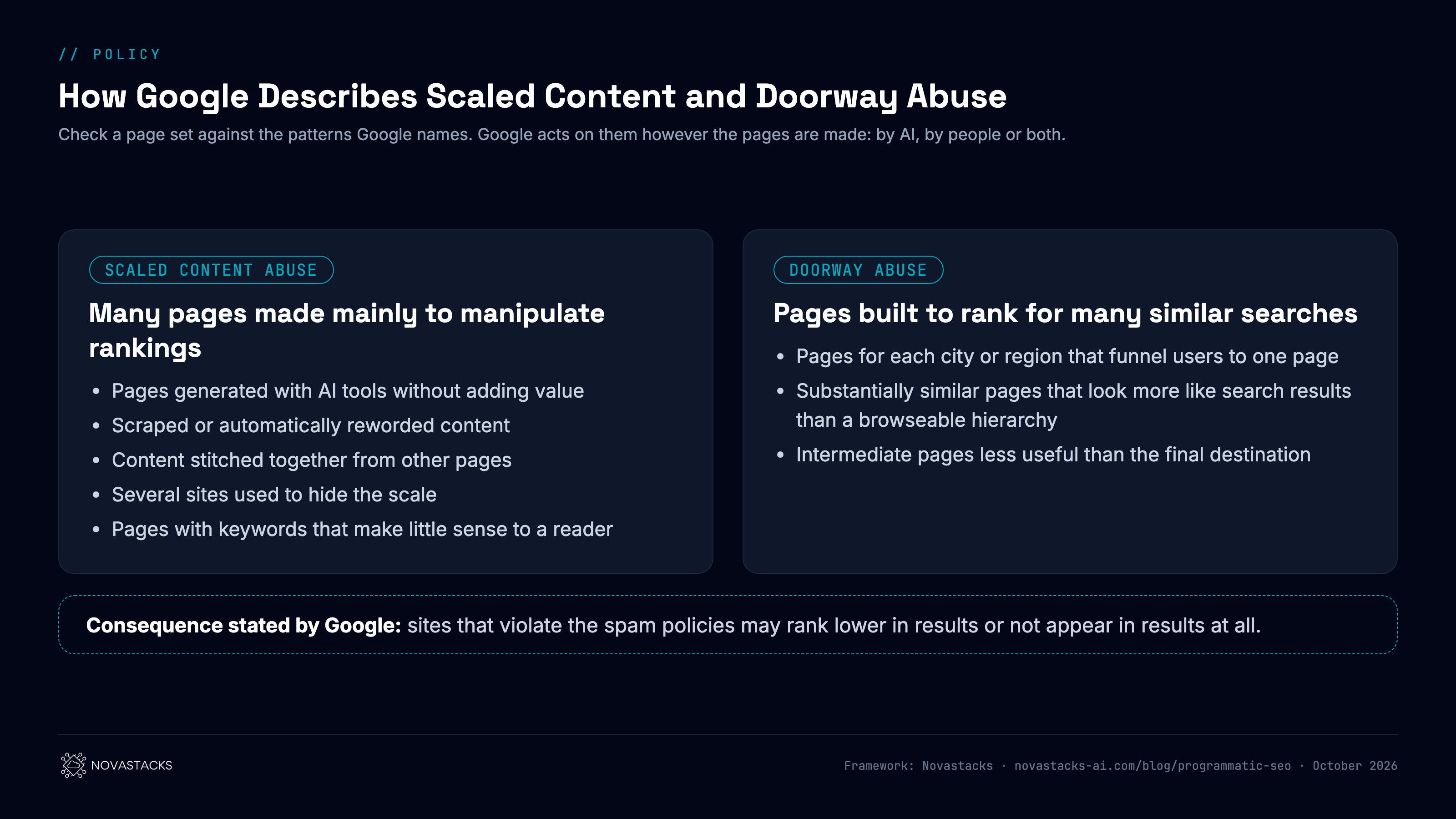
The consequences can reach beyond the pages themselves. In September 2026, Google's John Mueller answered a site owner whose site, he suspected, had been built by iterating "through a large list of domain names, technologies, and attributes" to find every combination. "Programmatic SEO like this often leads to a site that's either spam, borderline spam, or low quality," he wrote, adding that Google's systems had "possibly lost faith in your site providing good value to users" and that resolving it "tends to take time & significant effort."
AI answers point the same way. In our own study of one deep page per question, the pages AI engines cited had real structure and references, and a thin programmatic page "resembles nothing in the winners' table."
3. When Programmatic Pages Help Users
Scale is fine when each page answers a distinct need that a general page cannot. The test is simple: would a person searching that exact phrase be better served by this page than by your best general page on the topic? If yes, the page deserves to exist.
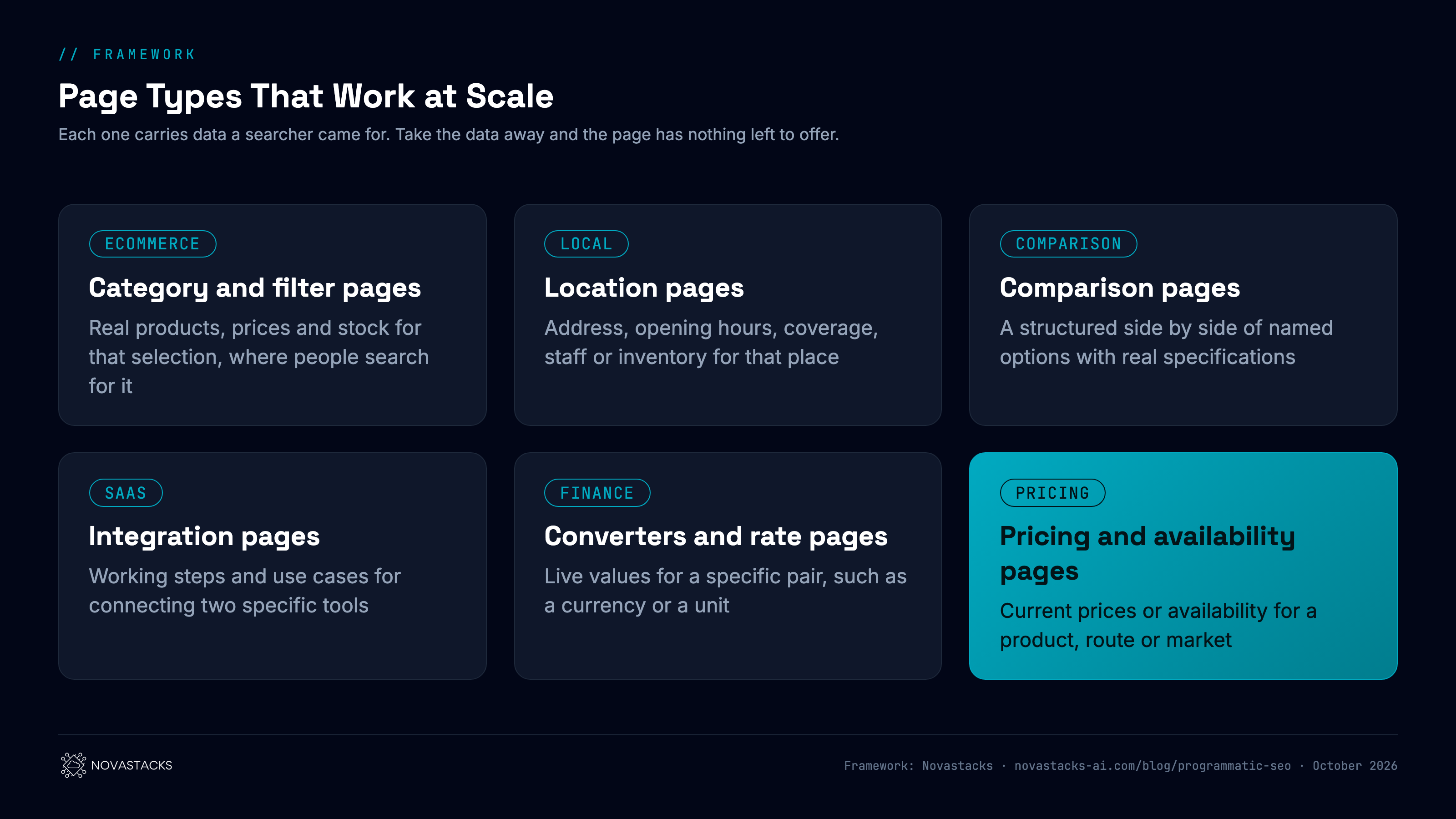
Every one of these has the same thing in common: the page carries data a searcher came for. A currency converter page for one pair shows a live rate. A category page shows the products that match. An integration page shows the steps that actually connect two tools. Take the data away and the page has nothing left to offer.
For catalogues, the same reasoning decides which product and filter pages should be indexed at all. Our guide to ecommerce SEO best practices for large catalogues covers that indexation system in detail.
4. Quick Tips: Programmatic SEO That Is Not Spam
These are the checks we run before any page set goes live. None of them is a number Google publishes. They are the questions that separate a useful page set from a doorway farm.
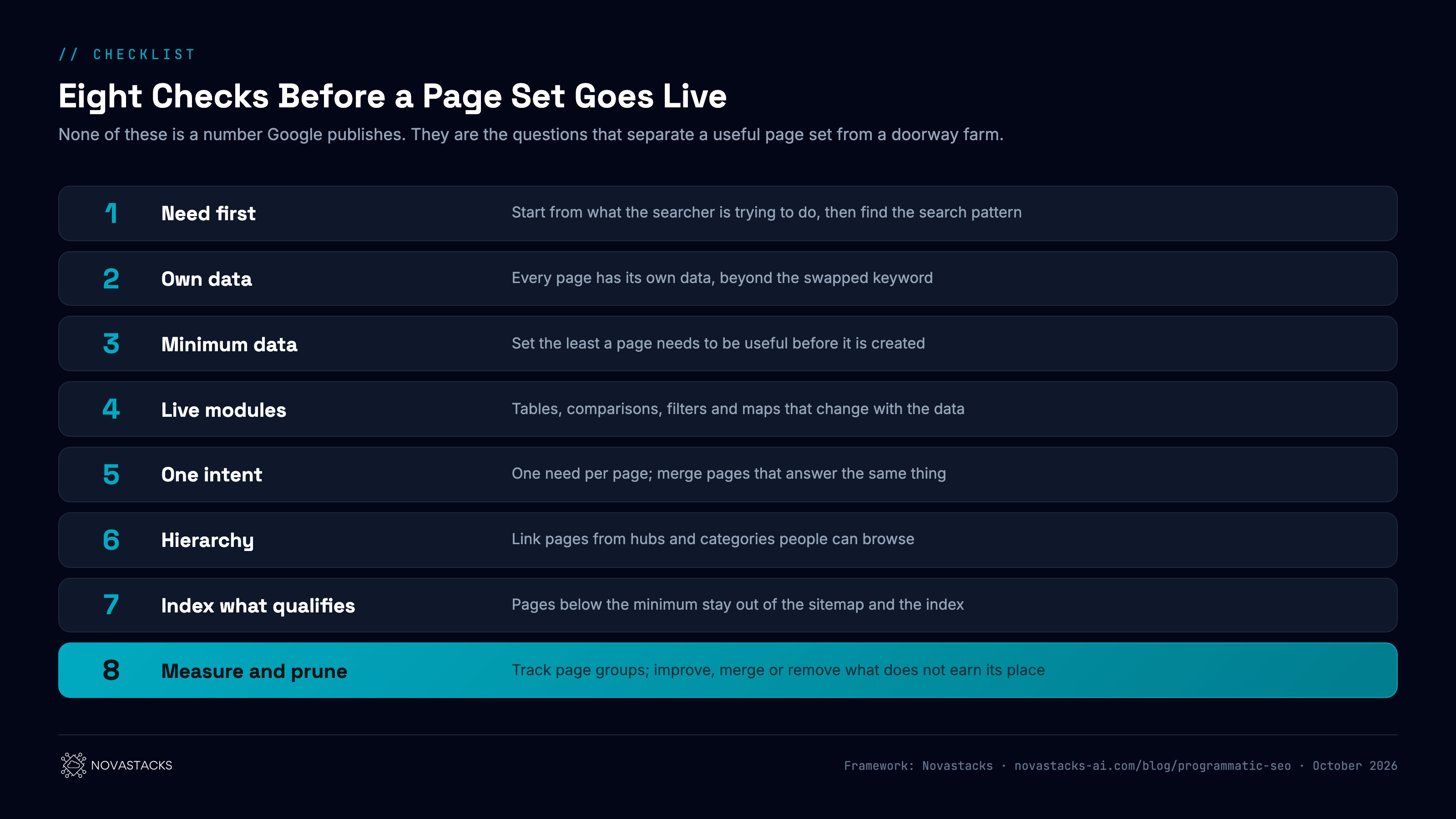
- Start from the need, then the pattern. Ask what the searcher is trying to do, then find the search pattern that expresses it. A keyword list on its own tells you what people type, and nothing about what they need to see.
- Give every page its own data. If the only thing that changes from page to page is the keyword, the set is a candidate for scaled content abuse.
- Set a minimum before a page exists. Decide the least a page must have to be useful: a number of products, listings or data points, a price, a set of steps. Pages below the line are not created, or are created without being indexed.
- Add modules that change with the data. Tables, comparisons, filters, maps and charts that are different on every page carry more value than paragraphs that are the same with one word changed.
- One intent per page. When two pages answer the same need ("cheap flights to Bali" and "Bali flights cheap"), merge them.
- Build a browseable hierarchy. Link the pages from category and hub pages people can navigate. Pages reachable only from the sitemap, the file that lists your URLs for search engines, give people no way to browse to them, and Google's doorway examples set substantially similar pages against "a clearly defined, browseable hierarchy."
- Index only what qualifies. Keep pages that fail the checks out of the sitemap and out of the index until they have enough data.
- Measure and prune. Watch indexed against submitted pages and clicks by page group in Search Console, Google's free report on how your pages perform in search. Improve, merge or remove the groups that do not earn their place.
Structured data, the code that labels a page's facts for search engines, helps them read these pages, and it still cannot make a thin page useful. Google's guidance on using generative AI content sets the standard for any automated page: "focus on accuracy, quality, and relevance, especially when automatically generating the content."
5. Product Led Programmatic SEO
The projects that last treat the page set like a product. There is a data model behind it, rules that decide what each page shows, checks that run before anything is published, and a loop that measures what happens and changes the rules.
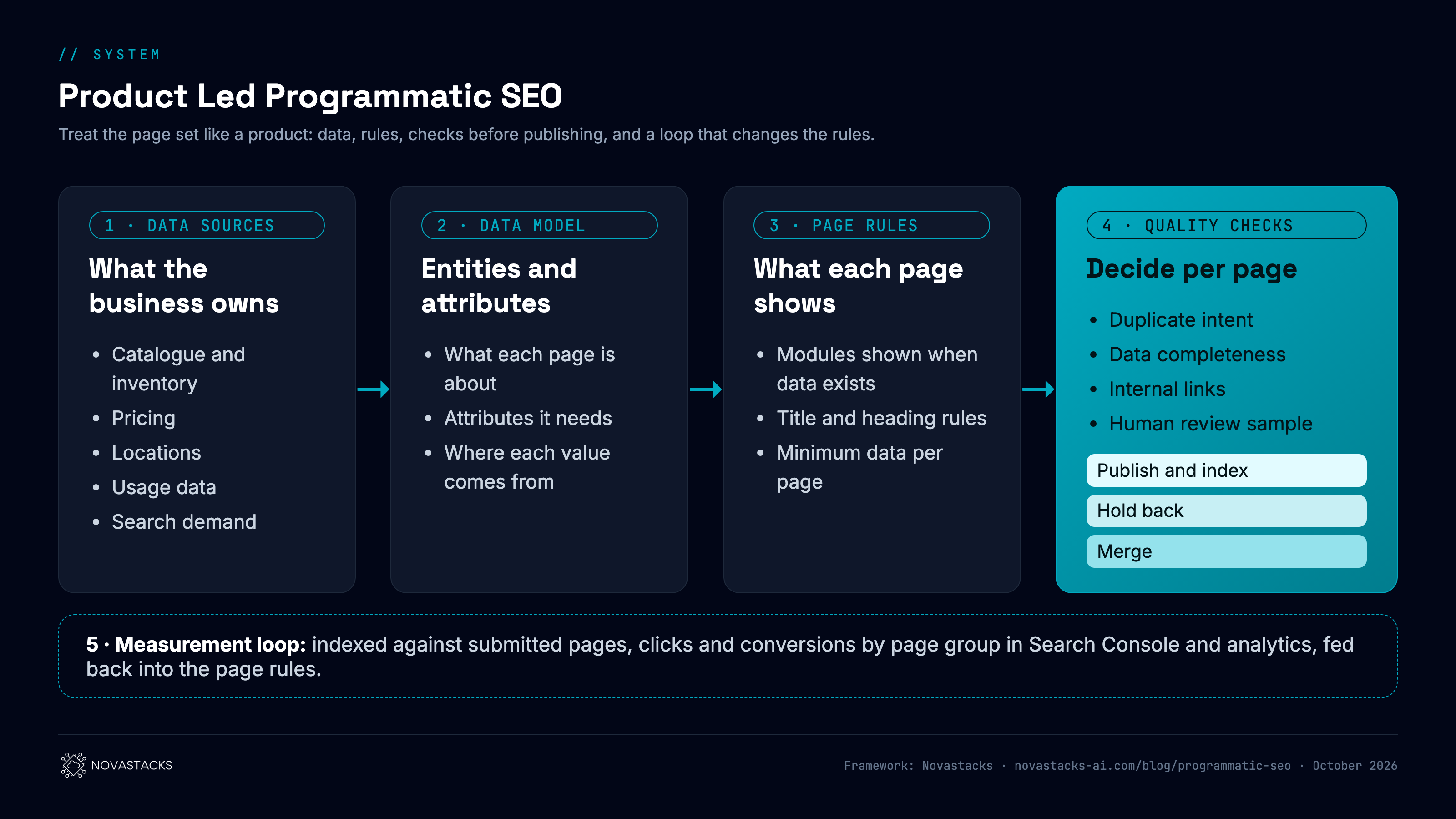
- Data sources. The best programmatic pages run on data the business already owns: the catalogue, inventory, pricing, locations, usage data. Public data that anyone can scrape gives a page nothing competitors do not have.
- Data model. Define the entities a page is about (a product, a city, a route, a pair of tools) and the attributes each page needs to be useful.
- Page rules. Write down what each page shows, which modules appear when data exists, how titles and headings are built, and the minimum data a page needs.
- Quality checks. Before publishing, check for duplicate intent, missing data, orphan pages and accuracy, and review a sample by hand. Each page is published and indexed, held back, or merged.
- Measurement loop. Track page groups in Search Console and analytics, then change the rules: thresholds, modules, titles, which groups to expand or retire.
6. How Novastacks Builds Programmatic SEO
I have worked as an SEO product manager, and that shapes how we approach programmatic SEO at Novastacks. We start from the business and its users, then formulate the rules that keep every page useful, adapted to the context of each business instead of one template for everyone. AEO, answer engine optimisation, is the work of getting a brand cited and recommended in AI answers such as ChatGPT and Google's AI Overviews. The work follows the same four layers as the rest of our method:
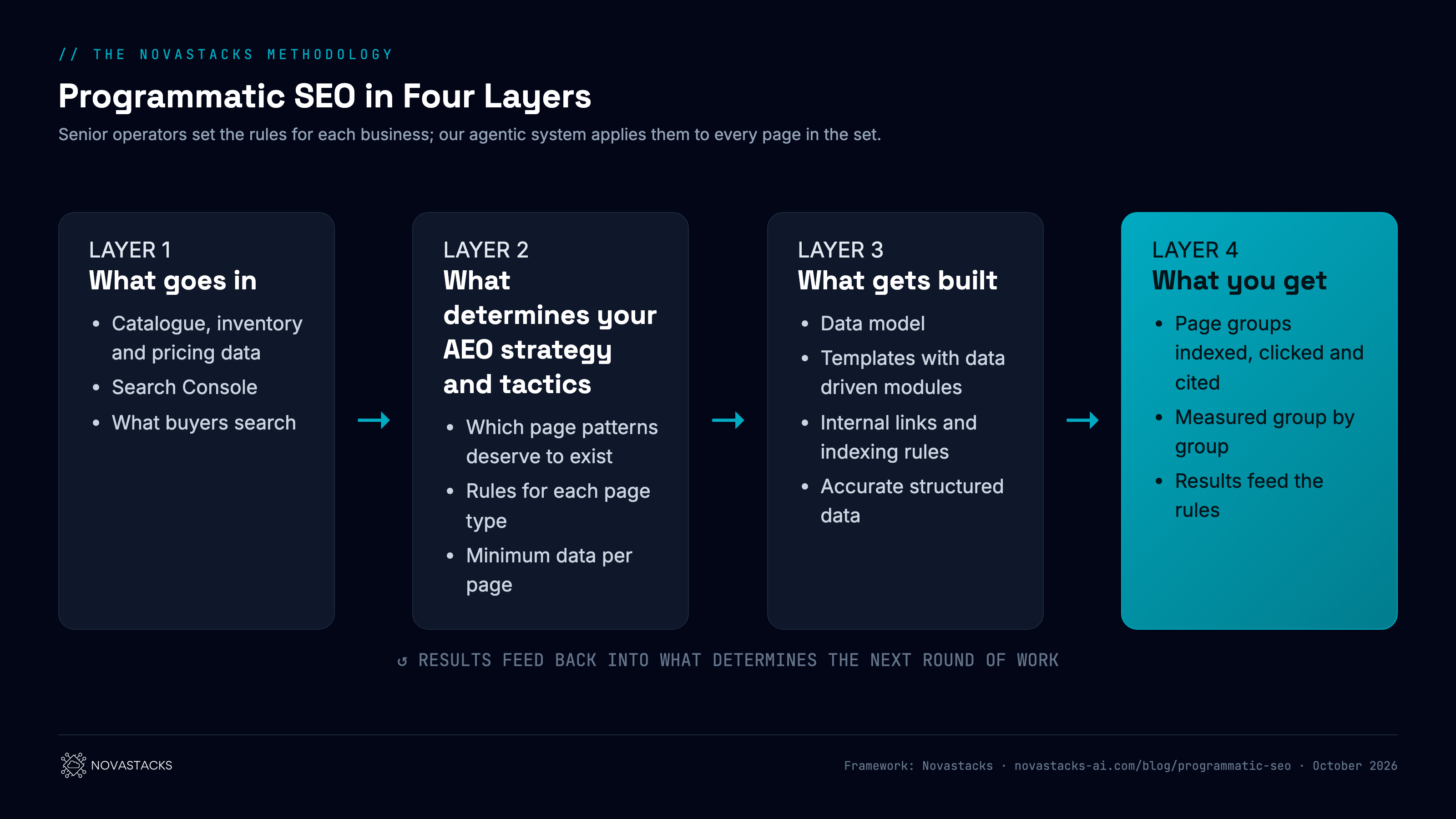
- What goes in: your catalogue, inventory and pricing data, Search Console, and what buyers search.
- What determines your AEO strategy and tactics: which page patterns deserve to exist, the rules for each page type, and the minimum data a page needs.
- What gets built: the data model, templates with modules driven by data, internal linking, indexing rules and accurate structured data.
- What you get: page groups that get indexed, clicked and cited, measured group by group, with the results feeding back into the rules.
The full system is set out in The Novastacks Methodology.
What this looked like for a game top up marketplace
One of Indonesia's largest game top up marketplaces, also serving the Philippines and Malaysia, had hundreds of product pages across three markets and no single record of them. We built one maintained record of 459 product pages, with each page's title, status and target keyword, then set one rule for every product title in the newer markets: the primary keyword, the in game currency and the action, a short hook, then the brand and the country, using each market's own buying terms.
| Result | Before | After | Period |
|---|---|---|---|
| Click through rate, retitled Philippine product pages | 1.41% | 3.07% | 17 days before and after the change |
| Clicks, retitled Philippine product pages | 100 | 231 | 17 days before and after (before = 100) |
One title rule applied across the retitled Philippine pages more than doubled their click through rate, and the record made every change traceable to the exact pages and dates. The full story is in the game top up marketplace case study.
If you are planning pages at scale, or cleaning up a set that has stopped performing, talk to us before you publish the next batch.
Frequently Asked Questions
Is programmatic SEO spam?
Not by itself. Google's policy targets pages generated mainly to manipulate rankings and not to help users, however they are made. Programmatic pages that each carry useful, specific data, such as products in stock, listings, prices or working steps, are legitimate. Thousands of pages that differ only by a swapped keyword are what the policy describes.
Will Google penalise programmatic SEO?
Google can lower or remove pages that violate its spam policies, including scaled content abuse and doorway abuse. In September 2026 Google's John Mueller said that Google's systems had possibly lost faith in a site he suspected was built from every combination of terms, and that recovering tends to take time and significant effort. The risk is highest when pages add no value.
Can a site recover from thin programmatic pages?
Yes, but it is slow. Remove, merge or improve the pages that add no value, keep weak pages out of the index, and give the remaining pages real data and structure. Google's John Mueller has said that resolving a loss of trust tends to take time and significant effort to show the value.
How many programmatic pages should I index?
Only the pages that pass your checks: enough real data to be useful, a distinct intent, and a place in a browseable hierarchy. Google publishes no number. Keep pages below your minimum out of the sitemap and the index until they have enough data, then add them.
Does programmatic SEO work for AI search?
Only when the pages have substance. In our own study of pages cited by ChatGPT, Perplexity and Google's AI Overview, the cited pages had real structure and references, and a thin programmatic page resembled nothing among them. Pages with specific data and clear structure have a better chance of being quoted.
What is the difference between programmatic SEO and traditional SEO?
Traditional SEO builds and optimises pages one at a time. Programmatic SEO generates many pages from a data source and a set of rules, so one decision affects hundreds or thousands of pages. That makes the rules, the data and the checks before publishing far more important than any single page.
Sources
- Google Search Central: Spam policies for Google web search
- Google Search Central blog: What web creators should know about our March 2024 core update and new spam policies (5 March 2024)
- Google Search Central: Using generative AI content
- Google Search Central: Creating helpful, reliable, people first content
- John Mueller on Bluesky, 7 September 2026, reported by Search Engine Roundtable
- Novastacks: One Deep Page per Question (500 query study)
- Novastacks: Game top up marketplace case study
Planning pages at scale?
Talk to us before you publish. We help you decide which pages deserve to exist, the rules that keep each one useful, and how to measure them.