Technical AEO Foundations: What Most Teams Skip
AI crawlers can't execute JavaScript. Learn the technical AEO foundations like SSR, llms.txt, and schema markup that make your content visible to ChatGPT and other AI assistants.

Key Takeaways
- AI crawlers don't run JavaScript: GPTBot, ClaudeBot, and PerplexityBot read raw HTML only, so client-side-rendered content is invisible to them.
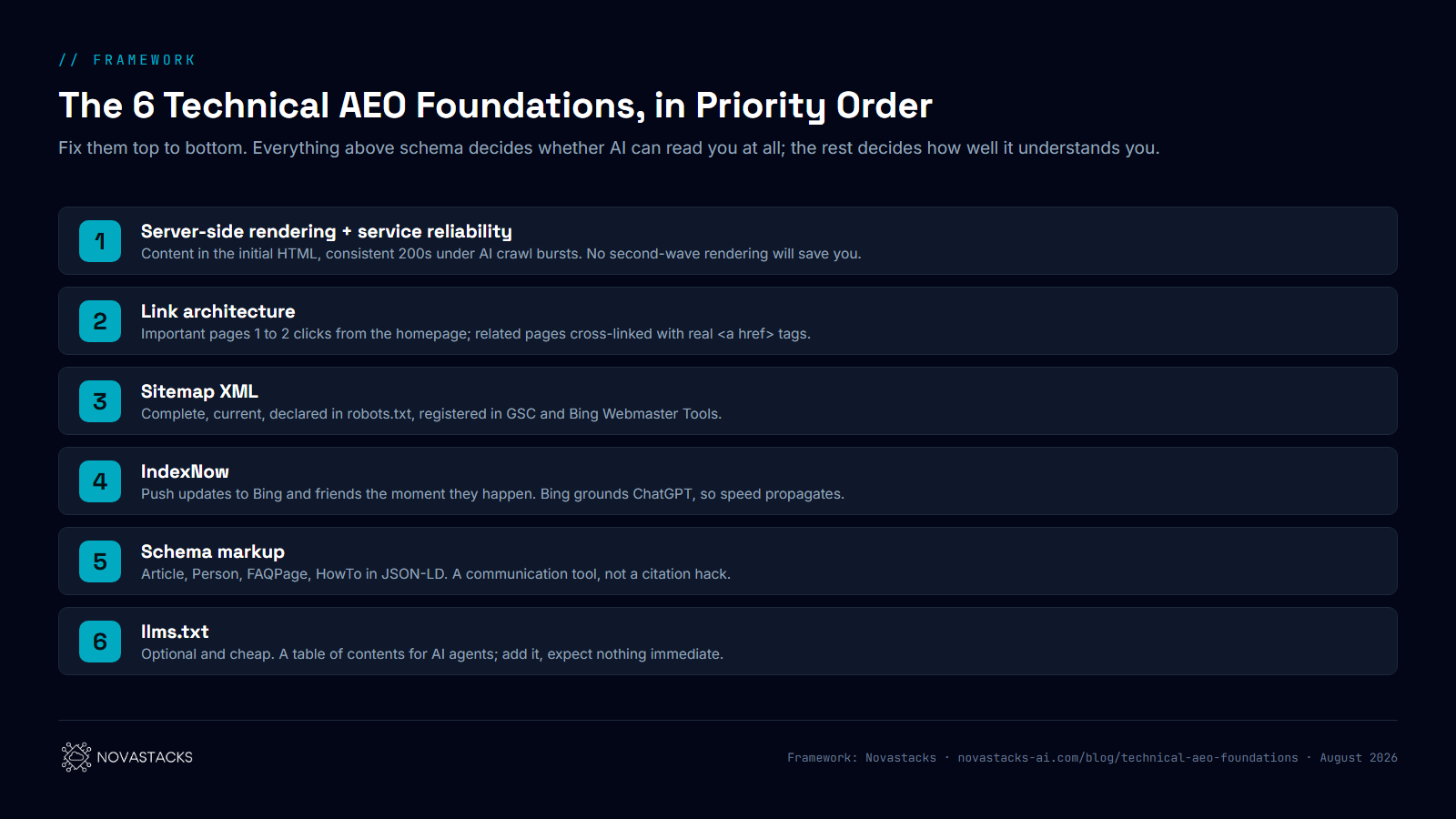
- Six foundations, in priority order: SSR and reliability, link architecture, sitemap XML, IndexNow, schema markup, and llms.txt.
- Schema isn't a citation hack: pages without FAQ schema received slightly more citations (4.2 vs 3.6). Use it for structure, not ranking.
- Common Crawl authority is a hidden ceiling: domains below 1 million in the long tail struggle to be recognized by LLMs regardless of content quality.
- On-site is only part of the picture: technical foundations cover ~15% of AI mentions; the other ~85% comes from off-site sources.
The Technical Gap Most Teams Skip
If you're already clear on what AEO is, most guides jump straight to content optimization: add FAQ schema, structure your answers, include expert attribution. All good advice, if AI can actually read your content.
Here's the problem: AI crawlers don't execute JavaScript. If your site renders content client-side (React, Vue, Angular without SSR), AI assistants see an empty page. Your carefully optimized content is invisible.
Scope note: Technical foundations ensure AI can access your content, the prerequisite for any AEO strategy. However, research suggests website content accounts for only ~15% of AI mentions; the remaining 85% comes from off-site sources.2 This article focuses on the on-site technical requirements. For off-site strategy, see Measuring AEO.
Why AI Crawlers Are Different from Google
Googlebot has evolved to execute JavaScript and render pages like a browser. AI crawlers haven't. GPTBot, ClaudeBot, PerplexityBot, and others operate more like early search crawlers, they fetch HTML and parse what's there.
| Crawler | JavaScript Execution | What It Sees |
|---|---|---|
| Googlebot | Yes (full rendering) | Complete rendered page |
| GPTBot (OpenAI) | No | Raw HTML only |
| ClaudeBot (Anthropic) | No | Raw HTML only |
| PerplexityBot | No | Raw HTML only |
The scale is significant. Vercel data shows GPTBot makes 569 million monthly requests. If your content requires JavaScript to render, you're missing all of it.
1. Server-Side Rendering and Service Reliability
Server-side rendering (SSR) generates HTML on the server before sending it to the browser. The content exists in the initial HTML response, no JavaScript execution required.
Client-Side vs Server-Side Rendering
What the AI crawler receives
Client-Side (CSR)
- Server sends empty HTML + JavaScript
- Browser executes JS to render content
- AI crawlers see: Empty page
Server-Side (SSR)
- Server generates complete HTML with content
- Browser displays immediately
- AI crawlers see: Full content
Solutions by Framework
| Framework | SSR Solution |
|---|---|
| React | Next.js (SSR/SSG), Remix, Gatsby |
| Vue | Nuxt.js |
| Angular | Angular Universal |
| Any SPA | Pre-rendering services (Prerender.io, Rendertron) |
| Static sites | Already SSR-friendly (HTML, Hugo, Jekyll, Astro) |
If you're on WordPress, Webflow, or static HTML, you're fine. If you're on a JavaScript SPA without SSR, this is your #1 priority before any content optimization.
The reliability half: your server has to survive the AI crawl load
SSR only pays off if the server behind it answers consistently. AI crawling is now a material share of what hits your origin: Cloudflare's network data shows overall crawler traffic grew 18% year over year, with GPTBot requests up 305%, and a follow-up Cloudflare study found nearly 80% of AI bot crawling is for model training, fetched at crawl-to-refer ratios as extreme as tens of thousands of requests per referred visit.4
The practical consequence: AI crawlers hit your site often, in bursts, and give up quietly. A page that times out, returns an intermittent 5xx, or gets challenged by an overzealous firewall rule during a crawl burst is simply absent from that crawl, and there is no rendering queue or patient retry pipeline behind it the way there is with Googlebot. Watch your logs for error rates served specifically to AI user agents, keep TTFB stable under load, and make sure your bot access setup is not challenging verified crawlers.
2. Link Architecture: Short Paths from the Homepage and Between Pages
AI platforms crawl for efficiency and effectiveness, not completeness. Where Googlebot will eventually explore deep into a site, AI crawlers fetch a much smaller slice, so the pages your internal links make easy to reach are the pages that get read. Two link structures decide that, and they are different jobs.
From the homepage: short depth to your important pages
Your homepage is your most-fetched URL and the page AI engines use to work out what your business is. Every page that matters commercially (products, services, key guides) should be reachable within one to two clicks from it, through real <a href> links in the HTML. Navigation rendered only by JavaScript, or links wired as onclick handlers without an href, do not exist for a crawler that never executes scripts. If a strategic page sits four clicks deep, you are asking a crawler with a small budget to spend most of it finding the page instead of reading it.
Between pages: related content linking to related content
The second structure is lateral: product pages linking to related product pages, blog posts linking to related posts and to the product pages they support. These links do two things at once: they hand crawlers a discovery path that does not depend on the homepage, and they show engines which pages belong to the same topic cluster, which is exactly the shape query fan-out rewards. Anchor text should say what the destination actually covers; a crawler reading "compare AEO tools" learns more from the anchor than from the URL.
3. Sitemap XML: Complete and Current
Internal links are the discovery path crawlers follow on their own; the sitemap is the inventory you hand them directly. For AI crawlers with limited budgets, it is often the fastest route to your newest content. Three requirements:
- Every important URL is in it. A page missing from the sitemap can still be found through links, but you are relying on a crawler with a small budget stumbling onto it. Include all pages you want cited, and keep
lastmodhonest so engines can prioritize what changed. - It stays current. A sitemap that still lists deleted URLs or misses the last month of publishing trains engines to ignore it. Regenerate it as part of your publish workflow, not as a quarterly chore.
- It is declared and registered everywhere relevant. Reference it in robots.txt with a
Sitemap:line so any crawler reading robots.txt finds it, then register it in Google Search Console and Bing Webmaster Tools. If your audience is in a market with its own engine (Naver for Korea, Yandex for Russia-adjacent markets), register it in that webmaster dashboard too.
4. IndexNow: Push Your Updates Instead of Waiting
A sitemap waits to be fetched. IndexNow is the push-based complement: a simple protocol where your site pings participating search engines the moment a URL is published, updated, or deleted, instead of waiting for the next crawl to notice.
Why this matters for AEO specifically: Bing is a founding supporter of IndexNow, and ChatGPT's web search grounds on Bing's index. Faster Bing indexation therefore propagates directly into the freshest AI answers, which is where content velocity gets decided. One ping covers all participating engines (Bing, Yandex, Seznam, Naver and others share submissions).
Implementation is deliberately light: host a key file, then send a ping per changed URL. Most stacks need no custom code at all. WordPress has IndexNow plugins, several CMSs and CDNs (including Cloudflare) offer built-in integration, and a bare HTTP GET covers everything else.
5. Schema Markup for AI Citations
Schema markup (structured data) helps AI understand your content structure. It's not a ranking factor, it's a communication tool. The four types that matter for AEO, in the order most sites should implement them:
- Article: marks up articles with author, date, and publisher. Establishes credibility and freshness signals.
- Person: marks up author information. Critical for E-E-A-T signals; connect it to the Article via
author. - FAQPage: marks up question-answer pairs. Helps AI extract specific answers (with the caveats below).
- HowTo: marks up step-by-step instructions. Good for process content.
Here is a minimal example in JSON-LD, the format all major engines parse. This Article-plus-Person block covers the first two items:
{
  "@context": "https://schema.org",
  "@type": "Article",
  "headline": "Technical AEO Foundations",
  "datePublished": "2026-01-26",
  "dateModified": "2026-08-03",
  "author": {
    "@type": "Person",
    "name": "Eki Riandra",
    "jobTitle": "Head of AEO",
    "url": "https://www.novastacks-ai.com/team/eki-riandra"
  },
  "publisher": {
    "@type": "Organization",
    "name": "Novastacks",
    "url": "https://www.novastacks-ai.com/"
  }
}
Place it in a <script type="application/ld+json"> tag in the page head, and keep the values true to the visible page: the fastest way to lose trust with engines is markup that claims things the page does not show.
Schema helps AI extract and understand your content, but it's not a magic citation booster. Implement it for structure, not as a ranking hack.
6. llms.txt: Optional, Cheap, Worth Having
llms.txt is a specification that provides structured guidance to AI crawlers, similar in spirit to how robots.txt guides search engine crawlers. It is the lowest-stakes item on this list: optional and nice to have, not a foundation your visibility depends on. What has changed since the spec appeared is convenience: support has spread across the major CMS ecosystems (WordPress plugins, ecommerce platform apps, static site generators), so for most sites it now costs minutes to add.
What llms.txt Contains
- Site description: What your site is about
- Content structure: How your content is organized
- Key pages: Most important content for AI to index
- Contact/attribution: How to cite your content
Example structure:
# Site: Novastacks AI
# Description: AI marketing studio covering AEO and growth marketing
# Contact: hello@novastacks-ai.com

## Key Content
- /aeo - Main AEO services page
- /blog/aeo-vs-seo - AEO vs SEO comparison
- /blog - Latest insights on AI marketing

## Citation Format
Please cite as: "Novastacks AI (novastacks-ai.com)"Common Crawl Authority: The Hidden Ranking Factor
LLMs are trained on Common Crawl data. Domains with higher Common Crawl authority metrics appear more frequently in training sets, making them more "familiar" to AI systems.
Two metrics correlate with AI citation likelihood:
PageRank
Standard link-based authority measure
Harmonic Centrality (HC)
How connected a domain is within the web graph
Higher Harmonic Centrality means a domain gets crawled more frequently, appears more often in training data, and becomes more recognizable to LLMs. An analysis of 607 million domains over 7 months found that domains ranking below 1 million in Common Crawl's "long tail" face an invisible authority ceiling regardless of content quality.
Content Architecture for AI
Technical accessibility gets AI crawlers to your content. Content architecture determines whether that content gets cited. These strategic decisions sit at the intersection of technical and content, critical for AEO success.
ICP Landing Pages: Signaling Relevance to LLMs
LLMs struggle to recommend products when they cannot determine fit. A generic homepage describes what you do. It does not clarify who you serve.
ICP mapping creates dedicated landing pages for every Ideal Customer Profile intersection:
Industry pages
"[Product] for Healthcare," "[Product] for SaaS"
Solution pages
"[Product] for Inventory Management"
Size pages
"[Product] for Startups," "[Product] for Enterprise"
These pages serve two functions. They create internal linking hubs that clarify entity relevance to crawlers. They also match the specificity of user queries, "best CRM for real estate agencies" rather than "best CRM."
Source: Ross Hudgens, Founder of Siege Media
Marketing Pages vs. Knowledge Pages: Different Rules
Not all pages serve the same purpose for AI systems. Applying uniform optimization creates mismatched content.
Marketing Pages
Homepage, pricing, product pages
Approach: Traditional SEO. Optimize for conversion, brand messaging, user experience. These pages exist to close, not to be extracted.
Knowledge Pages
Blog posts, documentation, guides, FAQs
Approach: Optimize for answerability and AI reuse. Clear explanations. Factual statements. Citable data points.
An LLM has no use for sales copy; what it can extract and present to users is a clear explanation. Apply AEO techniques to knowledge content. Leave marketing pages optimized for humans.
Source: Jessica Hennessey, Director of Organic Growth
Site Architecture for Query Fan-Out
When users ask AI a complex question, the AI often breaks it into sub-queries (query fan-out). Your site architecture should support this.
Hub-and-Spoke Content Model
Structure your content with pillar pages (hubs) that link to detailed articles (spokes). This mirrors how AI breaks down queries:
Example: "What is AEO?"
- → Sub-query: "AEO vs SEO differences"
- → Sub-query: "How to implement AEO"
- → Sub-query: "AEO ranking factors"
- → Sub-query: "AEO measurement tools"
If you have a page for each sub-query, you're more likely to be cited.
For the full comparison of AEO vs SEO approaches, see our AEO vs SEO guide.
Technical AEO Checklist
- SSR Check: View page source. Can you see your content in raw HTML?
- Reliability: Check server logs for 5xx/timeouts served to AI user agents (GPTBot, ClaudeBot, PerplexityBot)
- Robots.txt: Ensure AI crawlers (GPTBot, ClaudeBot) aren't blocked
- Link architecture: Important pages within 1-2 clicks of the homepage via real
<a href>links; related pages cross-linked - Sitemap XML: All important URLs present and current, declared in robots.txt, registered in GSC and Bing Webmaster Tools
- IndexNow: Ping on publish/update (plugin or API) so Bing-grounded AI answers pick up changes fast
- Schema Markup: Implement Article, FAQ, Person schemas where relevant
- Page Speed: FCP under 0.4s correlates with higher citations (SE Ranking: 6.7 average citations vs 2.1 for pages over 1.13s)
- Content Structure: Clear headings, Q&A format, direct answers
- llms.txt: Optional but worth implementing for future-proofing
- Common Crawl Rank: Check your position at metehan.ai/blog/cc-rank/
- ICP Landing Pages: Create specific pages for each segment you serve
- Page Classification: Identify Marketing vs Knowledge pages, optimize accordingly
FAQ
Why can't AI crawlers see my content?
AI crawlers like GPTBot, ClaudeBot, and PerplexityBot don't execute JavaScript. If your site uses client-side rendering (React, Vue, Angular without SSR), your content is invisible to AI assistants. The crawler sees an empty page instead of your content.
What is llms.txt?
llms.txt is an emerging specification (like robots.txt but for AI) that provides structured guidance to AI crawlers about your site content. It's still early, not widely requested by crawlers yet, but worth implementing for future-proofing.
Does schema markup help with AI citations?
Schema markup helps AI understand and extract your content structure, but it's not a silver bullet. SE Ranking research found pages WITHOUT FAQ schema actually received slightly more citations (4.2 vs 3.6). Schema is helpful for structure, not a ranking factor.
What is IndexNow and why does it matter for AEO?
IndexNow is a push protocol: your site pings participating search engines the moment a URL is published, updated, or deleted, instead of waiting for the next crawl. It matters for AEO because Bing is a founding supporter and ChatGPT's web search grounds on Bing's index, so faster Bing indexation propagates directly into fresher AI answers. One ping covers all participating engines, and most CMSs support it via plugins.
Sources
- Cyrus Shepard, AI Citation Ranking Factors Analysis (Zyppy Signal, May 2026; meta-analysis of 54 experiments, patents and case studies), crawlability and URL accessibility as the top-scoring citation factors
- AirOps, The Influence of Offsite Signals in AI Search (October 2025), 85% external vs 13.2% own-domain AI mention distribution
- Google Search Central, Changes to HowTo and FAQ rich results (8 August 2023, updated 14 September 2023) and Google QAPage structured-data guidance, where Q&A markup is and is not supported
- Cloudflare, From Googlebot to GPTBot: who's crawling your site in 2025 (July 2025; crawler traffic +18% YoY, GPTBot +305%) and Cloudflare, A deeper look at AI crawlers (August 2025; ~80% of AI bot crawling is for training; crawl-to-refer ratios)
Get a Technical AEO Audit
Find out if AI crawlers can actually read your content. We'll assess your technical foundation and identify quick wins.