llms.txt Explained: What It Does, What the Evidence Says, and How to Write a Good One
llms.txt is a plain text map of your site for AI systems. It will not move your Google rankings, and there is no evidence yet that it earns AI citations. It can still matter as AI agents start using websites for people. Here is the honest picture, and how to write one that is worth having.

Key Takeaways
- llms.txt is a markdown file at the root of a site that points AI systems to its most important content, proposed by Jeremy Howard in September 2024.
- It has no effect on Google rankings: Google says Search ignores it. Three studies, including one of about 300,000 domains, found no measurable link to AI citations.
- Its real value is for AI agents that read a site to complete a task. Chrome's Lighthouse now checks for it under agentic browsing, and AI labs publish their own for their developer docs.
- Treat it as a low cost nice to have today, and write it well: a clear summary, the pages that answer real questions, and a useful description on every link.
- Most files fail by listing every URL or repeating marketing slogans. A good file reads like a briefing for someone new to the business.
Every few months a new file promises to fix AI visibility. llms.txt is the one most businesses ask us about. Some have been told it is essential for appearing in ChatGPT. Others have generated one with a plugin, uploaded it, and heard nothing since.
Both reactions miss what the file is for. llms.txt is useful, in a narrower way than the hype suggests, and most of the files we see are written in a way that would not help even the systems that do read them. This guide covers what the file is, what the evidence says, where it matters, and how to write one properly.
1. What llms.txt Is
llms.txt is a plain text file written in markdown, a simple formatting style in which # marks a heading and [text](url) marks a link. It sits at the root of a website (https://www.example.com/llms.txt) and gives large language models a short, clean map of the site's most important content. It was proposed by Jeremy Howard on llmstxt.org in September 2024, and the proposal reached version 2 in August 2026. The proposal's stated aim is to give large language models content they can read easily.
It is easy to confuse with two files every site already has, and it does a different job from both:
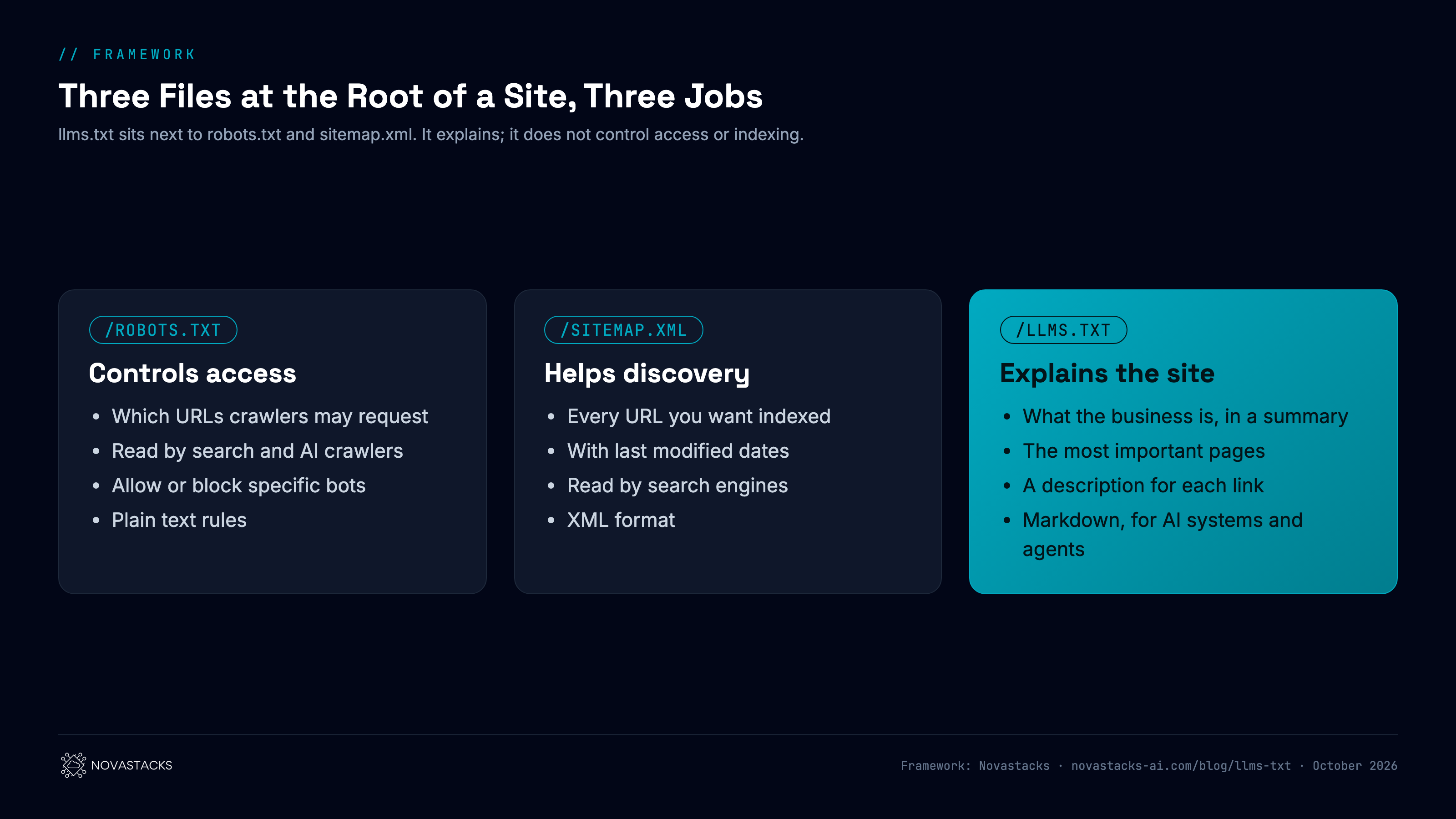
- robots.txt controls access: which URLs crawlers may request.
- sitemap.xml helps discovery: every URL you want indexed.
- llms.txt explains: what the business is, and which pages matter most, with a sentence on each.
2. Does llms.txt Help SEO or AI Citations?
For Google rankings, no. Google's AI optimisation guidance says creating these files "will neither harm nor help your site's visibility or rankings in Google Search, as Google Search ignores them." In 2025 Google's John Mueller made the same point about AI services generally: "AFAIK none of the AI services have said they're using LLMs.TXT (and you can tell when you look at your server logs that they don't even check for it)."
For AI citations, there is no strong evidence either way, and the studies so far point to no effect:
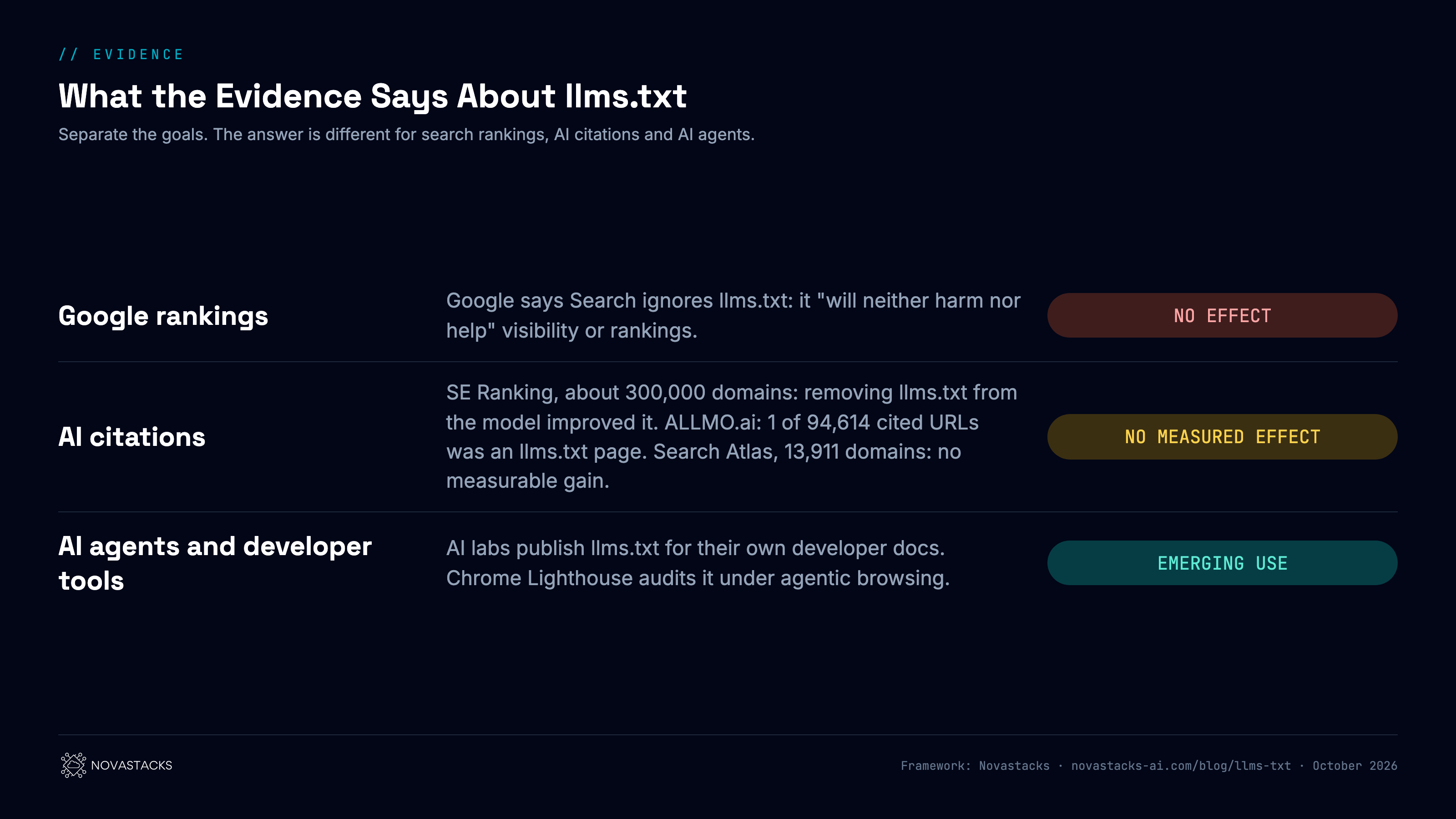
| Study | What it measured | Finding |
|---|---|---|
| SE Ranking, November 2025 | About 300,000 domains | 10.13% had the file; removing it from their citation model "actually improved its accuracy" |
| ALLMO.ai, January 2026 | 94,614 cited URLs from 11,867 AI answers | 1 cited URL was an llms.txt page, and 1 of the 50 most cited domains published the file |
| Search Atlas, June 2026 | 13,911 matched domains, six AI platforms | "Publishing /llms.txt does not produce measurable gains in LLM visibility" |
All three are studies by companies that sell AI visibility tools, and they agree. If someone promises that llms.txt will get you cited in ChatGPT, ask for their evidence.
3. Where llms.txt Can Matter: AI Agents
The case for llms.txt is about agents more than search. AI agents increasingly read websites to complete a task for someone: comparing products, finding a policy, setting up an integration, booking or buying. An agent with a clear map of the site spends less time crawling pages it does not need.
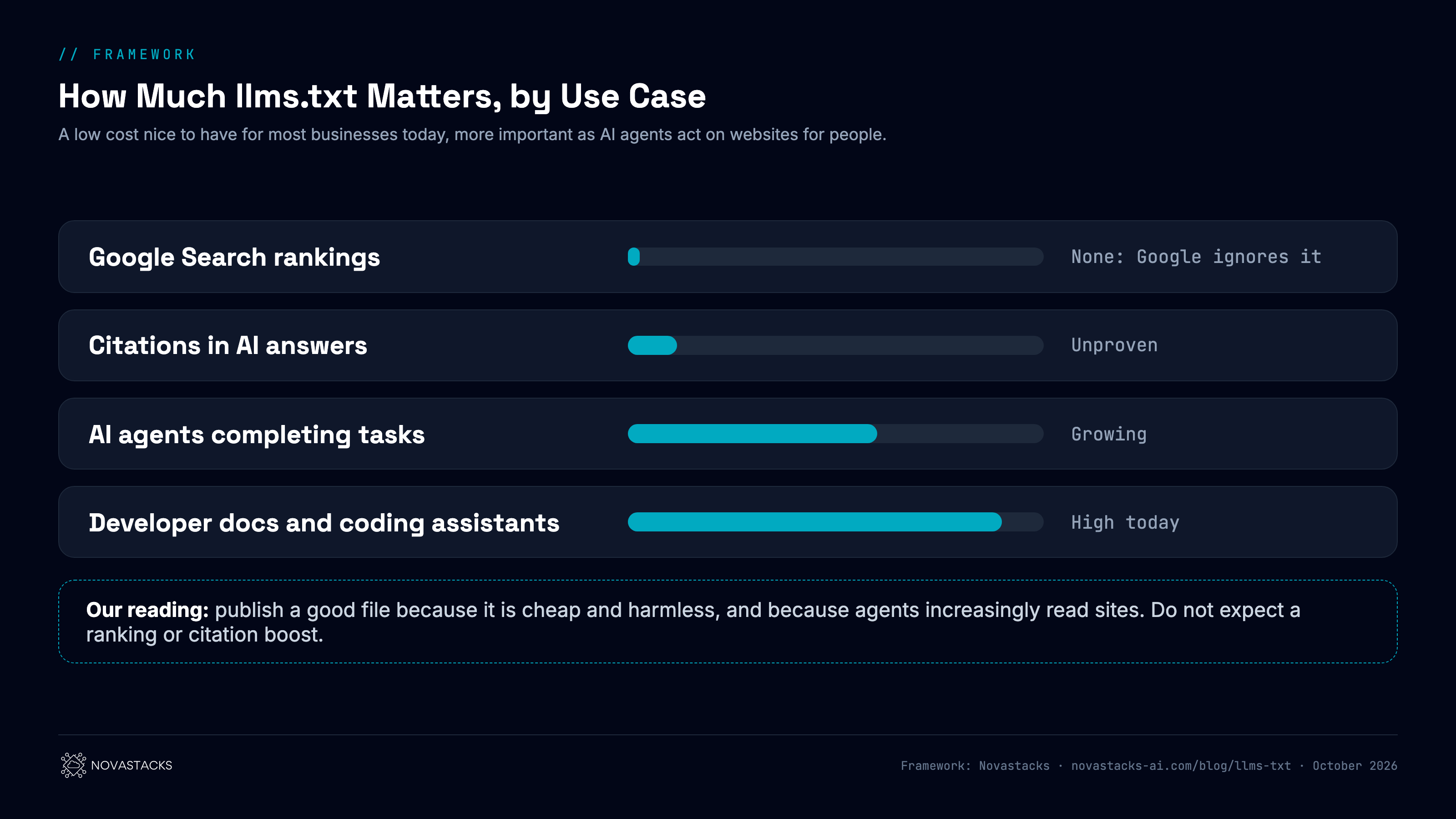
- The AI labs use it for their own documentation. Anthropic, OpenAI, Google's Gemini API and Perplexity all publish an llms.txt for their developer docs. The proposal's author, Jeremy Howard, writes that the files are used most heavily for software documentation, where coding agents follow them to find API references. That is his observation, not an independent measurement.
- Chrome's site audit tool now checks for it. Chrome's Lighthouse includes an llms.txt audit under agentic browsing, noting that "Without this file, agents may spend more time crawling the site." The same audit marks a missing file as not applicable, "as providing the file is optional at the moment."
- Google is relaxed about it. Its guidance says "It's completely fine if you decide to create and maintain LLMS.txt files (or other similar files) for other services or systems that use these files."
So the honest summary is this. For most businesses llms.txt is a nice to have today: cheap to publish, with no downside and no proven benefit in search. As agents do more on the web for people, a site that explains itself clearly to them will be easier to use, and the file becomes more useful.
4. The llms.txt Format, With an Example
The proposal defines a simple markdown structure. An H1 is the top heading, written with one #; an H2 is a section heading, written with ##. Only the first line is required; the rest is what makes the file useful.
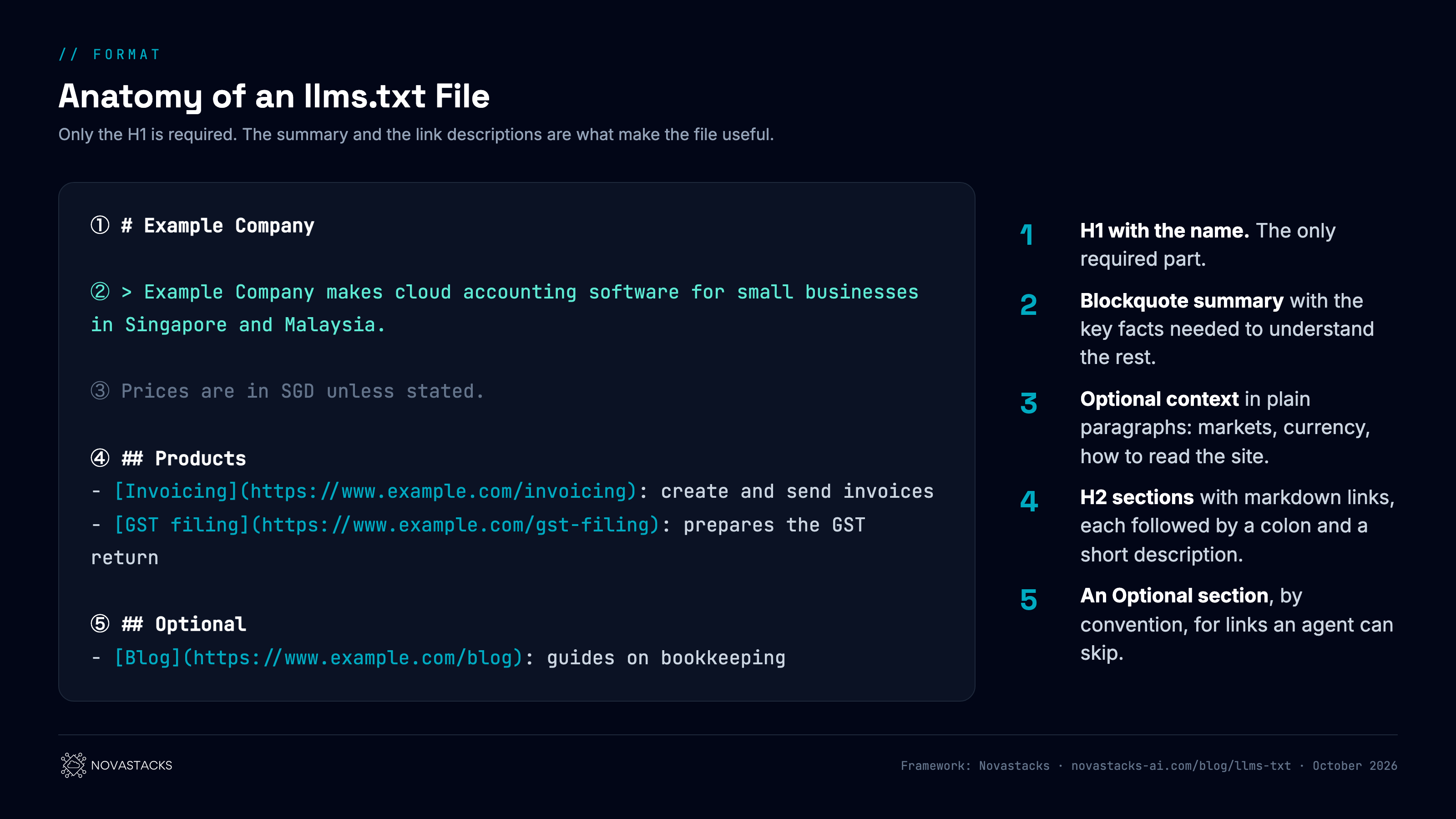
- An H1 with the name of the site. In the proposal's words, "This is the only required section."
- A blockquote summary "containing key information necessary for understanding the rest of the file."
- Optional context in plain paragraphs.
- H2 sections with link lists. Each item is a markdown link, then optionally a colon and notes about the page.
- An "Optional" section, by convention, for secondary links an agent can skip.
The proposal also asks sites to serve a clean markdown version of important pages at the same URL with .md added. Version 2 adds discovery links in the page head: rel="describedby" pointing to the llms.txt file and rel="alternate" type="text/markdown" pointing to a page's markdown version. It also settles how files for part of a site work: a file such as /docs/llms.txt covers the pages under its path, and the most specific file applies.
5. How to Set Up llms.txt, Step by Step
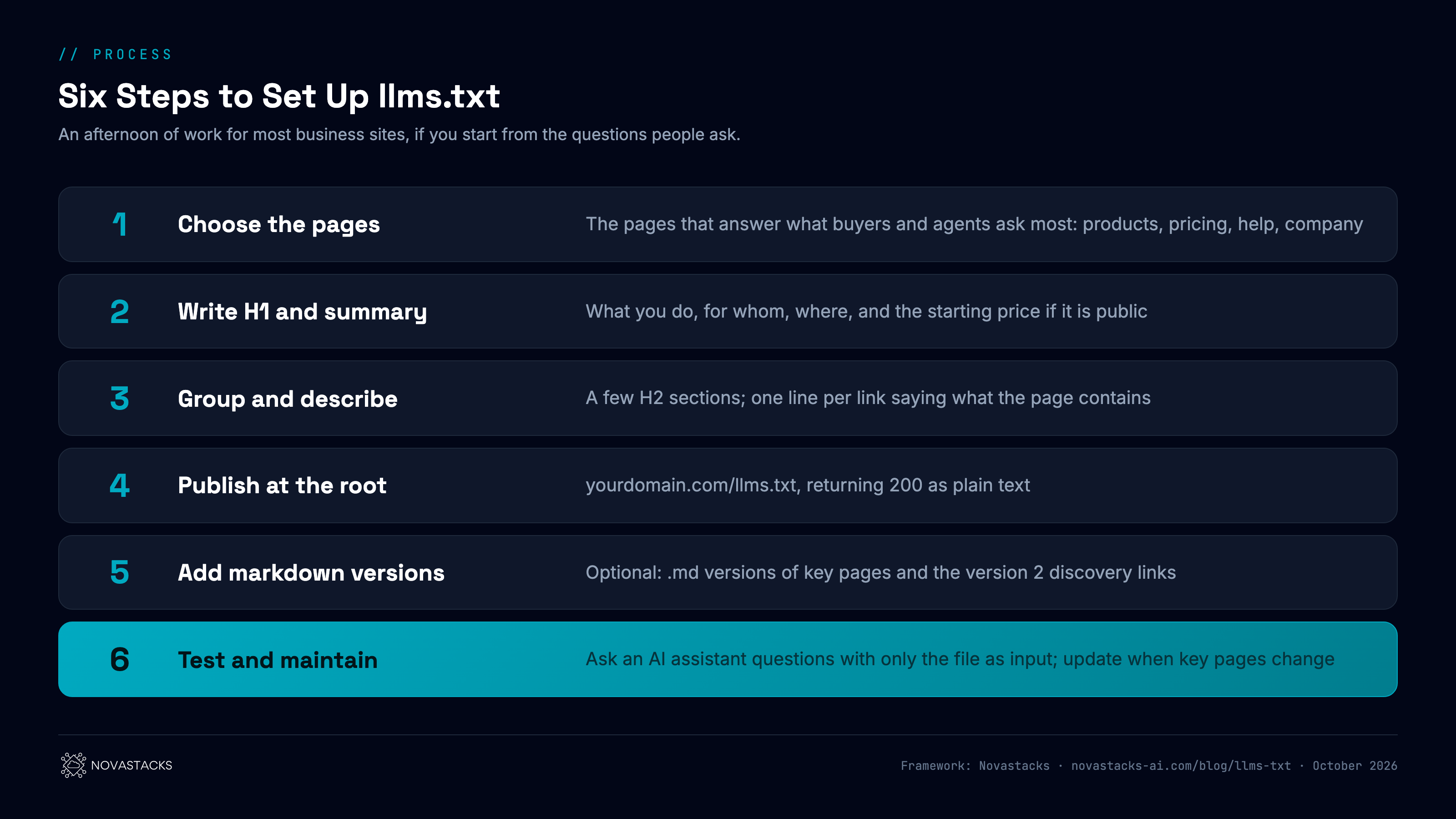
- Choose the pages. Start from the questions buyers and agents ask: what you sell, what it costs, how it works, how to get support. Pick the pages that answer them.
- Write the H1 and summary. Name the business, then state the facts that matter in two sentences: what you do, for whom, where, and the starting price if it is public.
- Group the links and describe each one. Use a few H2 sections such as Products, Pricing, Help and Company, with one line per link saying what the page contains.
- Publish at the root. Save the file as
llms.txtathttps://www.yourdomain.com/llms.txtand make sure it returns a 200 status as plain text. On most platforms this is an upload to the site root or a static file route. - Add markdown versions if you can. For documentation or help pages, a clean
.mdversion of each page and the discovery links from version 2 make the content easier for agents to read. - Test and maintain it. The proposal suggests you "Test your file by asking an agent questions about your content, giving it only your llms.txt as a starting point." Update the file whenever important pages, prices or products change.
6. A Weak llms.txt and a Better One
Most llms.txt files we review fall into two patterns. Some are generated by a plugin that dumps every URL on the site, including login pages and paginated archives. Others are written like an advert, with a summary full of claims and no facts. Neither tells an agent anything it can use.
Here is a typical weak file for a fictional accounting software company, Example Company:
# Example Company

> Welcome to Example Company! We are the leading innovative solutions provider, passionate about excellence.

## Pages
- [Home](https://www.example.com/)
- [About](https://www.example.com/about)
- [Blog](https://www.example.com/blog)
- [Blog page 2](https://www.example.com/blog?page=2)
- [Privacy](https://www.example.com/privacy)
- [Login](https://www.example.com/login)
And a better one for the same business:
# Example Company

> Example Company makes cloud accounting software for small businesses in Singapore and Malaysia. Plans start at SGD 29 a month, with GST and SST filing built in.

Example Company has served small businesses since 2015. Prices on this site are in SGD unless stated.

## Products
- [Invoicing](https://www.example.com/invoicing): create and send invoices, with automatic payment reminders
- [GST filing](https://www.example.com/gst-filing): prepares the GST F5 return from your transactions
- [Payroll](https://www.example.com/payroll): monthly payroll with CPF contributions calculated

## Pricing and plans
- [Pricing](https://www.example.com/pricing): three plans, what each includes, and the annual discount

## Help
- [Getting started guide](https://www.example.com/help/getting-started.md): set up a company, connect a bank, import contacts
- [Switching from spreadsheets](https://www.example.com/help/switch.md): how to move existing records

## Company
- [About us](https://www.example.com/about): team, offices and the markets we serve
- [Contact and support](https://www.example.com/contact): support hours, phone and email

## Optional
- [Blog](https://www.example.com/blog): guides on bookkeeping and tax for small businesses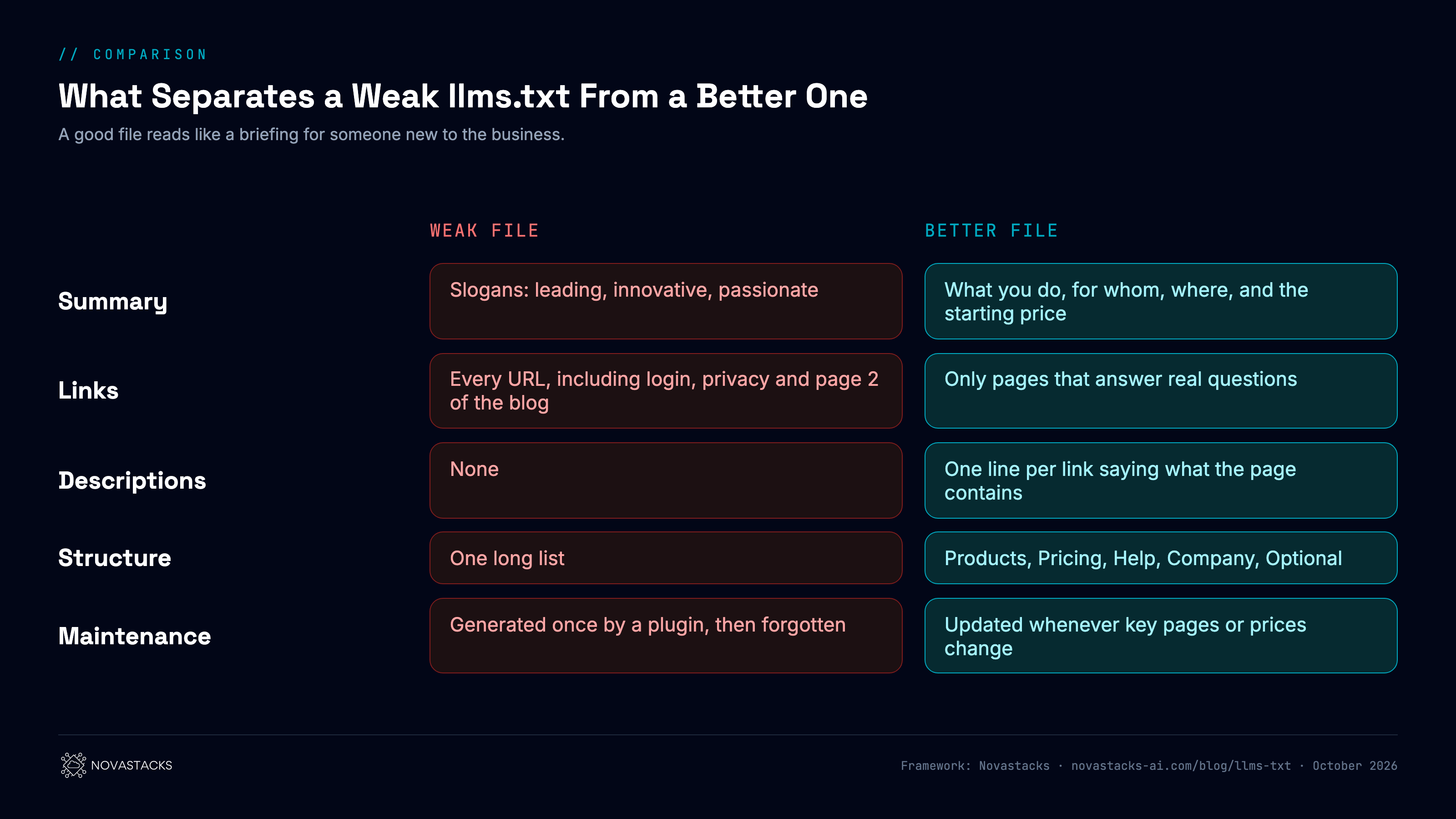
The better file reads like a briefing for someone new to the business. An agent asked "how much does Example Company cost?" or "does it handle GST?" knows exactly which page to open. Nothing in it is marketing, and nothing is there just because the URL exists.
7. How Novastacks Writes llms.txt for Clients
At Novastacks, an llms.txt is the last step of understanding a site, never the first. We write it after mapping how the site is structured, which pages do which job, and which questions buyers actually ask. Our work is AEO, answer engine optimisation: getting a brand cited and named in AI answers as well as found in search. The work follows the four layers of our method:
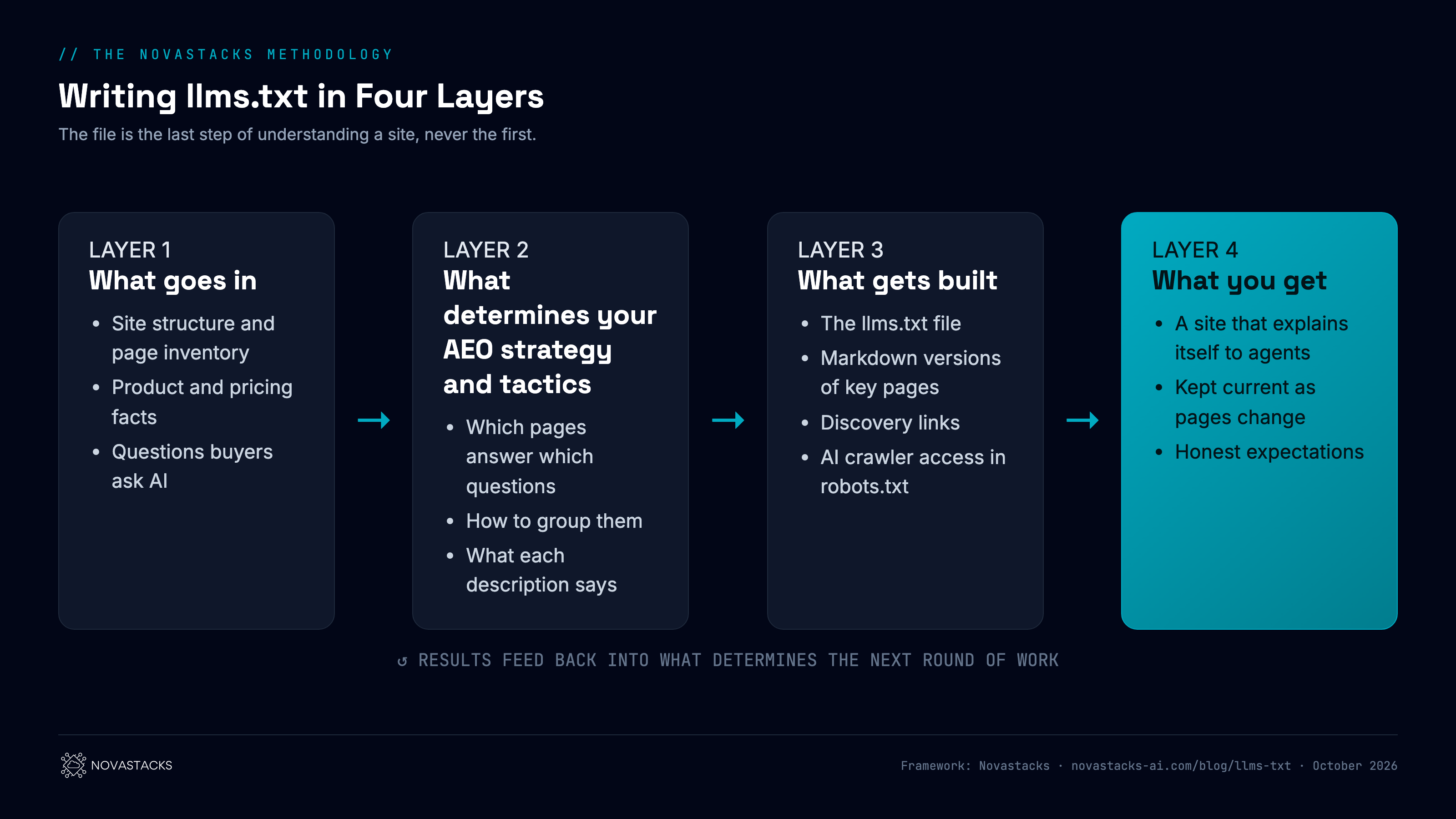
- What goes in: the site structure and page inventory, product and pricing facts, and the questions buyers ask AI assistants about the category.
- What determines your AEO strategy and tactics: which pages answer which questions, how to group them, and what each description must say.
- What gets built: the llms.txt file, markdown versions of key pages where they help, the discovery links, and a robots.txt that lets the AI crawlers you want reach the site.
- What you get: a site that explains itself clearly to AI agents, kept up to date as pages change, with honest expectations about what the file can and cannot do.
We also check the basics around it, because an llms.txt cannot help if AI crawlers are blocked or the pages it points to render only in JavaScript. Our free AEO checker tests both in under a minute. The full system is set out in The Novastacks Methodology.
If you want to know whether llms.txt is worth it for your site, and what a good one would say about your business, discuss it with us.
Frequently Asked Questions
What is llms.txt?
llms.txt is a markdown file at the root of a website that gives AI systems a short map of the site's most important content: a summary of the business and a list of key pages with a description of each. It was proposed by Jeremy Howard at llmstxt.org in September 2024.
Does llms.txt help SEO?
Not in Google. Google's guidance says creating llms.txt will neither harm nor help a site's visibility or rankings in Google Search, because Google Search ignores the file. It is fine to keep one for other systems that use it.
Does llms.txt help you get cited by ChatGPT or other AI assistants?
There is no evidence that it does. Studies by SE Ranking, ALLMO.ai and Search Atlas found no sign that publishing llms.txt leads to more citations in AI answers. Being cited depends on the content of your pages and the sources AI engines trust.
Is llms.txt worth creating?
For most businesses it is a low cost nice to have. It does no harm, takes little time to write well, and becomes more useful as AI agents read websites to complete tasks for people. Write it for clarity, and do not expect a ranking or citation boost.
Where do I put llms.txt?
At the root of your domain, so it loads at https://www.yourdomain.com/llms.txt and returns a 200 status as plain text. A site can also publish files for a section, such as /docs/llms.txt, and version 2 of the proposal says the most specific file applies.
What is the difference between llms.txt and robots.txt?
robots.txt controls which URLs crawlers may request. llms.txt does not control access at all: it explains what the site is and which pages matter, for AI systems that choose to read it. To allow or block AI crawlers, you still use robots.txt.
How often should I update llms.txt?
Whenever important pages, products or prices change, and at least when you review the site each quarter. An out of date file points agents to the wrong pages, which is worse than no file.
Sources
- llmstxt.org: The /llms.txt file (version 2, August 2026)
- Google Search Central: AI optimisation guide
- Search Engine Journal: Google says llms.txt comparable to keywords meta tag (April 2025)
- SE Ranking: Does llms.txt impact AI visibility and citations? (November 2025)
- ALLMO.ai: llms.txt and AI citations (January 2026)
- Search Atlas: Limits of llms.txt for AI search citation (June 2026)
- Chrome for Developers: Lighthouse llms.txt audit (agentic browsing)
- Anthropic developer documentation llms.txt
Want an llms.txt that reflects how your business works?
Talk to us. We map your site, the questions your buyers ask and the pages that answer them, then write and maintain the file with you.