How to Find the AI Prompts Your Buyers Use and Which Ones Mention You
For marketing leads who want to know whether ChatGPT and Google AI recommend them, but do not know which questions to check: six sources of real buyer prompts, how to build a set worth tracking, and how to see which prompts name you.

Key Takeaways
- No engine publishes its prompts: there is no keyword planner for ChatGPT, so a prompt set is built from evidence of what buyers ask, then tested.
- Six sources cover most of it: Search Console long queries, sales and support calls, People Also Ask and community threads, the engines' own follow up questions, comparison and review pages, and Bing grounding queries.
- Your Search Console already holds prompts: 41% of the queries that reached our own site in 90 days had eight or more words.
- Raw questions are not a prompt set yet: rewrite them in the buyer's words and language, tag the stage, score priority, and freeze 20 to 50 per market.
- The stage decides whether you get named: one vendor in our study was named in 99.4% of answers to questions that included its name, 42.6% on shortlist and feature questions and 8.7% on educational ones.
- Each engine needs its own line: another vendor was named in 74 of 1,484 Google AI Overview answers and in 1 of 1,550 ChatGPT answers to the same questions.
You want to know whether ChatGPT recommends your company, and the first question stops you: recommends it for what? There is no keyword planner for AI engines, so most teams either guess a dozen questions or paste in hundreds of generic ones a tool suggested. Neither tells you what your buyers actually ask before they shortlist a supplier.
This guide shows where to find the real questions, how to turn them into a prompt set worth tracking, and how to see which of those prompts already name your brand and which name a competitor instead.
1. Why prompts are harder to find than keywords
Keyword research rests on published demand. Google shows search volumes, and every SEO tool is built on that data. None of the AI engines offers an equivalent public tool. Google's Search Console counts AI Mode prompts in its Performance report, but mixes them with ordinary searches and shows only the ones where your site appeared, and ChatGPT shows site owners nothing at all. Every prompt list, including the ones tools sell, is an estimate built from other evidence.
Prompts also look different. A buyer may type three words into Google and twenty into ChatGPT, adding their role, their market, their budget and the tools they already use. One keyword such as "payroll software" breaks into dozens of prompts that each carry a different buying context.
The good news is that the evidence exists, and some of it already sits in your own accounts.
2. Six places to find the prompts your buyers use
1. Search Console long queries
People now type into Google the way they type into ChatGPT, and some paste a full prompt straight into the search box. On our own site, 1,366 of the 3,354 queries that earned impressions between 29 July and 27 October 2026 had eight or more words: 41% of queries and 17% of impressions. One of them read: "how do i know what prompts i should track for our company in an ai search analytics tool?" It went on to ask for "the ones that actually matter for our category and buyer journey" instead of 500 generic questions. That is a prompt, and it arrived through Google.
How to pull it: in the Search Console Performance report, add a Query filter, choose Custom (regex), and use ^(\S+\s+){7,}\S+$ to keep queries of eight words or more. Run a second pass with ^(how|what|which|why|who|is|are|can|does|should)\b for question phrasing. Export both, covering the last three months. Search Console hides very rare queries, so treat the export as a sample of how buyers phrase things.
2. Sales and support calls
For a company with a sales team, this is the richest source, because buyers say out loud what they would type. Read or search call recordings and notes for the questions prospects ask before they commit: how long implementation takes, whether you integrate with their system, how you compare with the supplier they use now, what it costs for a team their size.
How to pull it: add one question to your discovery call script, "What did you ask ChatGPT or Google before you contacted us?", and log the answers word for word. From support, export the twenty most common ticket subjects for the last quarter.
3. People Also Ask, Reddit and Quora threads
These show the follow up questions real people ask around your category, in their own phrasing, including the doubts and complaints a buyer would not raise with a salesperson.
How to pull it: search your main category terms in Google from your market and record every People Also Ask question, expanding each one to reveal more. Then search Reddit and Quora for the category plus words such as "recommend", "alternative", "worth it" and "vs". Our guides to Reddit SEO and AI citations and Quora SEO show which threads AI engines quote.
4. The questions AI engines ask themselves
AI engines do not answer a prompt with one search. Google's own documentation says AI Overviews and AI Mode "may use a 'query fan-out' technique", issuing "multiple related searches across subtopics and data sources" to develop a response. Those sub questions show you what the engine thinks a buyer needs answered next.
How to pull it: run your strongest prompts in Google AI Mode, Perplexity and ChatGPT, then record the follow up questions each one suggests and the subtopics its answer is organised around. Perplexity usually lists related questions under its answers. Each of those is a candidate prompt in the engine's own words.
5. Comparison and review pages in your category
Buyers who reach the shortlist stage ask comparison questions, and the pages AI engines quote for those questions show the criteria buyers care about.
How to pull it: open the "best of" lists, "X vs Y" articles and review platform category pages for your market. Note the criteria each one compares on, such as price, integrations, support or local presence, and the competitor pairs they set side by side. Each criterion becomes a prompt: "Which payroll software for Singapore SMEs has the best local support?"
6. Bing Webmaster Tools grounding queries
Since February 2026, the AI Performance report in Bing Webmaster Tools shows how your content appears across Microsoft Copilot, AI generated summaries in Bing and selected partner integrations. Its grounding queries are, in Bing's words, "the key phrases the AI used when retrieving content that was referenced in AI-generated answers".
How to pull it: verify your site in Bing Webmaster Tools (you can import it from Search Console), open AI Performance and export the grounding queries. Read them as topic evidence: they are the engine's own retrieval phrases, shorter than what users type, and Bing describes them as a sample of citation activity.
3. Turn the raw questions into your prompt set
The six sources give you a long, messy list: fragments from Search Console, half sentences from call notes, forum titles, engine phrases. Tracking that list as it is would measure noise. Five steps turn it into the prompts that matter for your business.
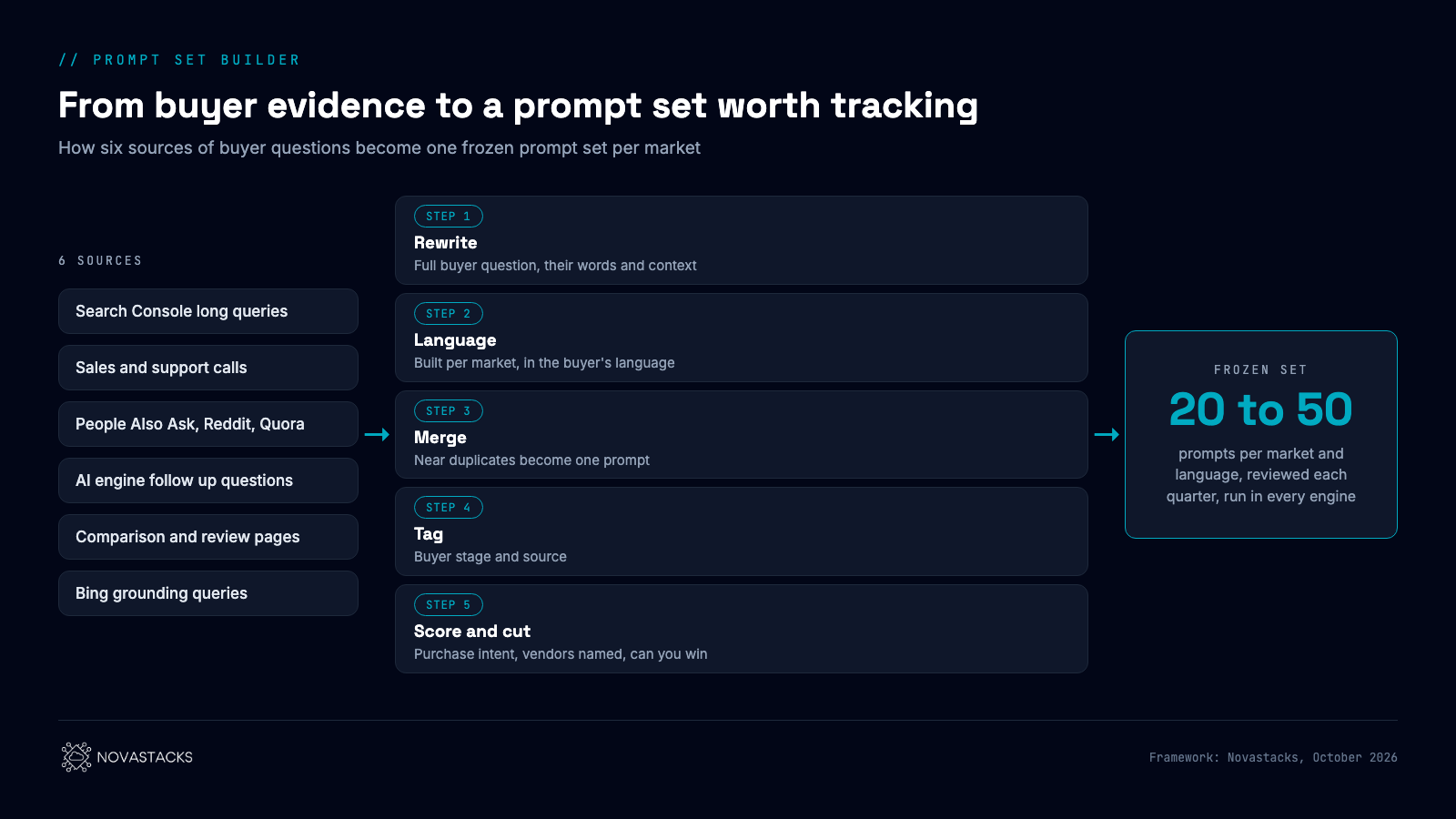
- Rewrite every item as a full question a buyer would type. Keep the buyer's own words and add the context they would give: role, company size, market, constraint. "payroll sg" becomes "What payroll software works best for a 40 person company in Singapore that already uses Xero?" The keywords you already rank for belong here too: rewrite each one as the question a buyer would ask behind it.
- Write it in the language your buyers search in. A Dutch restaurant owner asks in Dutch and an Indonesian shopper asks in Bahasa Indonesia. Translating an English list afterwards produces questions nobody asks, so build each market's set from that market's sources.
- Merge near duplicates. Ten phrasings of the same cost question become one prompt, with the clearest wording kept.
- Tag each prompt with its buyer stage and its source. The stages are in the next section. The source tag tells you later which evidence produced your best prompts.
- Score and cut. Rank each prompt on three questions: how close it is to a purchase, whether the engines already name suppliers when they answer it, and whether you have, or could build, the page that deserves to be cited. A prompt where no engine ever names a supplier cannot show you a recommendation, so it ranks lower. Keep the top 20 to 50 and freeze them.
4. Sort your prompts by buyer stage
A balanced set covers the whole journey, because each stage shows you something different. Five groups work well:
| Stage | What the buyer is doing | Example prompt (payroll software, Singapore) |
|---|---|---|
| Branded | Checking you by name | "Is [your brand] a good payroll provider for small companies?" |
| Educational | Learning about the problem | "What does a company need to run payroll correctly in Singapore?" |
| Shortlist | Comparing options | "What are the best payroll software options for Singapore SMEs?" |
| Decision | Checking price, fit and risk | "How much does payroll software cost for 40 employees in Singapore?" |
| Blind spot | Asking where you should appear but do not | "Which payroll provider is easiest to switch to from spreadsheets?" |
Keep branded prompts in their own group and report them separately. They show whether the engines describe you correctly, while the other four show whether the engines recommend you to buyers who have not heard of you yet.
5. How many prompts to track
Start with 20 to 50 per market and language. Fewer than 20 leaves whole stages empty; more than 50 is hard to read by hand, and a list you cannot read is a list nobody acts on. If you sell in three markets, that is three sets of 20 to 50, each built from its own sources.
Freeze the set for at least a quarter. If you keep editing the prompts, you can no longer tell whether a change in results came from the engines or from your edits. Review the list once a quarter, retire prompts that no longer match your offer, and add the ones new sales calls surface.
6. Find which prompts mention you
Run every prompt in each engine your buyers use: ChatGPT, Gemini, Perplexity and Google AI Overview are the usual four. For each answer, record three things: whether your brand is named in the text, whether one of your pages is cited as a source, and which competitors are named instead. Answers change between runs, so run each prompt more than once and read the result as a range.
The results rarely spread evenly, and the pattern is the useful part. In our August 2026 study, which put 89 buyer questions to ChatGPT and Google AI Overview every day for a month, and 39 of them to Perplexity as well, one vendor's naming rate depended almost entirely on the kind of question:
| Question type (Vendor A) | Questions | Answers | Vendor A named |
|---|---|---|---|
| The question includes the vendor's name | 11 | 1,011 | 99.4% |
| Shortlist and feature questions that do not name the vendor | 16 | 1,460 | 42.6% |
| Educational questions about the category | 11 | 1,005 | 8.7% |
A second vendor in the same study shows why every engine needs its own line. On its own 50 category questions, asked of both engines every day, it was named in 74 of 1,484 Google AI Overview answers (5.0%) and in 1 of 1,550 ChatGPT answers. A single blended score would have hidden that ChatGPT almost never names it. Our study of AI search as three separate channels found the same split at page level: 94.2% of cited URLs appeared in exactly one engine.
The stage labels come from how each question was tagged when the study began, and the figures describe these two vendors in their own categories. Run the same count on your own set; it takes an afternoon for 30 prompts across four engines.
7. What the results tell you
Once the sheet is filled in, three patterns cover most of what you will see, and each points to a different fix.
- Named on branded prompts, missing on shortlist prompts. The engines know you but do not recommend you to new buyers. The usual causes are no page built for the category question and too few other websites listing you as an option; our guide to why ChatGPT and AI keep recommending your competitors covers all nine causes.
- Cited as a source, but not named. Your page feeds the answer while your name stays out of it. We measured these ghost citations across 6,601 answers and found they hit some brands in three out of four citing answers.
- A competitor owns the shortlist prompts. Note which sources the engine cites for those answers. They are the comparison pages, review platforms and threads you need to appear on.
When you are ready to track the set every month, our guide to AEO tracking covers scoring, cadence and when to move from manual runs to a tracker.
8. A prompt sheet you can copy
One row per prompt per engine per run keeps everything comparable. These columns are enough to start:
| Column | What goes in it |
|---|---|
| Prompt | The full question, in the buyer's words |
| Market and language | For example Singapore, English |
| Stage | Branded, educational, shortlist, decision or blind spot |
| Source | Search Console, sales call, support, People Also Ask, forum, engine follow up, comparison page, Bing |
| Priority | High, medium or low, from your scoring |
| Engine and run date | One row per engine per run |
| Brand named | Yes or no |
| Your page cited | The URL, or blank |
| Competitors named | In the order the answer lists them |
| Sources cited | The domains the answer links to |
9. Still not sure which prompts your buyers use?
If the six sources feel like a lot of work for a first look, start with our free AI prompt discovery tool. It analyses your domain and sends you 30 to 50 buyer prompts across five funnel stages within 48 hours, which gives you a first set to test and edit. If you would rather talk the list through, book a 30 minute call with our team and bring the questions you are unsure about.
When a company works with us on answer engine optimisation, the prompt set is part of the Decision layer of The Novastacks Methodology. Prompt Radar Pro selects the buyer questions to track from the signals in the Data layer: Search Console, sales calls, customer reviews, the product catalogue and competitor pages. The set is configured per market and per language, so each market gets its own buyer questions. Each tracked question is checked several times and reported as a range, and we report per engine when an engine cites the brand and when it recommends it by name. The set is agreed with you before tracking starts.
Frequently asked questions
Which AI prompts should I track?
Track 20 to 50 full questions per market that your buyers actually ask before they buy, built from Search Console long queries, sales and support calls, People Also Ask and community threads, the engines' follow up questions, comparison pages and Bing grounding queries. Cover branded, educational, shortlist, decision and blind spot questions, and keep branded prompts in a separate group.
How do I discover the real prompts buyers ask AI tools?
No AI engine publishes the prompts its users type, so build the list from evidence: Search Console queries of eight words or more, what prospects say they asked ChatGPT on sales calls, support tickets, People Also Ask boxes, Reddit and Quora threads, and the follow up questions the engines suggest. Rewrite each one as a full question in the buyer's words and language.
Can I see what people type into ChatGPT?
No. ChatGPT does not show site owners what its users type, and no AI engine publishes prompt volumes, so every prompt list, including the ones tools sell, is an estimate. Search Console long queries come closest, because some people now type full prompts into Google; on our own site 41% of queries over 90 days had eight or more words.
How many prompts should I track?
Start with 20 to 50 per market and language. Fewer than 20 leaves buyer stages empty, and more than 50 is hard to read by hand. Freeze the set for at least a quarter so changes in results come from the engines, then review it once a quarter.
How do I know which prompts mention my brand?
Run each prompt in ChatGPT, Gemini, Perplexity and Google AI Overview, more than once, and record whether your brand is named, whether your page is cited and which competitors are named. Report each engine separately: in our study one vendor was named in 74 of 1,484 Google AI Overview answers but in 1 of 1,550 ChatGPT answers to the same questions.
What is prompt coverage?
Prompt coverage is the share of your tracked prompts where an AI engine names your brand, measured per engine and per buyer stage. It tells you which questions you are already part of and which ones a competitor owns.
Sources
- Novastacks August 2026 citation study: 89 questions put to ChatGPT, Google AI Overview and Perplexity daily through August 2026, 6,601 answers. Recomputed 30 October 2026: Vendor A named in 1,005 of 1,011 answers to questions including its name, 622 of 1,460 shortlist and feature answers and 87 of 1,005 educational answers; Vendor B named in 74 of 1,484 Google AI Overview answers and 1 of 1,550 ChatGPT answers. Vendors anonymised.
- Novastacks Search Console, novastacks-ai.com, 29 July to 27 October 2026: 1,366 of 3,354 queries with impressions had eight or more words (13,751 of 79,698 impressions).
- Google Search Console Help, "Performance report data". Checked 30 October 2026. AI Mode clicks and impressions are counted against the user's query in the Performance report.
- Google Search Central, "AI features and your website". Checked 30 October 2026. AI Overviews and AI Mode may use a "query fan-out" technique, issuing multiple related searches across subtopics and data sources.
- Microsoft Bing Blog, "Introducing AI Performance in Bing Webmaster Tools Public Preview". 10 February 2026, checked 30 October 2026. Covers Microsoft Copilot, AI generated summaries in Bing and select partner integrations; grounding queries are the key phrases the AI used when retrieving cited content, shown as a sample.
- Novastacks, "AI Search Isn't One Channel. It's Three.". 500 queries, April 2026: 94.2% of cited URLs appeared in exactly one engine.
Find the prompts your buyers ask AI
Get 30 to 50 buyer prompts for your business across five funnel stages, free, in 48 hours. Then test which ones name you and which name a competitor.