Does ChatGPT Recommend Different Companies in Different Countries? What We Found, and What to Check for Each Market
For companies that sell in more than one market: our test of identical buyer questions asked from Singapore, Hong Kong and Indonesia, in English and Bahasa, and how to check and improve your visibility market by market.

Key Takeaways
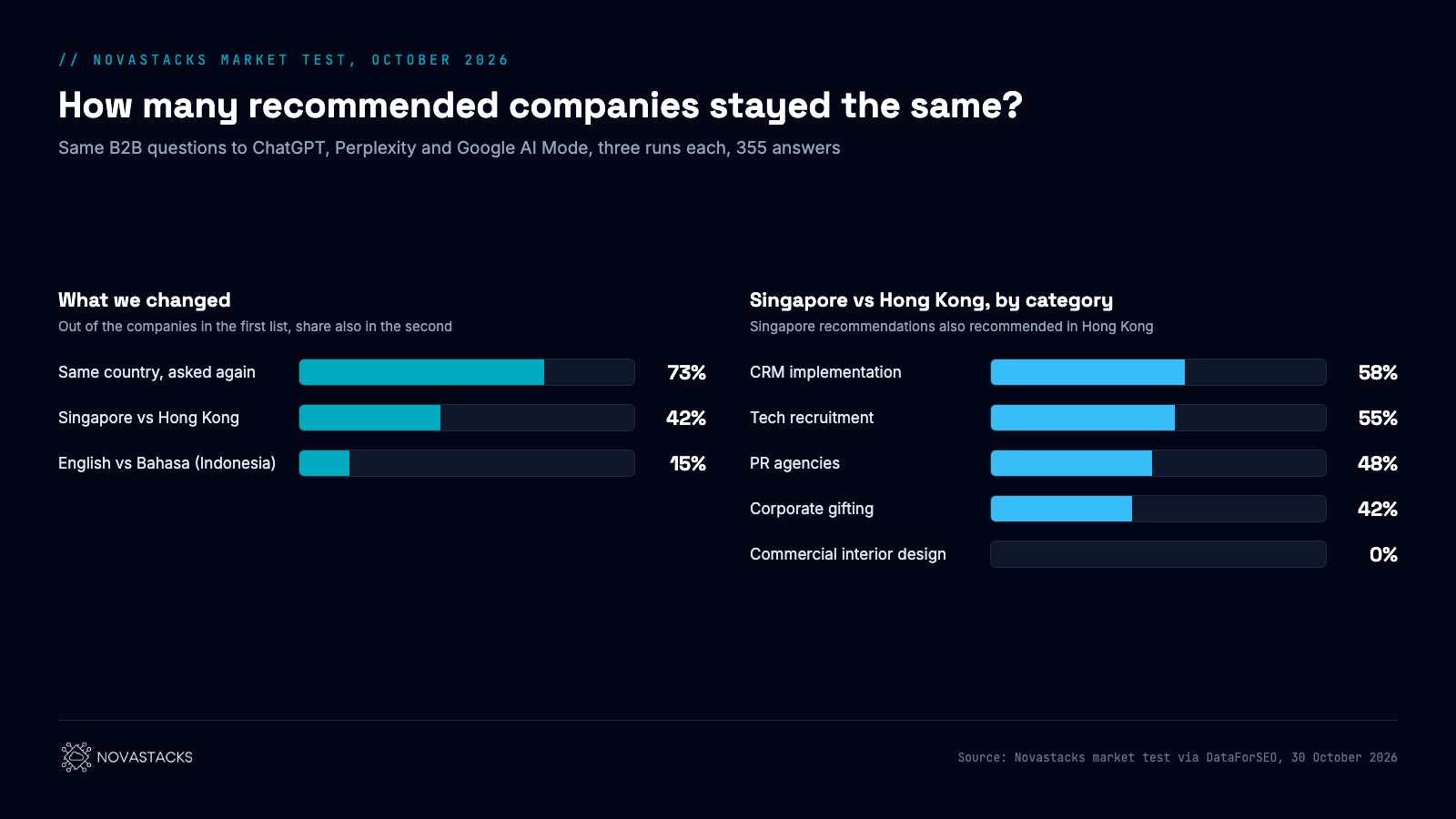
- The short answer: both the buyer's country and the language they type in change which companies AI recommends, and in our test, language changed it the most. Asked again in the same country, about 7 in 10 companies stayed; from Singapore to Hong Kong, about 4 in 10; from English to Bahasa, only 1 or 2 in 10.
- Yes, it changes by country: ChatGPT may use an approximate location from the user's IP address for local results, and in our test it localised answers even when the question named no country.
- Singapore and Hong Kong got different shortlists: only 42% of the companies recommended in Singapore were also recommended in Hong Kong, for identical English questions.
- Local services diverge completely: for commercial interior design, not one firm recommended in Singapore was recommended in Hong Kong.
- In our test, language moved the list more than location: asked from Indonesia, the Bahasa and English versions of the same questions shared only 15% of their recommended companies.
- Every market needs its own check: build a prompt set per market in the buyer's language, run it from that country more than once, and fix the local sources each market's answers rely on.
You sell in Singapore and Hong Kong, or in ten markets. Someone on your team asks ChatGPT for the best firms in your category, sees your name, and moves on. A buyer in another market asks the same question and gets a different list, and you never find out.
This article answers the question behind that worry: does ChatGPT recommend different companies in different countries? We tested it with identical questions asked from different countries and in different languages, and the answer is yes.
1. The short answer: both matter, and in our test language mattered most
We asked the same business questions in three ways and counted how many of the recommended companies stayed the same. Read each row as: out of every 10 companies in the first list, how many also appeared in the second list.
| What we changed | Stayed the same | What it tells you |
|---|---|---|
| Nothing: the same question asked again in the same country | About 7 out of 10 | AI answers are not fixed; some change is normal |
| The country: the same English question from Singapore, then from Hong Kong | About 4 out of 10 | Where the buyer asks from changes the list a lot |
| The language: the same question from Indonesia, in English, then in Bahasa Indonesia | About 1 or 2 out of 10 | The language the buyer types in changes the list the most |
So the answer is yes: ChatGPT and other AI engines recommend different companies in different countries, and in our test they changed even more when the buyer typed in their own language. Being recommended in one market tells you little about the next one.
Why it happens: OpenAI's help page on ChatGPT search says it "may use an approximate location based on your IP address to provide relevant local results", and that ChatGPT search "typically rewrites your query into one or more targeted queries" that it sends to search providers. Two people typing the same question in two countries can therefore trigger different searches and read different sources. A question typed in Bahasa Indonesia leads the engine further towards Indonesian sources and Indonesian companies.
2. How we tested it
We wrote ten questions a business buyer would ask, two in each of five categories, without naming any country: commercial interior design, PR agencies, corporate gifting, tech recruitment and CRM implementation partners. For example: "Which commercial interior design firms would you recommend for a new office fit out?"
| Test | What changed | What stayed the same |
|---|---|---|
| Location test | Asked from Singapore vs Hong Kong | Identical English questions |
| Language test | English vs Bahasa Indonesia versions of each question | Both asked from Indonesia |
We sent each question through DataForSEO, with the asking country set on every request. For ChatGPT we used OpenAI's gpt-4o-mini model with web search switched on, which is the API version of ChatGPT search; the ChatGPT app itself may use a newer model. For Perplexity we used its Sonar model, and the third engine was Google AI Mode. Each question ran three times per engine and country. That gave 360 answers, of which 355 returned successfully.
A language model then listed the companies each answer recommended, we merged spelling variants of the same name and checked a sample against the answers, and for each question and engine we compared every company named across the three runs in one market with those named across the three runs in the other. No company from the test is named here. It is a small test of ten questions (two per category) run on one day, so treat the category figures as a direction to test against your own market.
3. Singapore and Hong Kong got different shortlists
AI answers change a little even when nothing else changes: when we asked the same question again in the same country, about 73% of the companies were named again, roughly 7 out of 10. That is the normal level of change. Moving the same English questions from Singapore to Hong Kong pulled that number down to 42%, roughly 4 out of 10. Each row below shows, out of the companies that engine recommended in Singapore, the share it also recommended in Hong Kong:
| Engine | Also in Hong Kong | In plain numbers |
|---|---|---|
| ChatGPT | 28% | About 3 in 10 the same, 7 in 10 different |
| Google AI Mode | 32% | About 3 in 10 the same |
| Perplexity | 61% | About 6 in 10 the same |
| All three engines | 42% (139 of 331) | About 4 in 10 the same |
How to read the ChatGPT row: if ChatGPT recommended 10 firms to a buyer asking from Singapore, about 3 of those firms also appeared when we asked the same question from Hong Kong (across three tries), and the other 7 were replaced by different firms. ChatGPT and Google AI Mode localised the most. You can see it in the answers themselves: none of our questions named a country, yet 67 of 89 answers asked from Singapore used the word "Singapore", and 55 of 90 answers asked from Hong Kong used the words "Hong Kong".
4. Local services diverge completely
How much the list changed depended on what was being bought. Each row shows, out of the companies recommended in Singapore for that category, the share also recommended in Hong Kong:
| Category | Also in Hong Kong | In plain numbers |
|---|---|---|
| Commercial interior design | 0% | None the same |
| Corporate gifting | 42% | About 4 in 10 |
| PR agencies | 48% | About 5 in 10 |
| Tech recruitment | 55% | About 5 in 10 |
| CRM implementation partners | 58% | About 6 in 10 |
For commercial interior design, a service delivered on site, the two markets shared no firms at all. Categories where large regional or global firms operate kept about half their names. If your business is delivered locally, treat each market as a separate contest; if you sell regionally, expect a large part of the shortlist to change.
5. In our test, language changed the list even more than location
Here the country stayed the same and only the language changed. Asked from Indonesia, the English and Bahasa Indonesia versions of each question shared only 15% of their recommended companies (52 of 339): out of every 10 companies in the English answers, only 1 or 2 also appeared in the Bahasa answers. Compare that with about 7 out of 10 when nothing changes. The engines agreed: ChatGPT 15%, Perplexity 16% and Google AI Mode 15%.
A real example from the test
Here is one question from the test, asked to ChatGPT from Indonesia on the same day, once in English and once in Bahasa Indonesia. We have hidden the firm names.
Asked in English: "Which PR agencies are best for a B2B technology company?"
"Here are several PR agencies renowned for their expertise in the B2B tech sector:" Firm A (Amsterdam, Netherlands), Firm B (London, UK), Firm C (Boston, USA), and five more firms in the United States.
Asked in Bahasa Indonesia: "Agensi PR mana yang terbaik untuk perusahaan teknologi B2B?" (the same question)
"Memilih agensi hubungan masyarakat (PR) yang tepat untuk perusahaan teknologi B2B Anda di Indonesia sangat penting..." (in English: choosing the right PR agency for your B2B technology company in Indonesia is very important). Firm D (Jakarta, Indonesia), Firm E (Jakarta, Indonesia), Firm F (Jakarta, Indonesia), and three more firms in Jakarta.
Same question, same country, same day. The English answer never talked about Indonesia and recommended eight firms in Europe and the United States. The Bahasa answer talked about Indonesia in its very first sentence and recommended six firms, all in Jakarta. Not one firm appeared in both answers.
The rest of the test leaned the same way: about half of all English and Bahasa answer pairs (42 of 85) shared no firm at all. The table counts it for all 88 answers in each language: "Answer talked about Indonesia" means the answer used the word Indonesia or Jakarta, even though the question never named a country; "Local websites used" is the share of linked websites with an Indonesian .id address.
| Question language | Answer talked about Indonesia | Local websites used (.id) |
|---|---|---|
| English | About half (42 of 88) | 4% |
| Bahasa Indonesia | Almost all (83 of 88) | 17% |
The Bahasa questions pulled the answers towards local companies and local sources. About half the English answers from the same country did not mention Indonesia at all. A brand that appears in English answers but has no presence in its buyers' language can be invisible to the buyers who ask in that language.
Other research shows the country also changes how often brands are named at all. In a Semrush study across 14 countries, brands were named in 50% of AI answers in India and Sweden but in only 18% to 22% in Italy, Brazil and the Netherlands.
6. What to check for each market
Treat each market and language as its own prompt set and its own result. Five steps:
- List the markets that matter. The countries where you sell and want new buyers, and the languages those buyers search in. A market you do not serve does not need tracking.
- Build a prompt set per market, in the buyer's language. Use that market's Search Console queries, sales conversations and local forums, as in our guide to finding the AI prompts your buyers use. Translating an English list afterwards produces questions nobody asks.
- Ask from inside the market. Because ChatGPT can use your approximate location, checking from your own office shows your own market's answer. Use a tracker that sets the country, or ask a colleague in that market to run the questions.
- Run each question more than once. In our test, about a quarter of the companies named in one run were missing from the next run in the same market, so one answer is a sample and three runs are a picture.
- Record who is named instead of you, per market. The competitors and the cited sources differ by market, and so does the fix.
7. How to show up in each market
When a market's answers leave you out, look at what they cite. In our test the local language answers leaned on local sources, so the work is usually local too:
- A page for each market you serve. A service page scoped to that market, with local clients, local pricing or terms, and the market named plainly, gives the engine a page that fits a buyer's question from that country.
- Content in the buyer's language. Where buyers ask in their own language, publish the key pages in it, written for that market rather than translated word for word.
- Local sources that name you. Local directories, associations, press and comparison articles in each market. A firm known in Singapore through Singapore sources is not yet known in Hong Kong.
- The same facts in every market. Office locations, services and names must match across markets and languages, or the engines will mix them up. Our guide on what ChatGPT says about your brand covers how to make those facts consistent.
The same logic covers markets you do not want: state the countries you serve on your site and profiles, so the engines describe your coverage correctly.
8. Want each market checked for you?
Our free AI visibility tracker lets you choose your market, then tests 30 to 50 of your buyers' questions in their language across ChatGPT, Gemini, Perplexity and Google AI Overview, and shows who gets named and cited. If you sell in several markets, book a 30 minute call. In our work under The Novastacks Methodology, the buyer question set is configured per market and per language, so each market gets its own questions and its own measurement.
Frequently asked questions
Does ChatGPT give different answers in different countries?
Yes. OpenAI says ChatGPT may use an approximate location based on your IP address to provide local results. In our October 2026 test, identical English questions asked from Singapore and Hong Kong shared only 42% of their recommended companies, against about 73% when the same question was simply asked again in the same market.
Why does ChatGPT recommend different brands in different countries?
Because it searches the web from the user's approximate location and in the language of the question, so it reads different sources. Local services diverge most: in our test, commercial interior design recommendations in Singapore and Hong Kong shared no firms at all.
Does the language of the question change ChatGPT's recommendations?
Yes. In our test it changed the list more than location did. Asked from Indonesia, the Bahasa and English versions of the same ten questions shared only 15% of their recommended companies, and 94% of the Bahasa answers referred to Indonesia against 48% of the English ones.
How do I check if ChatGPT recommends my brand in another country?
Build a prompt set for that market in the buyer's language, run it from inside the market with a tool that sets the country or with a colleague there, run each question more than once, and record who is named and which sources are cited.
How do I get recommended by ChatGPT in a new market?
Give the engines local evidence: a service page scoped to that market, key pages in the buyer's language, and local directories, associations and press that name you, with the same facts about your company in every market.
Sources
- Novastacks market test, 30 October 2026, via DataForSEO: 10 location neutral B2B questions in five categories, ChatGPT model gpt-4o-mini with web search and Perplexity Sonar via API, and Google AI Mode, three runs each; Singapore vs Hong Kong in English, and English vs Bahasa Indonesia from Indonesia. 360 answers, 355 returned. Companies anonymised.
- OpenAI Help Center, "Searching the web with ChatGPT". Read 30 October 2026 (saved copy; the page blocks automated requests). ChatGPT "may use an approximate location based on your IP address to provide relevant local results"; ChatGPT search "typically rewrites your query into one or more targeted queries".
- Semrush, "Why 62% of AI Citations Don't Lead to Brand Mentions [Study]". 9 June 2026; 115 prompts in 14 countries. Brand mention rates of 50% in India and Sweden, 18% to 22% in Italy, Brazil and the Netherlands.
See how AI answers in your market
Choose your market and get 30 to 50 buyer questions tested in your buyers' language across ChatGPT, Gemini, Perplexity and Google AI Overview, free, within 48 hours.