What is AEO? Answer Engine Optimization Explained
Answer Engine Optimization (AEO) is the practice of structuring content to be cited by AI assistants like ChatGPT and Google AI Overview. Learn the fundamentals of AEO with this beginner's guide.
Key takeaways
- AEO is SEO for AI: structuring content so ChatGPT, Perplexity, and Google AI Overview cite you when they answer.
- AI search is already mainstream: about 48% of tracked Google queries trigger AI Overviews (BrightEdge, February 2026).
- Most mentions are off-site: ~85% of AI brand mentions come from external domains, Reddit, YouTube, and third-party content; only 13.2% come from your own domain (AirOps).
- Four authority layers decide citations: brand and topic authority, social and community authority, answerable content, machine readability. Two make a page quotable; two decide if the brand is trusted.
- Five on-site elements decide citations: the on-site foundation is what you control directly, including whether AI crawlers can read your pages at all.
- Entity recognition comes first: AI can't cite a brand it doesn't recognize.
What is AEO in Simple Terms?
Definition: AEO (Answer Engine Optimization) is the practice of structuring content so AI answer engines like ChatGPT, Perplexity and Google AI Overviews cite your brand when they answer a question. Where SEO optimizes for a ranked link, AEO optimizes for being named inside the answer. It is the core discipline we run at Novastacks.
AEO (Answer Engine Optimization) is the practice of structuring your content so AI assistants like ChatGPT, Perplexity, and Google AI Overview cite you when answering user questions. Think of it as SEO for AI: instead of ranking in search results, you're optimizing to be the source AI recommends.
When someone asks ChatGPT "what's the best software for [your industry]?", the AI searches the web, finds relevant content, and synthesizes an answer. If your content is AEO-optimized, you get cited. If it isn't, a competitor does.
Why AEO Matters Now
AI-powered search is no longer emerging. The adoption numbers are clear:
What about traffic impact?
A study of 40,000 US websites found organic traffic declined 2.5% year-over-year due to AI search features. AI Overviews reduce click-through rates by ~35% when they appear, but they currently appear on ~30% of queries.1
This represents a growth opportunity. Brands optimizing for AI visibility now capture an emerging channel while competitors focus exclusively on traditional search.
How AEO Works: From Crawl to Citation
Most explanations of AEO skip the part that actually matters: what physically happens between publishing a page and a buyer seeing your brand inside an AI answer. There are six steps, and you have different amounts of control over each one.
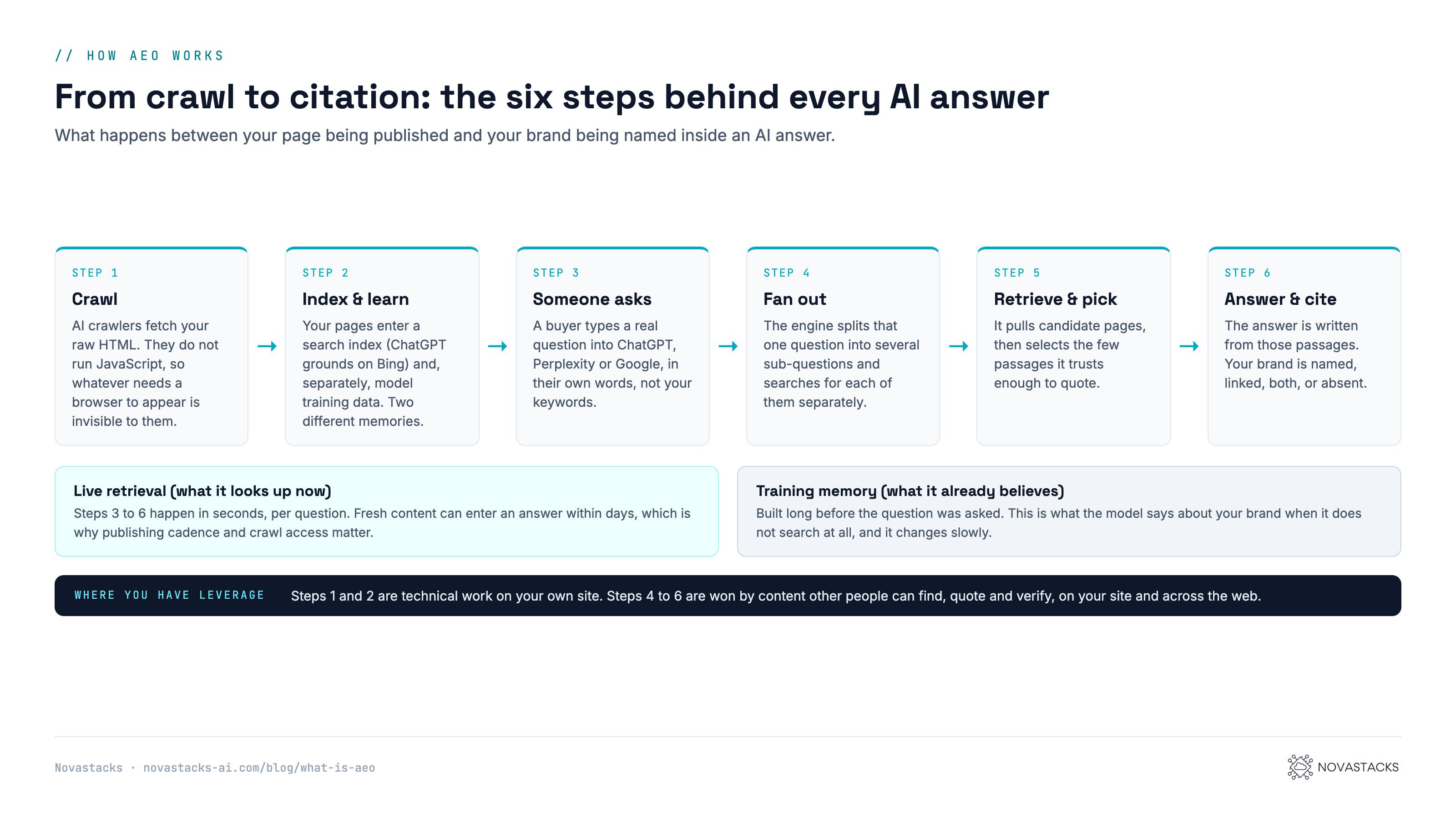
1. Crawl: can the machine read the page at all?
AI crawlers such as GPTBot, ClaudeBot and PerplexityBot fetch your raw HTML and move on. Unlike Googlebot, they do not come back later to run your JavaScript, so any content that only appears after browser code executes is, to them, an empty page. This is the single most common reason a well-written page never gets cited, and it is invisible to everyone on your team because the site looks fine to humans.
2. Index and learn: two different memories
What happens next splits in two. Your page can enter a live search index, which is what an assistant looks things up in (ChatGPT's search grounds on Bing's index, which is why Bing Webmaster Tools is worth watching). Separately, your content may enter model training data, which is what the AI already believes about you before it searches anything. The first updates in days. The second changes slowly and explains why an engine can describe your company using facts you retired two years ago.
3. Someone asks a real question
A buyer does not type your target keyword. They type a full question in their own words: "which inventory tool works for a small distributor in Singapore". That phrasing, not your keyword list, is what the engine works with.
4. Fan-out: one question becomes several searches
The engine rarely searches the question as typed. It breaks it into sub-questions, one for the product category, one for the location, one for the company size, and searches for each separately. This is what people misread about page depth. The winning shape sits between a thin page answering one question in a sentence and a sprawling guide touching thirty topics: scope the page to one question, then go deep on that question's full context, the sub-questions the engine will generate around it, the caveats, the numbers, the edge cases a buyer would ask next. In our own 500-query study, no page won more than 8 of the 500 queries, and 89.6% of cited pages won exactly one, which is why the study is called one deep page per question rather than one short answer per question.
5. Retrieve and pick the passages
Candidate pages come back, and the engine chooses which passages to trust. It is selecting extractable, verifiable text, not whole pages. A clear paragraph with a specific number and a named source is a candidate; a paragraph of positioning language is not.
6. Answer and cite
The answer is written from those passages. Four outcomes are possible for you: named with a link, named without a link, described without being named, or absent. All four are worth tracking, because being described without being named is a positioning problem, while being absent is a visibility problem, and they need different fixes.
Where AI Mentions Actually Come From
Before diving into tactics, understand this: according to AirOps research across 21,311 brand mentions, a brand's own domain accounts for just 13.2% of AI brand mentions. The remaining 85% comes from external sources, Reddit threads, YouTube transcripts, affiliate reviews, help center documentation, and third-party articles.2
Our own 500-query research points the same direction from another angle: in The Pages That Win Everywhere, only 15% of pages that ranked in Google's top 10 also earned an AI citation, which is why AEO treats external presence and on-site structure as two separate jobs.
This fundamentally changes what AEO means in practice. Optimizing your own pages is necessary but insufficient. Brands need an "away game", appearing in the off-site content that AI systems actually pull from when answering questions.
What this means for your AEO strategy:
- On-site optimization is the foundation you control directly
- Off-site presence drives the majority of AI mentions
- Both require attention, but most guides only cover the first
What AEO Factors Actually Decide Whether AI Names You?
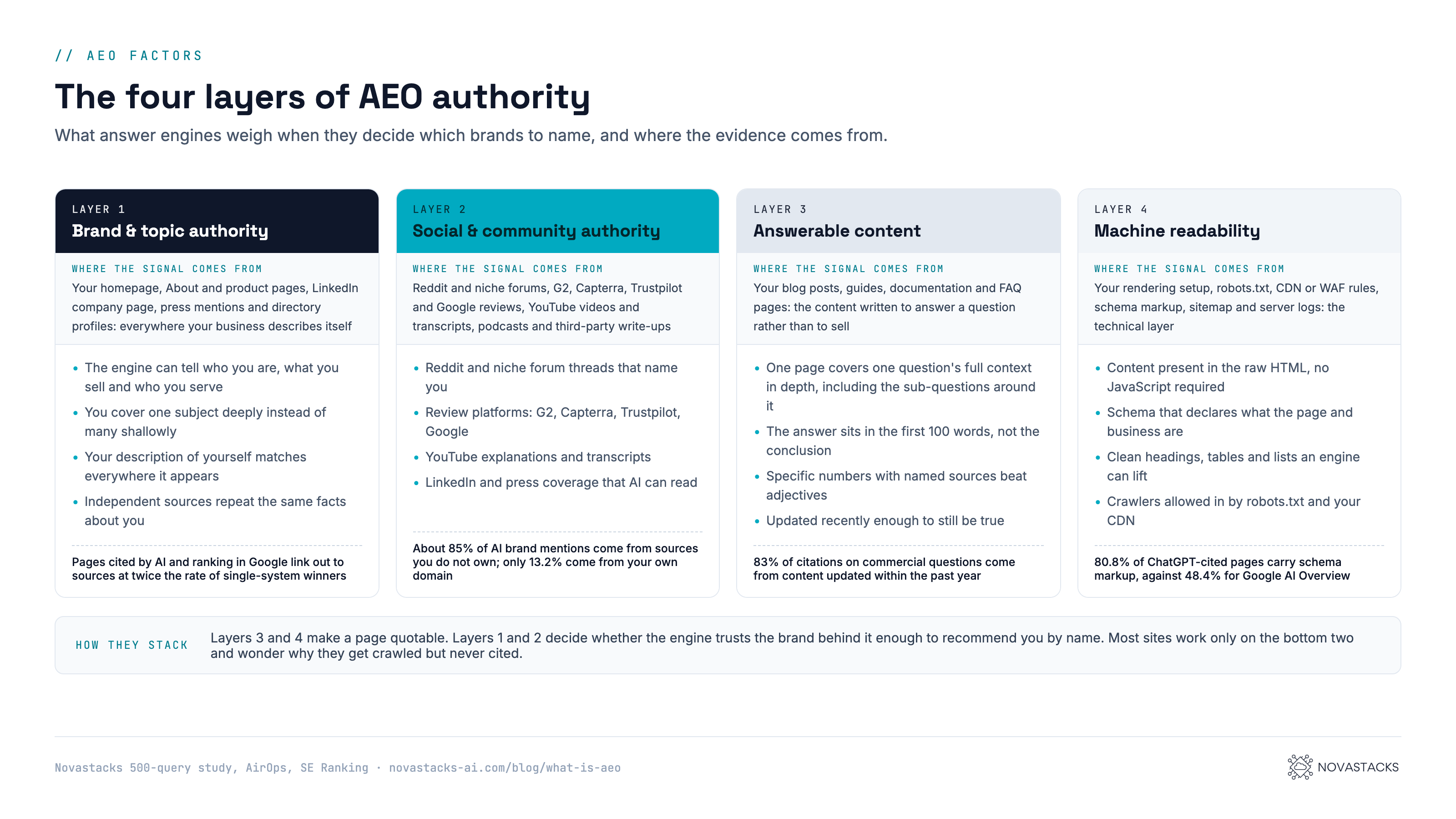
No engine publishes a ranking algorithm, and anyone selling you a definitive list is guessing. What we can do is look at which pages actually get cited, across our own 500-query study and the larger public datasets, and work backwards. Do that and the same four layers keep appearing. Two of them make a page quotable. The other two decide whether the engine trusts the brand behind it.
Layer 1: Brand and topic authority
Where this signal comes from: your homepage, About and product pages, your LinkedIn company page, press mentions and directory profiles: everywhere your business describes itself. The engine compares these against each other, so contradictions cost you confidence.
Before an engine can recommend you, it has to be confident it knows what you are. That sounds obvious, and it is where most brands quietly fail: the model has heard of the company but cannot state what it sells, who it serves, or how it differs, so it recommends a competitor it can describe cleanly instead.
Two things build this. The first is consistency: the description of your business on your homepage, your About page, your LinkedIn, your review profiles and any press coverage should agree with each other. Every contradiction is a reason for the engine to lower its confidence. The second is topical depth: covering one subject thoroughly, over time, does more for recognition than covering twenty subjects once each. Depth is what makes an engine treat you as a source on a topic rather than a company that once mentioned it.
One habit separates the pages that win here. In our study, pages that both ranked in Google's top 10 and earned an AI citation carried a median of 56 external links, roughly twice the rate of pages winning only one system. Citing your sources reads as confidence to a machine that is itself trying to assemble a sourced answer.
Layer 2: Social and community authority
Where this signal comes from: Reddit and niche forums, review platforms such as G2, Capterra, Trustpilot and Google, YouTube videos and their transcripts, podcasts and third-party write-ups. You own none of it, which is precisely why engines treat it as evidence rather than marketing.
This is the layer most companies have no plan for, and it carries the majority of what AI says about you. Roughly 85% of AI brand mentions come from domains you do not own. When an assistant researches a category, it reads what independent people wrote: Reddit threads and niche forums, review platforms such as G2, Capterra, Trustpilot and Google, YouTube explainers and their transcripts, LinkedIn posts, and press coverage.
The scale of this is easy to underestimate. In an analysis of 680 million citations, Wikipedia accounted for 47.9% of ChatGPT's top-10 sources while Reddit accounted for 46.7% of Perplexity's, which tells you both how concentrated citation behaviour is and how differently each engine weighs community content.5 A brand with no presence in those places is asking to be summarized entirely from its own marketing copy, which engines discount precisely because it is self-reported.
Practically, the work goes beyond publishing, into being discussed: earning genuine review volume, answering questions where your buyers already ask them, getting your product explained by someone who is not you, and making sure the facts those people repeat are accurate. You cannot manufacture this credibly, and attempts to do so are the fastest way to lose the trust the layer is meant to build.
Layer 3: Answerable content
Where this signal comes from: your blog posts, guides, documentation and FAQ pages: the content written to answer a question rather than to sell.
This is where page craft matters. The pattern that wins is a page scoped to one question but deep on the context around it, with the direct answer early, specific numbers attributed to named sources, and a last-updated date that is genuinely recent. Freshness is not cosmetic here: 83% of citations on commercial questions come from content updated within the past year, and pages left untouched for more than a year see their citation likelihood fall by over half.
Layer 4: Machine readability
Where this signal comes from: your rendering setup, robots.txt, CDN or WAF rules, schema markup, sitemap and server logs: the technical layer your engineering team owns.
The floor beneath everything else. Content present in the initial HTML, schema that declares what the page and the business are, headings and tables an engine can lift cleanly, and crawlers actually allowed in by both robots.txt and your CDN. Schema is not a magic citation lever, but it is clearly part of how engines classify a page: 80.8% of ChatGPT-cited pages carry schema against 48.4% for Google AI Overview. Full detail in technical AEO foundations.
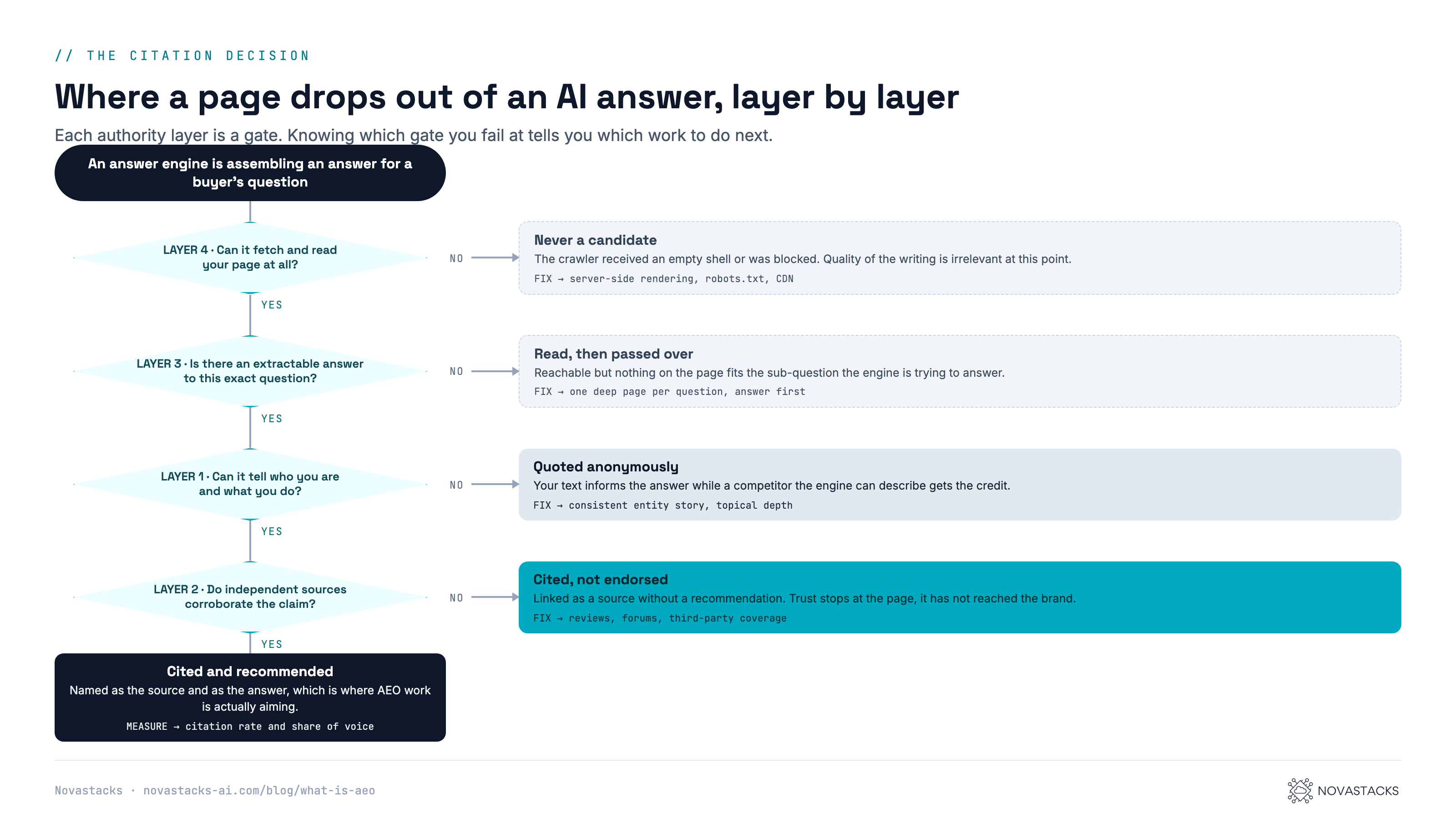
The On-Site Foundation: 5 Core Elements
These factors determine whether AI cites your website content:
1. Domain Authority (Referring Domains)
SE Ranking research shows domains with 32K+ referring domains get cited 3.5x more than those with under 1K. This is a helpful signal, not a requirement. Smaller brands can compete through content velocity and off-site presence.
Why it works: AI uses backlink signals as a proxy for source credibility and trustworthiness.
2. Content Freshness
AirOps found 83% of citations for commercial queries come from content updated within the past year, and pages left more than a year without an update see their citation likelihood fall by over half. Stale content rarely gets cited, regardless of quality. Regular updates signal relevance to AI systems.
Why it works: AI prioritizes recent information to provide accurate, up-to-date answers.
3. Direct Answers (First 100 Words)
AI extracts the first 100 words of content when selecting sources. If your answer isn't there, you won't be cited. Lead with a direct, concise answer - then expand with context.
Why it works: AI needs extractable snippets. Direct answers provide clean, citeable text.
4. Citeable Statistics
Specific numbers with clear attribution get cited more than vague claims. "About 48% of tracked Google queries trigger AI Overviews (BrightEdge, February 2026)" is highly citeable. "AI search is growing" is not.
Why it works: AI looks for verifiable data points to support its responses.
5. Machine-Readable Delivery (Rendering, Titles, and Metadata)
AI crawlers are not built like search engine crawlers. Googlebot queues pages for a second rendering wave and executes JavaScript before indexing; GPTBot, ClaudeBot, and PerplexityBot fetch your raw HTML once and move on. Vercel's crawler research found they download JavaScript files but never execute them. So if your main content, or the supporting content around it (navigation, FAQs, product specs, pricing), only appears after JavaScript runs, an AI crawler sees an empty shell where your page should be.
The same delivery job includes your page's explainers, the elements that tell a machine what the page is before it reads a word of body copy: the title tag is the label AI reuses when it names your page in an answer, the meta description is a ready-made summary an engine can quote, Open Graph tags control how the page presents when an assistant previews or shares it, and structured data declares who you are and what the page covers in a format machines parse without guessing. Get the full checklist in technical AEO foundations.
Why it works: AI can only cite what it can extract. Content served in the initial HTML response and labeled with accurate metadata is extractable; content locked behind JavaScript execution is invisible to most AI crawlers.
What About FAQ Schema?
FAQ schema helps AI understand your content structure, but it's not a citation-boosting hack. SE Ranking found pages WITHOUT FAQ schema actually received slightly more citations (4.2 vs 3.6). Focus on the fundamentals above.
Why AI Can't Cite You If It Doesn't Know You
LLMs struggle to recommend brands they don't understand. A documented brand guide isn't a marketing exercise, it's a technical requirement for AI visibility.
The framework that matters for AI recognition:
- Brand Identity What you are, stated plainly
- Voice & Personality How you communicate
- Target Personas Who you serve, with specificity
- Unique Selling Points What differentiates you from alternatives
- Products & Services Complete catalog with clear descriptions
- Competitors Who you compete against (LLMs use comparison queries)
AEO vs SEO: Key Differences
AEO and SEO are complementary but require different approaches. The comparison below shows where they part ways:
| Factor | AEO | Traditional SEO |
|---|---|---|
| Goal | Be cited by AI | Rank in search results |
| Key Signal | Authority + Freshness | Backlinks |
| Content Format | Q&A structure, direct answers | Comprehensive articles |
| Timeline | 60-90 days | 6-12 months |
| Author Importance | Critical | Low (except E-E-A-T) |
Bottom line: You need both. SEO drives traditional search traffic. AEO ensures you're visible to the growing AI-first audience. Read our detailed AEO vs SEO comparison.
One naming note before you go further. AEO, GEO, and AIO largely describe the same work: AEO is the umbrella term used here, GEO (Generative Engine Optimization) frames the same work around being named inside a generated answer rather than cited beneath it, and AIO (AI Optimization) is a tactical subset. If you have seen the acronyms used interchangeably and want the distinctions spelled out, compare AEO, GEO, and SEO side by side.
Getting Started with AEO
Here's a simple path to start implementing AEO today, drawn from our complete guide to AEO:
- Test your current visibility Ask ChatGPT questions your audience asks. Are you cited? Are competitors?
- Identify high-priority pages Focus on service pages and key content that answers common questions.
- Add structured markup Use Article, FAQ, and Person schema to help AI understand your content structure. Use tools like Screaming Frog to validate.
- Restructure content Use question-based headings. Lead with direct answers. Add citeable statistics.
- Track and iterate Check citations weekly. Refine based on what gets cited. Learn ChatGPT-specific optimization.
Once the first citations start appearing, the problem changes from visibility to valuation. How to measure AEO covers which metrics are worth reporting and which proxy numbers mislead.
Frequently Asked Questions
What is AEO in simple terms?
AEO (Answer Engine Optimization) is the practice of structuring your content so AI assistants like ChatGPT, Perplexity, and Google AI Overview cite you when answering user questions. Think of it as SEO for AI: instead of ranking in search results, you're optimizing to be the source AI recommends.
Why should I care about AEO?
About 48% of tracked Google queries now trigger AI Overviews, up from roughly 30% a year earlier (BrightEdge, February 2026). ChatGPT reports more than 900 million weekly active users (OpenAI). If your content isn't optimized for AI, you're invisible to a massive and growing audience - even if you rank #1 on traditional Google.
How does AEO work?
AI assistants use RAG (Retrieval-Augmented Generation) to find and cite sources. AEO optimizes for this process through: building domain authority (referring domains), content freshness (updating regularly), direct answers (first 100 words answer the query), citeable statistics (data points with sources), and machine-readable delivery (main content visible in the initial HTML with accurate titles, meta descriptions, Open Graph tags, and structured data, because most AI crawlers do not execute JavaScript).
What's the difference between AEO and SEO?
SEO optimizes for link clicks in search results. AEO optimizes for being the source AI uses to answer questions. Both rely on authority signals (backlinks/referring domains), but AEO also requires content freshness, direct answers, and citeable statistics. You need both for complete organic visibility. Read the detailed comparison.
Do backlinks still matter for AEO?
Yes, but as a strong signal rather than a gate. SE Ranking's analysis of ChatGPT citations found domains with 32K+ referring domains are cited 3.5x more often than domains with under 1K. That correlation favours established sites, but it is not a threshold you have to clear before you start. Smaller brands earn citations through content freshness, direct answers, and off-site presence, which is where roughly 85% of AI brand mentions originate.
What is an answer engine?
An answer engine is an AI-powered system that provides direct answers to user questions instead of a list of links. Examples include ChatGPT, Perplexity, Google AI Overview, Claude, and Gemini. Unlike traditional search engines, answer engines synthesize information and cite sources directly in their responses.
How long does AEO take to work?
Most implementations see first citations within 60-90 days. This is significantly faster than SEO (6-12 months). The speed comes from how AI indexes content - it processes structured data quickly, so properly marked-up content can appear in AI responses within weeks of implementation.
If most AI mentions come from off-site sources, why focus on my website at all?
Your website is the foundation. It establishes brand identity, authority signals, and the content AI uses to understand who you are. Off-site mentions amplify what your website establishes. Without a solid on-site foundation, off-site mentions lack context for AI to connect back to your brand.
Which domains do AI engines cite most?
Citation behaviour is highly concentrated and differs by engine. In an analysis of 680 million citations, Wikipedia accounted for 47.9% of ChatGPT's top-10 sources while Reddit accounted for 46.7% of Perplexity's. The practical read is not to chase those domains but to recognise that community and reference sources carry disproportionate weight, so presence in forums, review platforms and third-party explainers matters as much as your own publishing.
What factors influence whether AI cites your brand?
Four layers, working together. Brand and topic authority means the engine can state clearly what you do and who you serve. Social and community authority is what independent sources say about you, which accounts for roughly 85% of AI brand mentions. Answerable content means a page scoped to one question but deep on its context, with the answer early and numbers attributed. Machine readability means the content is in the raw HTML with schema and crawler access. The first two decide whether the brand is trusted; the last two decide whether a page is quotable.
Sources
- Ethan Smith, CEO of Graphite, Traffic decline study of 40,000 US websites (January 2026; the author notes his own commercial interest in the finding)
- AirOps, The Influence of Offsite Signals in AI Search (October 2025; 21,311 brand mentions across ChatGPT, Claude and Perplexity), 85% external vs 13.2% own-domain AI mention distribution
- AirOps, The Impact of Stale Content on AI Visibility: publishing cadence, content age and citation decay
- Profound, AI platform citation patterns (680 million citations, August 2024 to June 2025), engine-level source concentration: Wikipedia 47.9% of ChatGPT top-10 sources, Reddit 46.7% of Perplexity's
- SE Ranking, How to optimize for ChatGPT (129,000 domains / 216,524 pages), brand mentions, review profiles and entity signals in ChatGPT source selection
Comparing agencies? See the ranking of the 9 best AI SEO and AEO agencies in Singapore (2026): comparison table, methodology, and detailed top-5 profiles.
Ready to Get Started with AEO?
Get a free assessment of your current AI visibility and learn how AEO can drive qualified traffic to your business.